'Renewable energy not uncommon in NK'
By Kim Se-jeong
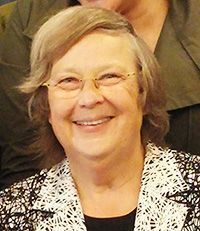
Baerbel Hoehn
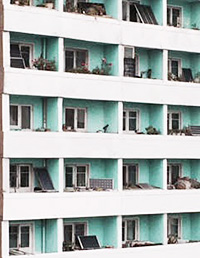
A photo taken on Oct. 21 shows many small solar panels installed at balconies of an apartment building in Pyongyang. / Courtesy of Baerbel Hoehn
Many households in Pyongyang, North Korea’s capital, have solar panels installed, according to a member of the Green Party in Germany who visited the reclusive state last week.
“It was great to see solar panels on balconies of homes,” Baerbel Hoehn, a member of the Bundestag, the German parliament, said during a meeting with Korea’s Green Party members in Seoul, Tuesday.
She visited North Korea with fellow politicians and German business representatives, and flew to the South earlier this week.
Acknowledging that the situation is worse in rural areas, Hoehn said, “I want to help people in rural areas and that must be the target. If we can start such sustainable projects in rural areas, people will be interested because I see daily problems.”
It has long been reported that North Korea’s energy situation is deplorable ― and is much worse outside Pyongyang. There’s almost no electricity in many rural areas, and that makes life harder for people who already suffer from hunger, Hoehn said. The amount of electricity North Korea generates annually is less than 10 percent of the amount produced in South Korea.
For such reasons, international charity groups which perform humanitarian work in rural areas install small power-generating facilities to meet power needs.
Hoehn said that it seems more North Koreans choose renewable energy sources for survival.
Other visitors to North Korea made similar observations.
Reuters quoted a Chinese businessman in Shandong Province who observed that solar panels started becoming popular in North Korea in 2012, and that almost 80 to 90 percent of his company’s solar panels were sold to North Koreans.
Reports say solar panels are widely available in North Korea. According to Reuters, small 20 watt panels can be purchased for $44 on the black market in the North.
Hoehn said the regime in North Korea is also paying attention to renewable energy.
In 2013, it passed a law promoting the use of renewable energy. In the same year, the regime also announced it will increase wind power by 10 percent annually and reduce taxes on foreign companies that invest in wind energy development.
During his new-year address in early 2014, North Korea leader Kim Jong-un reiterated the importance of wind power, sun and geothermal heat. Last November, the regime opened a renewable energy center and established funds to support green energy technologies.
Energy experts say, however, attracting foreign investors will not be easy because of North Korea’s notorious reputation and also because of the international sanctions.
Regarding the recent Volkswagen emissions scandal, the lawmaker said, “I was surprised a bit that they (the company) could do that, thinking nobody would find out about it.” Volkswagen was caught cheating on emissions controls during laboratory testing in September. It had to recall hundreds of thousands of vehicles around the world, and many consumers, including those in Korea, sued the company for compensation.
The lawmaker hopes this will spark an open discussion about the vehicle industry in Germany. “This is a special problem for Volkswagen, but cars running on fuels are also a problem in the long run for other manufactures. Because of climate change we'd like to talk about emission-free cars like electric cars."