NK defector school envisions unification

Cho Myung-sook, vice president of Yeomyung School for North Korean defectors, speaks during an interview with The Korea Times at the school in central Seoul, on July 28. / Korea Times photos by Kim Bo-eun
By Kim Bo-eun
As Cho Myung-sook, vice president of Yeomyung School for North Korean defectors, headed down the stairs to show this reporter around, a young female student arrived for class.
“I missed you!” the student cheerfully said in a sentence tinged with a North Korean accent. Cho playfully responded: “What are you talking about _ we just saw each other yesterday.”
The vice president, 45, did not appear to be a distant, authoritative figure, but was more like an older sibling. Cho says the past decade was a spectacular yet desperate struggle and the students had kept her going.
She recently received an offer to study unification in Germany, but declined.
“I realized I couldn’t go without seeing these children daily,” Cho said. “This is something I truly love and can do well.”
Cho and NK defectors
Cho’s first encounter with North Korean defectors was in China in the late 1990s. Cho was an activist and her husband the head of a civic group for immigrant workers when a major fraud case broke out in 1997. Some 10,000 Chinese Koreans fell victim to false promises of finding a job in South Korea. The couple, who were newlyweds at the time, chose China as their honeymoon destination to look into the incident.
There, she witnessed the dismal conditions North Korean defectors were living in, as refugees without a nationality, constantly fearing that Chinese authorities might discover them or that they might become subject to human trafficking.
Risking their lives, Cho and her husband brought 13 defectors into the South. Years later, she discovered that these defectors had dropped out of school and become bankrupt. Cho realized this was because they were never taught to make decisions for themselves.
She started by opening up her office so defectors could come to study. It was the beginnings of Yeomyung School, which was established in 2004.
Yeomyung School
Cho recognized that forcing defedlqtkctors into the regular school system in the South was not in their best interest. Because many defectors had never had a proper education, they would need customized classes. They also would need help overcoming their traumatic experiences and adjusting to life in the South.
So Cho designed a curriculum to take this three-pronged approach. Yeomyung School made its own textbooks and incorporated psychotherapy sessions as well as programs that would help students learn about everyday life in the city.
For example, they would be given a mission as simple yet daunting as going to a movie theater, buying a ticket from an automated machine and ordering popcorn, using the unfamiliar English word for the snack. The school placed teachers in the dormitories to guide and parent the students, most of whom have no friends or family here.
Over its 10-year history, Cho has tackled several obstacles for the school and its students. Yeomyung School became the first state-accredited school for North Korean youth. In 2010, the Seoul Metropolitan Office of Education recognized the school’s high school curriculum, which saves students from having to take the qualification exam to be acknowledged as graduates. The school also started receiving government funding and now gets 100 million won ($85,186) a year, 44 percent of its budget. The rest is funded through sponsorships. The students do not pay tuition.
It has 100 students in the high school and middle school divisions, although the latter is yet to be approved.
Global non-profit organization Ashoka has recognized Cho’s efforts and she was recently selected as a “fellow,” allowing her to receive funding for her work.
The organization has evaluated Yeomyung School as establishing a model for more such schools for minority groups _ not only North Korean defectors but also multi-racial children and others.
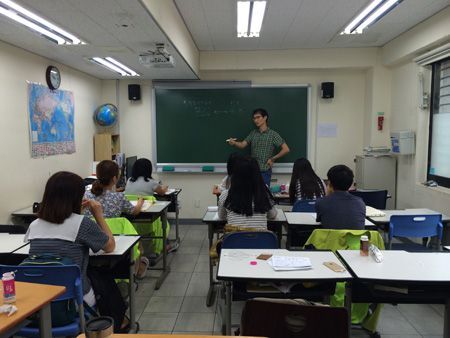
Students take a class preparing for the middle school qualification exam on July 28.
Graduates
Apart from these tangible achievements, Cho says graduates are essentially better off.
This reporter expected the vice president to mention the rate among the 170 graduates that go on to universities or get employed, but Cho had a different answer.
“Some of them excel in work, others are navigating their way in life,” she said. “Others come with a child in their arms.”
She seemed to find it particularly fulfilling to see graduates get married, have children and form a family.
“I go to students’ weddings and first-birthday parties for their children,” she said. “I cannot say how touching it is to see them become a husband, wife, father and mother.
“When these students first come to the school, they are suspicious of the teachers. This is because nobody had ever shown them the love and support that the teachers give them. They fear that the teachers may turn them over to authorities, based on their experiences. But time enables them to open up and learn to accept and also become subjects of ‘giving’ love.”
Cho says this could possibly be the single most important thing students learn at the school, over acquiring knowledge, diplomas and skill sets.
“Skill sets are not the priority,” Cho said. “This is something they can learn outside of school. Our aim is to make the graduates happy individuals.”
Struggles
The school has come a long way, but Cho says every day is still a struggle.
“The students that have recently joined the school are those born during the ‘Arduous March,’ or the great famine, that occurred in North Korea in the mid-1990s,” she said.
“They are very different from the other students _ both their physical and mental health is much poorer.”
But these struggles are nothing compared with the barriers she faces when trying to change existing systems.
“It isn’t easy to bring change,” she said. “People like what’s familiar to them. It costs money to change things. And while some people will benefit from the change, others will experience loss _ and these people will resist the change.”
Cho, who started working at age 23, says she has lost a lot of friends on the journey.
“One day, I thought I should go and watch a movie to take my mind off things, but I looked at my phone and realized I had nobody to call,” she said.
And despite her extensive efforts, life is still tough for many North Korean defectors here.
The suicide rate among North Korean defectors in the South is three times that of South Koreans, according to 2012 data from the Ministry of Unification. The dropout rate of defector students is also three times that of South Korean students (2014 data from the Unification Ministry and the Korea Hana Foundation).
Vision and preparation
About 1,500 North Koreans cross borders into the South each year and there are some 28,000 defectors living in the South.
With the continual influx of North Koreans it has become imperative not only to find ways to integrate them into the South, but think and prepare with a longer-term vision.
Cho says Yeomyung School is just a stepping stone for a bigger plan she has in mind. Yeomyung in Korean is “dawn.” As such, Cho wishes for the school to serve as the early beginnings and base for a new era ahead.
Although there is little discussion in the South about unification, Cho is already preparing for how to integrate the disparate two regions and people.
She envisions establishing a “Unification School,” with students from the North and South.
“The South should prepare through North Korean defectors,” Cho said. “They are not people that should be subject to pity. We should see them as partners for preparing for unification.”