Seoul equivocal on UN move against NK leader
By Kang Seung-woo
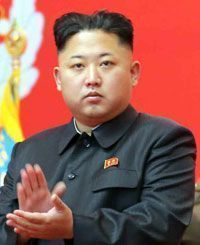
North Korean leader Kim Jong-un
The government is taking an ambiguous stance on the United Nation’s action to pursue legal action against North Korean leader Kim Jong-un.
According to diplomatic sources, the U.N. is moving to refer the dictator to the International Criminal Court (ICC) to stand trial for violations of human rights.
They said that the European Union (EU) sent U.N members a draft resolution to drum up support for the prosecution of the North Korean leader at the ICC.
“We expect that the draft will require a lot of coordination in the negotiations process,” the Ministry of Foreign Affairs said in a statement Thursday.
“At this stage, it is premature to talk about how the U.N. will come up with a final draft.”
“The draft resolution is the first time that an attempt has been made at the U.N. to hold the North Korean leadership accountable for its human rights abuses,” according to the sources.
The resolution on human rights abuses in North Korea needs to be voted on by the U.N. General Assembly and related councils.
The draft came months after the U.N. Committee of Inquiry (COI) concluded in a February report, after a year-long investigation, that the North’s leadership was committing crimes against humanity ― ordering systematic torture, starvation and killings comparable to Nazi-era atrocities ― on an unprecedented scale.
It also included a recommendation that the U.N. should refer the details to the ICC and have those responsible prosecuted, including Kim.
In March, the U.N. Human Rights Council in Geneva endorsed a resolution condemning North Korea for “systemic, widespread and gross human rights violations,” by an overwhelming majority.
The ICC can only investigate crimes in its member states, but if the U.N. Security Council gives the ICC jurisdiction, it can pursue crimes in non-state parties as in the cases of Libya in 2011 and Sudan in 2005.
In the wake of the COI report, the North has made diplomatic efforts to avoid international pressure over its human rights issues.
Last week, the North’s top three ranking officials unexpectedly visited Incheon to seek a breakthrough with the South while being under fire from the international community over its human rights abuses.
In addition, it dispatched Kang Sok-ju, a secretary in charge of foreign relations for the ruling Workers’ Party of Korea (WPK), to Europe and Mongolia, while North Korea’s Foreign Minister Ri Su-yong made a rare attendance at the U.N. General Assembly in New York.
However, the EU’s resolution is a draft, so it may go though some changes in the details, the foreign ministry predicted.
The U.N. recently adopted resolutions pertaining to the issue by holding a formal vote rather than achieving consensus due to opposition from the North and the reserved attitudes of permanent members of the Security Council, China and Russia.
The North has long been accused of grave human rights abuses, ranging from holding hundreds of thousands of political prisoners in concentration camps to committing torture and holding public executions.
Amid growing international criticism on the issue, the dictatorial regime has defended its human rights record.
On Wednesday, Choe Myong-nam, a North Korean foreign ministry official, claimed in a New York briefing that there are no prison camps in his country.
“In law and practice, we have detention centers whereby people improve their mentality, stop wrongdoings and are reformed through labor. That’s what happens in the center. That’s what we call reform through labor detention,” he said.
Last month, the North also issued its own assessment of the country’s policies that “guarantee genuine rights of the people,” claiming that hostile forces were peddling the issue in a bid to tarnish its image and bring down the nation’s social system and ideology.