Last 7 South Koreans return home
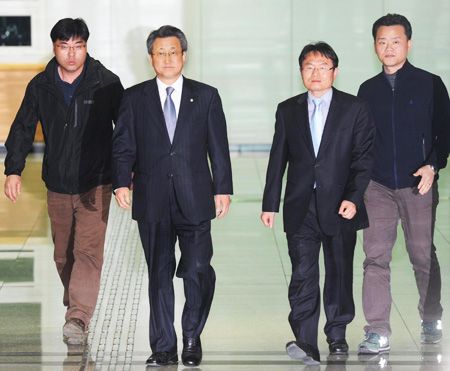
Hong Yang-ho, second from left, chairman of South Korea’s Gaeseong Industrial District Management Committee, arrives from the inter-Korean industrial complex at the Customs, Immigration and Quarantine Office or CIQ in Paju, Friday evening. Hong led an eleventh-hour agreement on the payment of wages for North Korean workers. Hong and six others, who returned home, were the last among of 800 South Koreans who worked at the symbol of inter-Korean economic cooperation. Korea Times photo by Hong In-ki
Gaeseong Complex brought to complete closure
By Chung Min-uck
The last seven South Koreans remaining in the Gaeseong Industrial Complex returned home Friday evening, bringing the symbol of inter-Korean economic cooperation to a complete close.
With South-North Korean relations at an all-time low, there appears to be no knowing whether the nine-year-old industrial park will be brought back on line.
However, Seoul has reportedly decided not to sever electricity and water supplies to the area, according to government sources. They said that it was a decision aimed at preventing the facilities from becoming obsolete and at the same time not to goad the North.
The electricity supplied from the South is used by North Korean residents in the town of Gaeseong.
According to Yonhap News, Seoul wants a skeleton crew to shuttle back and forth to the complex to maintain the infrastructure in an apparent attempt to keep communication with Pyongyang open.
The two Koreas reached an eleventh-hour agreement on the payment of wages for North Korean workers at the complex at around 3:30 p.m.
The Ministry of Unification said four vehicles carrying the seven arrived at the Customs, Immigration and Quarantine office (CIQ) in Paju at around 6:50 p.m.
It was a barter resembling the cold war-era swap of American and Soviet spies. South Korea sent two trucks full of cash to the tune of $13 million, according to the ministry.
The seven included Hong Yang-ho, the chairman of the Gaeseong Industrial District Management Committee, who led negotiations on the payment of wages to North Korean workers and tax issues.
“We urged the North to normalize the complex. We expect to have discussions through various channels,” Hong told reporters upon arriving at the CIQ.
Despite the settlement, the two sides failed to agree over the return of finished goods and production materials owned by South Korean companies in the complex, according to the ministry.
Representatives of South Korean businesses in Gaeseong issued a statement beseeching authorities in both the North and South to allow them back to Gaeseong to resume work.
“We were guaranteed free corporate activities for 50 years,” they said in a statement, adding that the latest development broke that guarantee.
The seven returnees were the last South Korean nationals remaining in the border town just north of the demilitarized zone. About 800 South Koreans worked there before Pyongyang barred South Koreans and cargo from entering it on April 3.
Seoul ordered all South Koreans out last Friday after Pyongyang repeatedly declined to accept talk proposals that could help normalize operations.
The North effectively shut down Gaesong after it told all of its 53,000 workers not to report to work on April 9.
Following the return of the seven, all South Koreans have withdrawn from the joint complex that first started churning out products in late 2004, severing all cross-border ties that had been forged over several decades.
Meanwhile, the government earlier decided to provide 300 billion won ($273 million) in emergency relief funds to local companies that were forced to halt operations at the complex.
The total amount of loans includes 63 billion won from the Inter-Korea Cooperation Fund, 100 billion won from the Small and Medium Enterprise Promotion Fund, 100 billion won from the Korea Finance Corporation and another 36.9 billion won provided by the Technology Credit Guarantee Agency.