N. Korea likely to use HEU bomb
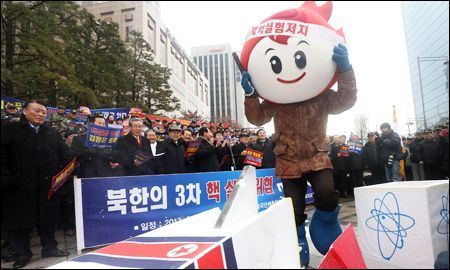
Conservative civic group members hold a rally in front of Seoul Finance Center, central Seoul, Wednesday to protest North Korea’s move to conduct a third nuclear test. They held a performance destroying a mock North Korean rocket. / Yonhap
Nuclear test may testify Pyongyang’s technical finesse
By Chung Min-uck
Since North Korea announced it will conduct a third nuclear test at a “higher level” last month, there has been speculation as to what kind it will carry out.
Based on the type, the aftermath would be different in terms of security concerns.
Experts say the most likely choice would be a highly enriched uranium (HEU) bomb.
“There is a lot of evidence that it could be a uranium bomb,” Daniel Pinkston, an analyst with the International Crisis Group, a non-governmental security think-tank, told The Korea Times, Wednesday. “The North has two or more uranium enrichment facilities and they have been acquiring material and technology consistent with an enrichment program. The facility at the Yongbyon nuclear complex, as seen two years ago, looked quite modern and advanced. Many believe that it is not the first facility and suggest the North has been producing and enriching uranium for some time.”
The previous 2006 and 2009 North Korean nuclear tests used plutonium. Watchers believe if Pyongyang decides to test HEU devices this time, it would be a “game changer” in the international community’s denuclearization efforts.
“Unlike plutonium production, uranium can be enriched regardless of the size of the facilities as long as there is a constant power supply and centrifuges,” said Yang Moo-jin, a professor at the University of North Korean Studies in Seoul. “All efforts that are being made for denuclearization will likely end in vain. The International Atomic Energy Agency (IAEA) would not be able to inspect North Korea’s nuclear activities. Also those activities cannot be monitored from a distance using satellite imagery.”
Bomb’s explosiveness
The strength of the bomb is another matter of concern. North Korea has been raised the explosive power in previous plutonium tests. The 2006 test was rated at the equivalent of 1 kiloton of TNT, while that of 2009 was estimated to be around 4 kilotons.
“If the third test amounts to 15 to 20 kilotons, then North Korea will become a real nuclear power,” Yang said.
Other options
Of late, an observer at the defense ministry speculated that North Korea may try to detonate a hydrogen bomb this time
“If the North successfully develops a hydrogen bomb, it would be a serious threat to regional security,” said Yang.
Colloquially known as a hydrogen, or H-bomb, the device is a thermonuclear weapon and is considered mankind’s most destructive weapon. The world’s first test of the bomb in 1952 yielded 10.4 megatons of explosive energy which is 750 times the level of the bomb detonated over Hiroshima.
Also being talked about is whether the North will carry out a multiple nuclear test.
The speculation comes as activity has been detected at two separate tunnels at North Korea’s Punggye-ri test site in the country’s northeast.
“It would be beneficial for the North to carry out simultaneous nuclear tests as it can evade having more international sanctions imposed,” the professor said. “There have been such cases of a multiple tests in other countries such as India and Pakistan.”
“Every test is a threat to international security,” said Pinkston. “Firstly, the North would perfect its technology. Secondly, it is a big threat due to proliferation implications. There are a lot of reasons to believe the North would very well share the test results with Iran for example and any other potential buyer.”