2 Koreas poles apart in motives
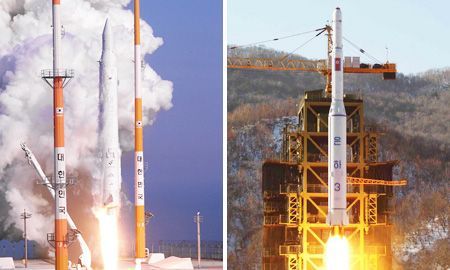
The left photo shows the Naro space rocket blasting off from Naro Space Center in South Jeolla Province, Wednesday. The right photo taken by North Korea’s official Korean Central News Agency on Dec. 12, 2012 is of the Unha-3 rocket lifting off from a launch pad in Cholsan County, North Pyongan Province, North Korea. / Yonhap
By Kim Young-jin
With the successful launch of the Naro rocket, South Korea has gone head-to-head with North Korea, which recently succeeded in sending a payload into orbit.
Analysts and officials, however, said Thursday that the two were starkly different.
South Korea became the 11th nation to send a rocket into space, Wednesday, less than two months after the North. Both released relatively small satellites into orbit.
Other similarities are few, however, as Seoul secured contact with its satellite early Thursday, while many are skeptical that the North was able to do the same.
The major contrast is that the South followed international norms that safeguard against weapons development and proliferation, measures that the North has defied. Multistage rocket technology can be used for intercontinental missiles.
“You know our view that there is no basis for comparing the behavior of the ROK in space with the behavior of the DPRK,” State Department spokeswoman Victoria Nuland said at a press briefing, using the acronyms for the South and North, respectively.
The North says its Dec. 12 launch was for scientific purposes; but the international community condemned the move as a test of ballistic missile technology. The regime is feared to be moving toward long-range nuclear capability.
Analysts point to Pyongyang’s 2003 withdrawal from the Nuclear Non-Proliferation Treaty (NPT), which seeks to prevent the spread of nuclear weapons technology and promote the peaceful use of nuclear energy, as the key reason why Pyongyang isn’t trusted to launch rockets.
It conducted nuclear tests in 2006 and 2009, drawing resolutions from the U.N. Security Council (UNSC), and is expected to carry out a third test soon, a move that would trigger “significant action” from the council.
International Crisis Group analyst Daniel Pinkston said he didn’t deny that the North has an interest in peaceful use of outer space, citing benefits for telecommunications, weather forecasting and agriculture. But he said its deviation from international norms raises security concerns.
The North often cites its membership in the Outer Space Treaty as giving it the right to launch satellites.
“That treaty stipulates that access must be in accordance with international law. UNSC resolutions are considered international law. And (the council) has determined that North Koreas behavior is a threat,” Pinkston said.
The analyst added that due to high costs, countries seeking the peaceful use of satellites often have other nations carry out the launches for them. The North, by focusing on launching first, was raising red flags on the military benefits.
Observers say South Korea’s compliance with relevant treaties such as the NPT and Missile Technology Control Regime, and its compliance with the International Atomic Energy Agency, made its program more transparent.
The North boasts of having a deterrent developed by its late dictator Kim Jong-il, espouses a “military-first” policy and regularly threatens to attack the South.
Last week, amid a spate of anger over the U.N. resolution, Pyongyang said that its rocket launches and nuclear tests were directed at changing Washington’s “hostile policy” toward it.