China flexes military muscle in response to Camp David summit

This photo grab from video footage broadcast by China's CCTV shows a Chinese warship conducting drills in waters near Taiwan, Saturday. AP-Yonhap
North Korea may vent anger through ICBM launch
By Jung Da-hyun
China flexed its military muscle by holding military drills in the vicinity of Taiwan, Saturday, just six hours after South Korea, the United States and Japan held a trilateral summit at Camp David, the U.S. presidential retreat, to discuss issues including Beijing's assertive behavior in the Taiwan Strait.
According to the Taiwanese defense ministry, 42 Chinese aircraft and eight naval vessels participating in the drills were detected at waters near Taiwan Saturday morning. Also, 26 Chinese aircraft crossed the median line of the Taiwan Strait, which for decades acted as an unofficial barrier between the respective military forces of China and Taiwan.
These military drills are believed to reflect China's anger toward Taiwanese Vice President William Lai's recent visit to the United States.
However, it is noteworthy that the drills also followed the summit at the U.S. presidential retreat whose joint statement titled, “The Spirit of Camp David,” denounced Beijing's “dangerous and aggressive behavior” in the South China Sea and strongly opposed any unilateral attempts to change the status quo in the Indo-Pacific.
“The drills are not solely a response to Lai's visit to the U.S., but a range of factors, including the establishment of multiple three-way consultative institutions in security and the economy from the summit, which may have brought about the drills,” said Chung Jae-hung, a research fellow at the Sejong Institute.
“Given that the consultative groups appear to be aimed at addressing challenges by China, it is reasonable to expect a direct response from Beijing both militarily and economically,” Chung added.
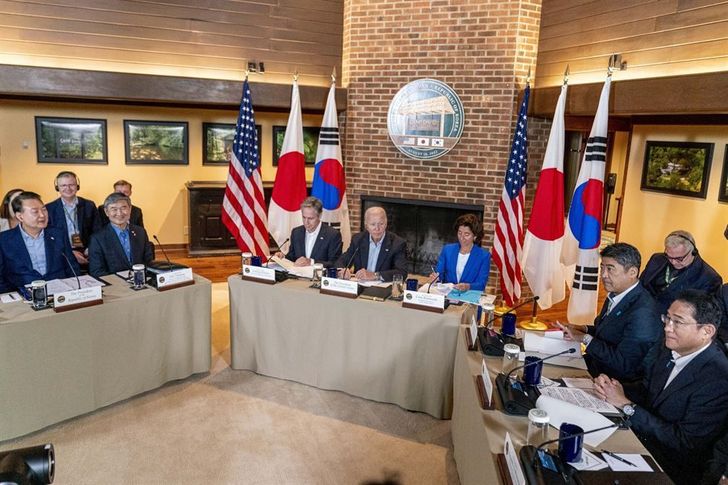
President Yoon Suk Yeol, U.S. President Joe Biden and Japan's Prime Minister Fumio Kishida attend a summit at Camp David in Maryland, Friday (local time). AP-Yonhap
Their collective commitment to uphold peace and stability in the Taiwan Strait directly opposes Chinese President Xi Jinping's efforts to bring Taiwan under Chinese control.
In that respect, China had strongly blasted the event in the lead-up to the summit.
"The international community has its fair judgment on who is stoking conflicts and exacerbating tensions," Wang Wenbin, a spokesperson for China's Foreign Ministry, said Friday.
Chung predicted an escalation in the scale and intensity of China's military maneuvers in the future. In particular, the joint maritime exercises conducted by China and Russia could expand further. A joint naval exercise of Russian and Chinese vessels took place near Alaska, Aug. 6.
China is not the sole nation expected to react strongly to the outcomes of the trilateral summit, according to analysts.
“North Korea has continuously criticized the emergence of the Asian equivalent to NATO,” said Cho Han-bum, a senior researcher at the state-run Korean Institute for Unification.
In addition, as South Korea and the U.S. are set to kick off the annual Ulchi Freedom Shield (UFS) exercise today, Pyongyang is also expected to stage a show of force that could include the launch of an intercontinental ballistic missile (ICBM), Cho added.
The South Korean and U.S. militaries plan to conduct a number of complementary large-scale, combined training exercises to strengthen interoperability during the UFS, which is scheduled to run until Aug. 31.