ANALYSIS Wang Yi's return may lead to more talks between Seoul, Beijing

Wang Yi, China's new foreign minister, attends the 13th Meeting of BRICS National Security Advisers and High Representatives on National Security in Johannesburg, South Africa, Tuesday, in this photo released by Xinhua News Agency. AP-Yonhap
Experts say replacement could be turning point, but does not signal dramatic change in bilateral ties
By Nam Hyun-woo
China has replaced outspoken Foreign Minister Qin Gang with his predecessor Wang Yi after speculation mounted over the month-long absence of the outgoing minister from public view.
The reasons for the shakeup remain under wraps, but government officials and experts in Seoul said Wang's return offers greater momentum for dialogue to thaw chilled ties between South Korea and China, because the new foreign minister has a deeper understanding of South Korea and a solid network among Seoul's decision makers.
China's state broadcaster CCTV announced the replacement during Tuesday's evening news, without explaining the reasons for Qin's removal. Qin had a quick rise to the foreign minister position last year, as his combative rhetoric apparently earned Chinese President Xi Jinping's trust while Beijing pursues a policy described as “wolf warrior diplomacy.”
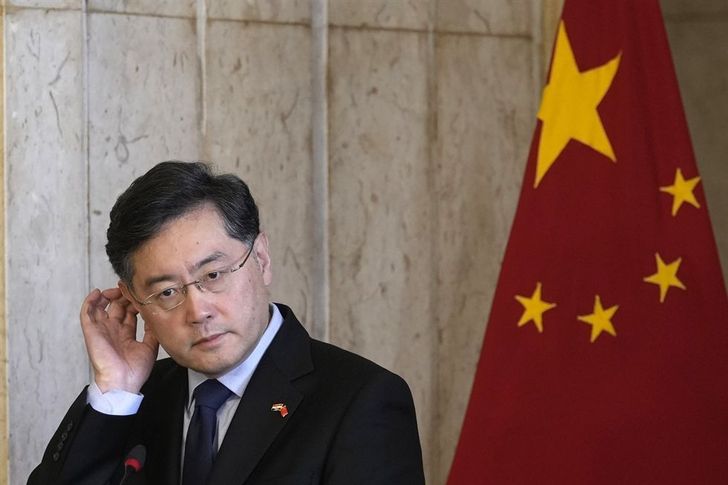
Former Chinese Foreign Minister Qin Gang listens during a press conference with his Egyptian counterpart Sameh Shoukry at the foreign ministry headquarters in Cairo, Egypt, Jan. 15. AP-Yonhap
Compared to Qin, Wang, who served as foreign minister from 2013 to 2022 and is now director of the foreign affairs arm of the ruling Communist Party, is known for his rich diplomatic experience as Beijing's top diplomat.
Wang is also known for his experience in dealing with multiple South Korean presidential administrations, presenting himself at many critical junctures of Northeast Asian diplomacy, such as the six-party talks involving the two Koreas, China, Japan, the U.S. and Russia.
In regards to the Yoon Suk Yeol administration, Wang is known to have “a relation of mutual respect” with Seoul's Foreign Minister Park Jin.
“A gentleman is better than a wolf warrior in diplomacy,” a high-ranking official of the South Korean government told The Korea Times asking not to be named. “For the development of friendly relations between South Korea and China, a gentleman's diplomacy of mutual respect and virtue are more desirable instead of a rude and tough wolf warrior's diplomacy.”
Sources said Park's favorable relations with Wang have played an important role in their meeting on the sidelines of the ASEAN Plus Three Foreign Ministers' Meeting in Indonesia, on July 14, which was seen as a turning point in the two countries' frayed relations.
During the meeting, Wang said, “We want the China-South Korea relations to return to a stable development trajectory and the past 30 years of achievements between the two countries remain untarnished.”
The meeting ended in a relatively cordial atmosphere, even though they touched upon issues that both countries find sensitive, such as Chinese envoy to South Korea Xing Haiming's controversial remarks on Seoul-Washington relations and Seoul's stance on Taiwan.
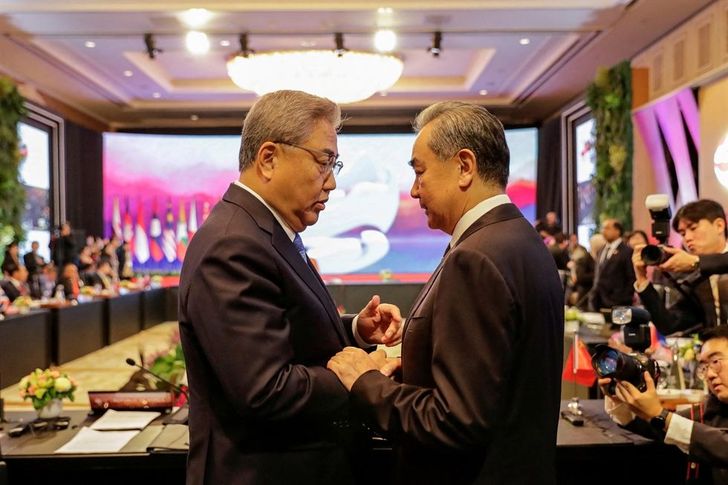
Foreign Minister Park Jin, left, talks to China's Communist Party's foreign policy chief Wang Yi prior to the ASEAN Plus Three Foreign Ministers' Meeting in Jakarta, Indonesia, July 13. Reuters-Yonhap
Park and Wang also met in Qingdao in August last year, where they stressed that the two countries have very different standpoints over the deployment of U.S. Terminal High Altitude Area Defense (THAAD) batteries in South Korea, requiring them to stay away from the issue to keep bilateral relations stable.
Experts also said that Wang's return could offer momentum for positive talks between the two countries, though it does not signal a drastic change in China's diplomatic stance on Seoul.
“For South Korea, Wang is a relatively comfortable partner for talks,” said Kim Heung-kyu, the director of the U.S.-China Policy Institute at Ajou University.
“His relations with Foreign Minister Park, deep understanding of the circumstances in South Korea and wide network with influential people here enable a positive outlook that Beijing could be more flexible in terms of its relations with Seoul.”
A senior researcher at an international think tank, who wished to remain anonymous, also noted that “Wang's return offers more room for conversation between the two countries.”
“Wang is now standing as the top diplomat of China and a member of the Politburo of the Chinese Communist Party,” he said. “The power of his speech and actions are incomparable to 10 years ago, and his expertise and understanding of South Korea will be a chance for the two countries to engage in more talks.”
However, the experts stressed that the replacement does not guarantee that the two countries' relations will improve suddenly, because the current downturn is a complex outcome of the U.S.-China rivalry, Beijing's One China principle and Seoul's strong diplomatic shift toward Washington and Western countries.
“Chances are slim for a drastic change in the direction of China's diplomacy toward South Korea following the shakeup,” Kim at Ajou University said. “It is not a matter that can be decided by its foreign minister, and it is a direction determined by China's higher-level officials.”