INTERVIEW New Peruvian ambassador shares his vision for stronger Korea-Peru ties

Peruvian Ambassador to Korea Paul Duclos speaks during an interview with The Korea Times at his residence in Yongsan District, Seoul, July 11. Arriving in Korea in March, Duclos outlined the packed schedule for the 60th anniversary celebrations of Korea-Peru diplomatic ties. Korea Times photo by Choi Won-suk
Peru Embassy packed with events to honor 60th anniversary of diplomatic relations
By Kwon Mee-yoo
New Peruvian Ambassador to Korea Paul Duclos has embarked on his diplomatic mission in Korea at a critical moment as the two countries honor the 60th anniversary of their diplomatic relations this year.
Stepping into the ambassadorial post for the first time, Duclos is bringing a fresh approach and ambitious agenda to his role, poised to celebrate the significant milestone and bolster the long-standing ties between the two nations, exploring new avenues of cooperation and mutual growth.
During an interview with The Korea Times, he recalled his first-ever visit to Korea about 15 years ago. At that time, he was serving at the Peruvian Embassy in Japan and had made a trip to the neighboring nation to witness a football match between Korea and Peru during the 2007 FIFA U-17 World Cup Korea.
"We also had a chance to visit Seoul including the palaces and it was a nice experience. Now I have returned and can see a completely different city, particularly the advancement of digital technology and (Seoul) is such a modern city with a lot of advances," he told The Korea Times at his residence in Yongsan District, Seoul, July 11.
Duclos has high expectations for his tenure in Korea, embracing his ambassadorial role with enthusiasm.
"What I see in Korea is that it is a country completely open to the world, wanting to captivate the world in every aspect, particularly in your way of culture. The way you work with K-pop, K-series (drama), K-cosmetics and K-food is something of a country that is seen looking to the world right now," Duclos said.
Duclos outlined the packed schedule for the 60th-anniversary celebrations of Korea-Peru relations, highlighting the significance of the milestone.
"The 60th anniversary is a moment of reflection on what we have achieved in the past, but also what we aim for the future," he said. "We have festive celebrations, but at the same time, it's a way to continue working on strengthening our relationship."
As part of the comprehensive agenda, high-level officials from Peru, including the vice minister of foreign affairs, minister of environment and minister of development and social inclusion, visited Korea earlier this year to engage in discussions on political, economic, technological and environmental cooperation.
The ambassador highlighted that the minister of development and social inclusion's visit was a chance for Peru to share its approach to social inclusion and equality with Korean authorities. "One of the priorities of the Peruvian government is to fight against poverty and to achieve social inclusion and equality. It was our chance to share these policies with the Korean authorities,” he said.
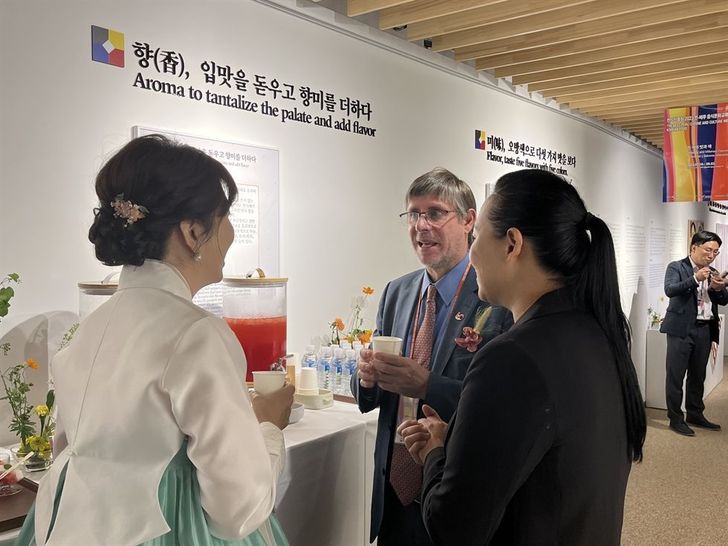
Peruvian Ambassador to Korea Paul Duclos, center, speaks with Korean Food Promotion Institute President Yim Kyeong-sook, left, during the opening ceremony of "Diversity and Millenary Flavors" exhibition introducing Peru's cuisine at Hansik Space E:eum in central Seoul, July 19. Courtesy of Korean Food Promotion Institute
Cultural events lined up
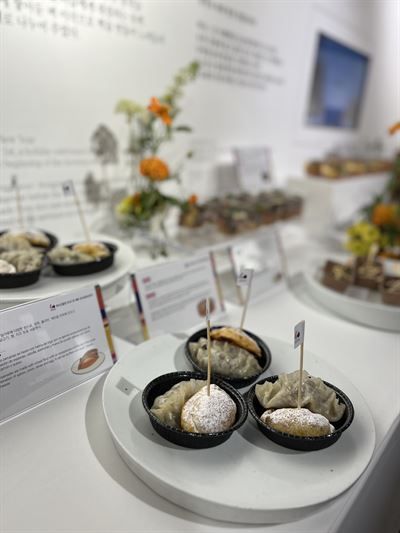
Peruvian empanada and Korean mandu are served together during the opening of “Diversity and Millenary Flavors" exhibition introducing Peru's cuisine at Hansik Space E:eum in central Seoul, July 19. Courtesy of Korean Food Promotion Institute
The embassy also has a flurry of cultural events coming up.
"Culture and heritage are our strength, and we're eager to showcase that here in Korea. We're going to prepare various activities throughout the year, including exhibitions and gastronomic events. Our training vessel from the Peruvian Navy will dock in Busan in September," Duclos said. "There's a lot of activity that we are preparing to celebrate the year as it should be."
He was referring to the BAP Union, the Peruvian Navy's training vessel, which is set to visit Busan in September as part of its world circumnavigation.
"The BAP Union is a beautiful sailing ship. The ship is going to be open to the public and in the boat, you'll find exhibitions that show different aspects of Peruvian culture. We're going to have to take all the possible advantage in order to make Peru known in Busan,” he said.
"All these activities are our way of showcasing Peru to Korea. We want to illustrate not just our similarities, but also what makes Peru unique. Through this, we hope to strengthen our ties further and continue the celebration of our 60 years of friendship and cooperation."
Another event is an exhibition dedicated to Peru's ancient civilizations and the Inca Trail, an intricate network of trails.
"Peru is crossed by the Andes in the middle so our pre-Hispanic civilizations developed more than 5,000 kilometers of trails throughout the country's difficult geography. These trails, still in use today, are a testament to our ancestral ingenuity and now a UNESCO World Heritage site that we share with other Andean countries like Argentina, Chile, Ecuador, Colombia and Bolivia."
Duclos plans to host another exhibition on Pucara bulls, a traditional Peruvian artifact that is often placed on the roofs of houses in Peru for good luck and protection, later this year. The exhibit, organized by Peru's Ministry of Foreign Affairs, has been traveling to Peruvian embassies around the world and will arrive in Korea in November.
"We're going to show some 40 Pucara bulls of different sizes and colors by different artisans from the Puno region. Each city or province has its own unique way to paint the Pucara bulls," he explained.
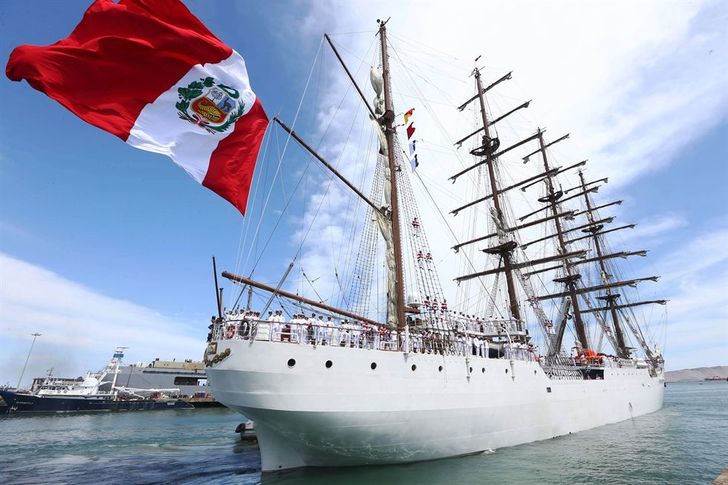
BAP Union, a sailing training vessel of the Peruvian Navy, will visit Busan in September as part of its world circumnavigation. Courtesy of Peru's Ministry of Defense
As an integral part of the cultural exchanges, Peruvian gastronomy will be introduced to Korea as well. Peru's unique cuisine has gained recognition across the globe, winning the title of the World's Leading Culinary Destination at the World Travel Awards 10 times.
He noted that Peruvian cuisine, a blend of the country's native ingredients and techniques with influences from Europe, Asia, Africa and the Middle East, has its own signature dishes and flavors.
"We're very proud of our culinary tradition. We did not replicate these cuisines, but there is a fusion between Peruvian flavors or techniques with the influence of these countries. As a result, we are one of the most important gastronomies in the world," he said.
Numerous Peruvian eateries regularly appear on the list of the World's 50 Best Restaurants, with Central Restaurante in Lima, helmed by Peruvian chef Virgilio Martinez Veliz, claiming the top spot this year.
"In collaboration with the Korean Food Promotion Institute, we're preparing a gastronomy event where we'll present Peruvian dishes and also explore similarities with Korean food," the ambassador said, referring to the "Diversity and Millenary Flavors" exhibition at Hansik Space E:eum in central Seoul, which opened on July 16 and runs through Sept. 3.

Peruvian Ambassador to Korea Paul Duclos speaks during an interview with The Korea Times at his residence in Yongsan District, Seoul, July 11. Korea Times photo by Choi Won-suk
Smart city for future
Ambassador Duclos said that the signing of a free trade agreement between Korea and Peru in 2010 is one of the most significant milestones in bilateral relations as it propelled trade growth.
"It has led us to bring Peruvian agricultural products to Korea. When you go to supermarkets, you can find high-quality Peruvian products such as asparagus, avocados, mangoes, grapes and bananas. There are more products that we want to bring to the Korean table," he said. "We aim to expand this basket of products with prospects for pomegranates, citruses and blackberries.”
In 2012, Peru and Korea solidified their commitment to mutual growth through a comprehensive strategic partnership. This umbrella partnership encompassed various sectors, including digital data transformation, defense, security, environment, health and agriculture.
"A priority for the embassy is to learn about Korea and Korea is one of the best in the world in regard to the information and digital government. In 2021, the Peru-Korea Center on e-government and data transformation was established in Lima and it is an example of cooperation that helped us to develop this sector and to begin to work on smart cities," he said.
The concept of a smart city represents an integration of digital technology to address the needs of the people. Duclos noted that this concept is being promoted actively in Peru, with cities like Lima and Cusco making moves in this direction.
"The center sponsored by the Korean government helps us to develop these kinds of tools for digital government and to reduce bureaucracy," Duclos said, explaining how smart cities could revolutionize Peru, given its distinctive, stretched-out geography.
Looking to the future, the ambassador shared the news of Peru chairing the Asia-Pacific Economic Cooperation (APEC) in 2024, with Korea taking over in 2025.
"This back-to-back chairmanship will undoubtedly strengthen the special bond between our two nations," he said, adding that the occasion will ensure high-level interactions between the two countries, with the Korean president likely visiting Lima for the 2024 summit and the Peruvian president visiting Korea in 2025.