Disability art plays key role in Canada's diplomacy

Ryu Jung-suk, President and CEO of Canada's National accessArts Centre, poses in front of Canadian artists' works created in collaboration with Korea's Gangnam Welfare Center for the Arts & Culture at the "Intense Difference of Its Own” exhibition at KF Gallery in central Seoul, June 20. Korea Times photo by Kwon Mee-yoo
By Kwon Mee-yoo
In the exhibition "Intense Difference of Its Own," disability art from Korea and Canada shatters prejudices against disability. The works, ranging from Kim Hyun-woo's paintings, which are steeped in mathematical principles and musical composition, to Carol Harris' whimsical creations and Brian Ehnis's evocative landscapes, further enrich the display, demonstrating the wide array of talent and perspectives that such art brings to the table.
The exhibit, commemorating the 60th anniversary of diplomatic relations between Korea and Canada, is held in cooperation between the Korea Foundation (KF), Canadian Embassy in Korea and Canada's National accessArts Centre (NaAC). It showcases how the works of disabled artists have become an integral part of Canadian diplomacy and global affairs, reflecting the country's commitment to inclusivity, advocacy and human rights.
At the heart of this initiative is Ryu Jung-suk, a Korean Canadian who serves as the founding President and CEO of NaAC, who carries an unwavering belief in the power of art, putting artists first in his operation of the organization.
When Ryu first joined the art center in 2017, it was operated more as a social service charity, focusing on delivering programs for people with disabilities where art was viewed as a form of social service.
"It's such a new thought to think of somebody with a disability as an artist first, that somebody with a disability could actually begin to earn an income, make a presence or make a meaningful contribution to our communities as an artist," Ryu said during an interview with The Korea Times at the KF Gallery in central Seoul, where the exhibition is held, June 20.
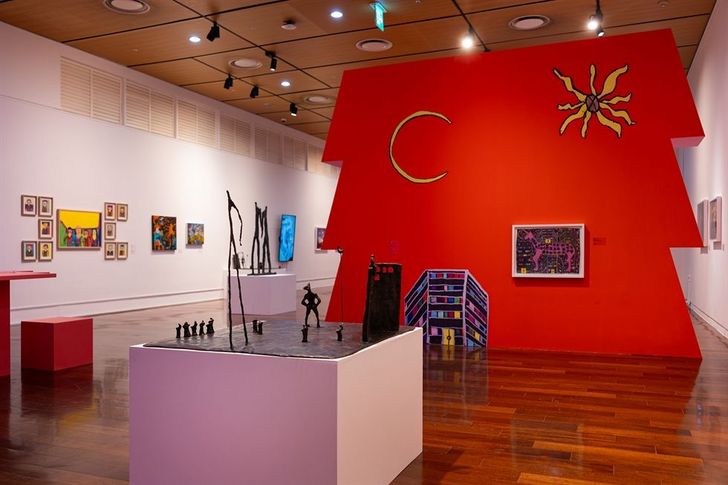
Installation view of the "Intense Difference of Its Own” exhibition at KF Gallery in central Seoul / Courtesy of Korea Foundation
The NaAC was founded in 1975 as the In-Definite Arts Society and after merging with the Momo Movement and the Artistic Expressions, it became Canada's oldest and largest disability arts organization.
"Back when we were a much smaller organization, all of our team members were social workers. When I told them, I want to reframe the way we think about supporting our artists as 'artists first,' it was so difficult for them to understand that. It really took a very difficult conversation internally," he said, adding that the evolution has been slow, particularly within the disability sector in Canada.
Ryu's groundbreaking approach and relentless activism have begun to shift perceptions, bringing about long-overdue recognition for disabled artists in Canada. He also recognized that the NaAC must continue to advocate and lobby for policy changes to ensure more equitable opportunities for disabled artists.
"We constantly lobby the government around changing policies and how things are funded so that there's a more equitable opportunity for somebody with a disability to make a contribution as an artist," he said.
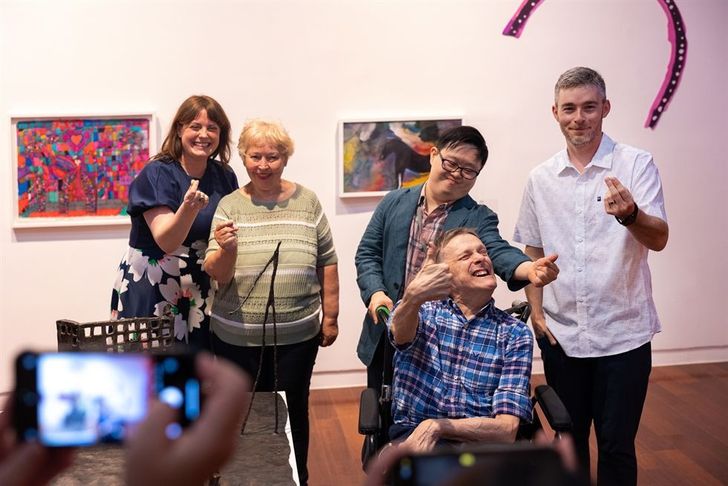
Artists with disabilities pose during the opening ceremony of the "Intense Difference of Its Own” exhibition at KF Gallery in central Seoul, June 20. Courtesy of Korea Foundation
Another notable fact about the NaAC is that primary federal funding does not come from social services funding streams but rather Global Affairs Canada, the governmental department that manages Canada's diplomatic relations.
"In 2021, we announced the very first partnership between global affairs and a disability arts organization, where 13 of our artists' works were acquired to be a part of the Government of Canada's permanent visual arts collection. What's important is that our role in that process is to not create a special procedure because they happen to have a disability, but go through the same assessment process and the same criteria applied to any other artists," Ryu said.
The NaAC artists and their works have been shown in various cities around the globe, including Seoul, Hong Kong, Dubai, Guadalajara, New York and Tokyo, increasing the visibility of works by disabled Canadian artists on the global stage and promoting cultural exchange and understanding. The Seoul exhibit is part of the efforts.
"For example, the big initiative we did in Dubai was in order to engage in bilateral conversations between Canada and the UAE on human rights. (Global Affairs) view us as an incredible tool to be able to open the doors for that conversation. Empathetic views of people with disabilities can be used as a lever to open up other layers of the conversation around human rights and it is something that, I think, Global Affairs sees as a very powerful tool. We're excited to be able to be part of it and share the Canadian brand,” Ryu explained.
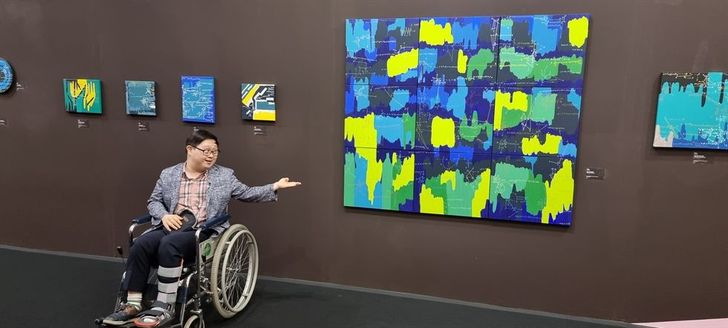
Korean artist Kim Hyun-woo, also known as Pixel Kim, explains his works at the "Intense Difference of Its Own" exhibition at the International Convention Center Jeju, July 12. Courtesy of Korea Foundation
Growing recognition of artists with disabilities
Ryu also noted that the change in perception of disabled artists is notably palpable in Korea as well.
"Just in the recent few years, I've seen a huge difference. I think suddenly there is not only a desire and an interest, but also a willingness to work with artists, content producers and even actors who have disabilities," Ryu said, giving an example of actor Jung Eun-hye, who is playing a character with Down syndrome in the Korean drama series "Our Blues."
"There's an acceptance (in Korea). I don't see that happening in Canada. I haven't seen a mainstream TV series where they've hired an actor with Down syndrome. But here in Korea, that is happening ... The fact that the one piece of art that is hanging in the president of this country's office happens to be by an artist with Down syndrome. You don't see that anywhere else in this world."
Ryu highlighted that although recognition for artists with disabilities in Korea has improved, the support system still has significant room for growth.
"Even Pixel has bounced between studios because he can't find studio space to work with," Ryu said.
Currently, the NaAC provides support to over 350 artists but is still grappling with a significant waitlist for entry due to the lack of opportunities for artists with disabilities.
Artist Kim has participated in a residency program at the center and has showcased his work alongside other NaAC artists in Canada and internationally. His collaboration offers a promising insight into the potential for cooperation between Korea and Canada through the works of disabled artists.
"We're the largest organization of our kind in Canada and we have a large space that is able to support these types of different endeavors. Not every city or province in Canada has this, but at least we have an example of something that can that work. I think it's a lot of this work is still on the shoulders of parents and caregivers in Korea,” he said.
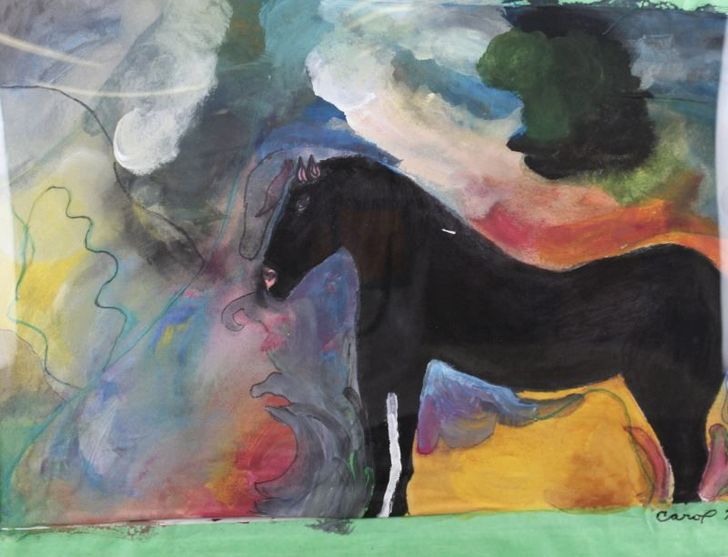
"Black Stallion" by Carol Harris / Courtesy of Canada's National accessArts Centre
The NaAc president contrasts this with Canada's approach, which places an emphasis on fostering independence from an early age. This approach applies equally to those living with disabilities, resulting in less reliance on family or caregivers for support during adulthood.
"In our case, we have an established organization that's doing that advocacy on our community's behalf and we get government support to be able to do that. Whereas in Korea that falls on the backs of very passionate parents and sometimes can be very effective too," Ryu said.
The exhibit, which runs through Aug. 12 in Seoul, was also showcased at the International Convention Center Jeju earlier this month to celebrate the 19th World Congress of the World Federation of the Deaf. After the Seoul run, it will travel to commemorate the deepening ties between Korea and Canada. This signifies more than just an artistic tour, but serves as a symbolic bridge in promoting inclusivity and human rights through disability arts.
"Just because I accept somebody for having a disability doesn't change how they can be involved in, integrated and included in our communities. So I think that there's still that level of indifference," Ryu said, adding that he takes inspiration from disability-related initiatives in Korea and such advocacy, propelled by the courage and commitment of disability rights advocates which is crucial in shaping an inclusive society.