S. Korea, US, Japan to hold 3-way summit on Aug. 18

U.S. President Joe Biden shakes hands with Korean President Yoon Suk Yeol as Japan's Prime Minister Fumio Kishida looks on ahead of a trilateral meeting on the sidelines of the G7 summit in Hiroshima, Japan, May 21. AP-Yonhap
Real-time NK missile data sharing likely to take form
By Nam Hyun-woo
The leaders of South Korea, the United States and Japan are expected to gather for a trilateral summit at Camp David in Maryland, Aug. 18, during which they will likely discuss a real-time North Korean missile information-sharing program and other security issues spanning the Indo-Pacific region.
Seoul's presidential office said Thursday that the trilateral summit between Korean President Yoon Suk Yeol, U.S. President Joe Biden and Japanese Prime Minister Fumio Kishida will take place next month in the U.S. It will announce the time and place after coordination between the three countries.
However, some media outlets reported that the summit will be held at Camp David, the U.S. presidential country retreat, on Aug. 18.
The summit was proposed in May by Biden when the three leaders met on the sidelines of a G7 summit in Hiroshima, Japan, as they did not have enough time for lengthy conversations on pending issues at the event.
During the planned summit, the leaders are anticipated to manifest their strengthening cooperation in security, matters of economy and other global issues.
Among security issues, North Korea's escalating nuclear and missile threats and their deterrence are anticipated to be at the top of the agenda.
North Korea is intensifying the level of its provocations recently by testing solid-fuel intercontinental ballistic missiles and launching what it claims to be a military spy satellite. On Wednesday, Pyongyang launched two short-range ballistic missiles into the East Sea, in an apparent protest against a U.S. nuclear-armed ballistic missile submarine's port call in Busan a day earlier.
At the same time, Kim Yo-jong, sister of the North's leader Kim Jong-un, is disseminating rhetoric against the formation of the joint Seoul-Washington Nuclear Consultative Group, and U.S. promises to provide extended deterrence to its allies.
Against this backdrop, the three leaders are likely to engage in talks for the real-time data-sharing program on North Korean missiles, which was agreed to during their trilateral summit in Phnom Penh, Cambodia in November.
Currently, the three countries share data through the Trilateral Information Sharing Arrangement (TISA) and the General Security of Military Information Agreement (GSOMIA) between Seoul and Tokyo.
The TISA was signed in 2014 as a framework for the three countries to share classified information voluntarily only through the U.S. Under the GSOMIA, South Korea and Japan share data only when a request is made.
The new real-time information-sharing program is anticipated to overcome current limitations and improve each country's ability to detect and assess threats posed by incoming missiles.
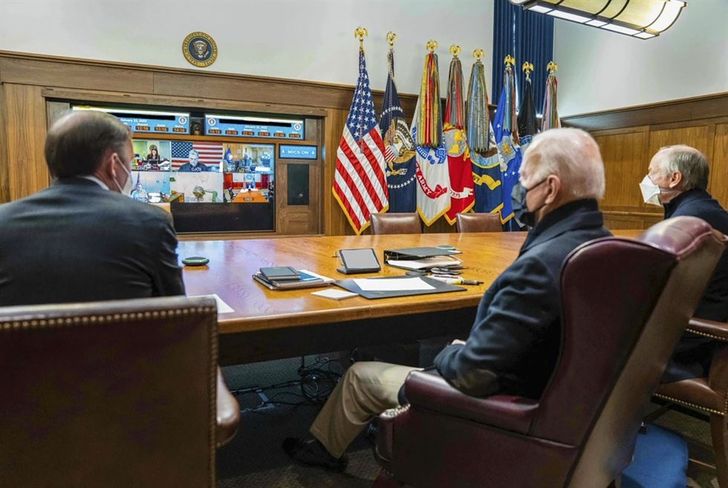
U.S. President Joe Biden, center, joins a virtual meeting with his national security team and senior officials to discuss Russia's aggression toward Ukraine, Jan. 22, 2022, at Camp David in Maryland, in this photo released by the White House. AP-Yonhap
Discussion of the countries' solidarity in global security issues, including the war in Ukraine is expected.
Yoon recently paid an official visit to Ukraine and promised Seoul's strong support and practical aid. All three leaders have now visited the war-torn nation.
It will be the first time for the three heads of state to flock together specifically for a summit. So far, trilateral meetings have been taking place on the sidelines of multilateral events such as the G7 and NATO summits.
“Along with the content of the leaders' talks, the standalone trilateral summit itself bears a strong diplomatic message, that the three countries' ties are stronger than ever,” a senior official at the presidential office said.
The summit, however, is also triggering concerns that it could prompt China, Russia and North Korea to strengthen their cohesion and heighten the confrontational atmosphere surrounding the region.
According to news reports from Russia and China, the two countries' naval forces have begun joint exercises, named “Northern/Interaction-2023,” in the East Sea, with the Chinese defense ministry saying the drills are aimed at “safeguarding the security of strategic waterways.”