EXCLUSIVE IAEA defends its UN status as some lawmakers question relevance

Rafael Grossi, right, director general of the International Atomic Energy Agency (IAEA), shakes hands with Rep. Wi Seong-gon of the Democratic Party of Korea during a meeting with the opposition party's lawmakers at the National Assembly in Seoul, July 9. The IAEA defended its status as an international organization “within the United Nations system" after some lawmakers questioned the agency's relevance in an apparent bid to undermine the credibility of its Fukushima report. AP-Yonhap
Nuclear watchdog maintains radiation dose from Fukushima water 'will be undetectable and negligible'
By Jung Min-ho
The International Atomic Energy Agency (IAEA) defended its status as an organization “within the United Nations system” after some Korean lawmakers questioned the agency's relevance in an apparent bid to undermine the credibility of its report that gave the green light to releasing into the ocean treated wastewater from a crippled nuclear plant in Fukushima.
In response to inquiries recently sent by The Korea Times, Sinead Harvey, the agency's press officer, also expressed confidence in the result of its safety review of the Japanese plan, saying the radiological dose to the Korean public would be 'negligible."
“The IAEA is an autonomous international organization within the United Nations system. It is the world's central intergovernmental forum for scientific and technical cooperation in the nuclear field with a membership of 176 Member States,” Harvey said.
The statement comes after several lawmakers of the opposition Democratic Party of Korea (DPK), including Yang Yiwonyoung and Lee Jae-jung, raised doubts about the IAEA's relations with the U.N. and its expertise in writing such a report.
The IAEA official said the agency conducted an “independent and impartial” analysis regarding all aspects of the release plan and applied relevant international safety standards. What this means is that the IAEA assessed if Japan's measures would have any possible consequences in terms of the protection of present and future generations in the country as well as other ones.
“International safety standards apply not only to local populations but also to populations remote from the discharge activities; and that where effects could span generations, subsequent generations have to be adequately protected without any need for them to take significant protective actions. This is an important fundamental safety principle given the long-term approach currently envisaged for discharging ALPS-treated water,” Harvey said.
“Based on the marine dispersion model used by TEPCO, activity concentrations of tritium and other radionuclides in international waters will not be influenced by the discharge of ALPS-treated (the Advanced Liquid Processing System filtration process) water into the sea and will be undetectable or indistinguishable from background levels.”
Those international standards used by the IAEA are constantly updated, “taking into account advances in science and technology and learnings from research and experience” and are approved by all IAEA member states and co-sponsored by the competent organs of the U.N. and its relevant agencies, she noted as IAEA Director General Rafael Grossi explains in the report's foreword.
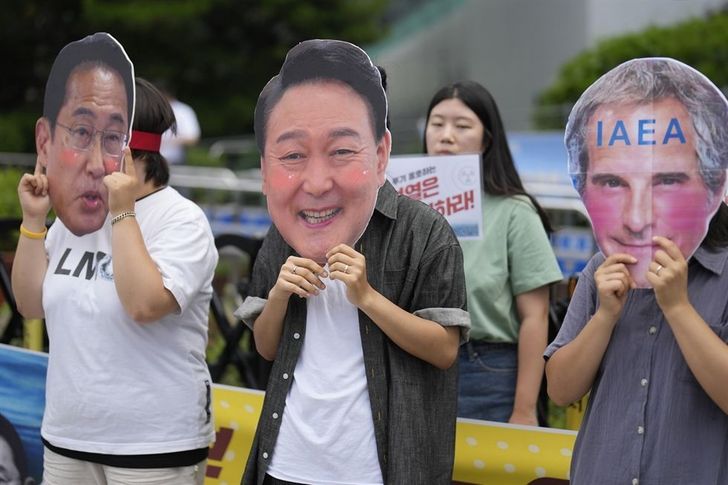
Protesters wearing masks of President Yoon Suk Yeol, center, Japanese Prime Minister Fumio Kishida, left, and Rafael Grossi, director general of the International Atomic Energy Agency, hold a rally against Japan's plan to release treated radioactive water into the Pacific Ocean from the Fukushima nuclear power plant, in Seoul, July 7. AP-Yonhap
After two years of inspections, the IAEA issued the report on July 4. Governments around the world, including the Yoon Suk Yeol administration, have endorsed it.
During his visit to Seoul last week, Grossi had talks with DPK lawmakers, who attacked him over a report they claimed was “tailored for Japan” and expressed regret over its “predetermined” conclusion. To assure them, he said the IAEA will monitor the implementation of the release plan from its regional office in Fukushima.
Harvey said independent third-party laboratories will also join the monitoring effort to test for all the radionuclides that matter for the safety assessment of the water to be discharged.
“We will be able to confirm ― with 100 percent confidence ― whether the water meets all regulatory safety requirements. The IAEA's independent sampling, data corroboration and analysis activities include the sampling, analysis and interlaboratory comparison for ALPS treated water and for environmental samples,” the official said.
“The IAEA's sampling, data corroboration, and analysis activities also include a review of sampling and analytical methods used by TEPCO and any other relevant technical institutions.”