Yoon asks Japan for S. Korea's participation in Fukushima water release

President Yoon Suk Yeol shakes hands with Japanese Prime Minister Fumio Kishida during their summit at a hotel in Vilnius, Lithuania, Wednesday (local time). The leaders met on the sidelines of the North Atlantic Treaty Organization (NATO) Summit. Yonhap
By Nam Hyun-woo
VILNIUS ― President Yoon Suk Yeol requested Japan to let South Korean experts participate in the process of Tokyo's planned release of treated wastewater from the damaged Fukushima Daiichi Nuclear Power Plant, during his summit with Japanese Prime Minister Fumio Kishida on the sidelines of the 2023 NATO Summit in Vilnius, Lithuania, Wednesday (local time).
Yoon stressed that the safety and health of South Koreans are the top priority, adding that Seoul respects the International Atomic Energy Agency's (IAEA) assessment of Japan's release plan. The U.N. nuclear agency said the plan meets safety standards as the water being released would have a negligible radiological impact, according to the presidential office.
The president also asked for Japan's “real-time sharing of monitoring information” on whether the release of treated wastewater is taking place as planned and to make immediate notifications to South Korea in case the concentration of radioactive materials in the treated water surpasses tolerable standards.
It remains uncertain if Japan will accept Yoon's requests.
Following the IAEA report, Japan is poised to announce its final plan for releasing more than 1.2 million tons of treated wastewater from the damaged nuclear power plant into the Pacific Ocean and Japanese media anticipate the process to begin in September.
In response to Yoon's requests, Kishida highlighted the IAEA report, affirming his dedication to the safe execution of the release plan and refuting any adverse impact on the health of the Japanese and Korean people, according to Seoul's presidential office.
Also, Kishida noted that Tokyo will receive the IAEA's review after the release and “promptly announce the monitoring information.” In case the concentration of radioactive materials in the wastewater exceeds tolerable levels, Japan said it will implement “appropriate responses including the immediate halt of the release.”
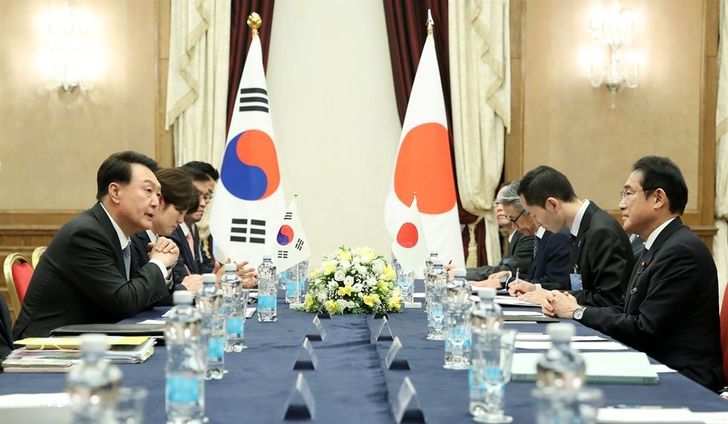
President Yoon Suk Yeol speaks to Japanese Prime Minister Fumio Kishida during their summit at a hotel in Vilnius, Lithuania, Wednesday (local time). The leaders met on the sidelines of the North Atlantic Treaty Organization (NATO) Summit. Yonhap
Although he asked for South Korea's participation in the monitoring process, Yoon is perceived by many South Koreans as virtually condoning Japan's release plan, which is anticipated to incite angry responses at home. As a result, the president will likely face a dilemma of explaining his rationale to the public, because polls show that many South Koreans still have concerns over the release plan.
A Gallup Korea poll from June 27 to 29 also showed that 78 percent of 1,007 respondents said they are worried about the safety of the release plan. Further details of the poll are available on the National Election Survey Deliberation Commission's website.
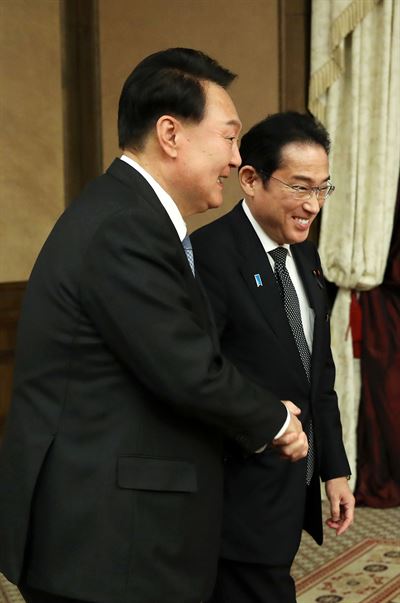
President Yoon Suk Yeol and Japanese Prime Minister Fumio Kishida head to a photo spot during their summit at a hotel in Vilnius, Lithuania, Wednesday (local time). The leaders met on the sidelines of the North Atlantic Treaty Organization Summit. Yonhap
The 30-minute summit with Kishida was the sixth between the two leaders, with the last one held two months ago on the sidelines of the Group of Seven Summit in Hiroshima, Japan. Showcasing significantly improved bilateral relations, Kishida greeted Yoon by saying “hello” in Korean.
“Thanks to the mutual efforts, Seoul-Tokyo relations are moving toward the direction of improvements and progress,” Yoon said during the summit. “And I believe the two countries can contribute to regional peace and stability, as well as the resolution of global issues.”
Yoon also noted that North Korea's missile launch, which took place hours before their summit, is a provocation against world peace and a blatant violation of U.N. Security Council resolutions. He added that he expects “to continue close communication” with Kishida in the second half of this year.
Bilateral relations have been improving during the Yoon administration, as the president seeks to strengthen South Korea's national security through a trilateral cooperation between Seoul, Washington and Tokyo, despite conflicts in the two countries' shared history.
“I welcome that the two countries' government and private sectors are cooperating in a wide range of areas, while I and President Yoon are trailblazing the new era of Japan-South Korea relations,” Kishida said, citing a meeting by their defense ministers last month and recent exchanges between business lobby groups of the two sides.
Kishida also noted that the North's latest missile launch is a threat to international peace and stability and highlighted the need for close bilateral cooperation.