Gov't urged to seek regular inspections of Fukushima water discharge

Protesters stage a rally at the National Assembly in Seoul, Sunday, against the Japanese government's plan to release treated radioactive water from the crippled Fukushima Daiichi Nuclear Power Plant. AP-Yonhap
By Lee Hyo-jin
The Korean government should urge Japan to allow Seoul to conduct regular inspections to monitor the progress of treated wastewater being discharged from the tsunami-wrecked Fukushima Daiichi Nuclear Power Plant, as Japan finalizes plans to open its storage tanks, experts and diplomatic observers said, Monday.
A summit between President Yoon Suk Yeol and Japanese Prime Minister Fumio Kishida slated for later this week would be a chance for the Korean government to make some concrete demands to Tokyo concerning its planned release of the treated wastewater, the experts said.
Tokyo's plan to discharge the treated but still slightly radioactive water into the Pacific Ocean gained momentum after receiving the green light from the International Atomic Energy Agency (IAEA) last week.
Amid heightened public anxiety here, Yoon is expected to meet with Kishida on the sidelines of the North Atlantic Treaty Organization (NATO) summit taking place in Lithuania on Tuesday and Wednesday.
“It's very regretful that the situation is turning favorably for Japan following the release of the IAEA's report. However, the Japanese government is unlikely to immediately set a date for the release given the strong backlash from the Korean and Chinese public,” said Yang Ki-ho, a professor of Japanese Studies at Sungkonghoe University
“In the meantime, Korea should urge Japan to launch a joint investigation into the treatment system,” he added, referring to ALPS, a filtration system developed by Japan which is used to remove radioactive materials from the contaminated water stored in the Fukushima plant.
Yang pointed out that the IAEA's comprehensive report published on July 4 examined only the safety of the ALPS-treated water, without properly scrutinizing the capability of Japan's treatment system.
Regarding the IAEA's report, the Korean government said it respects the outcome of the international organization's safety review, but did not immediately support or oppose the water release plan, delaying a response until Japan announces its final decision.
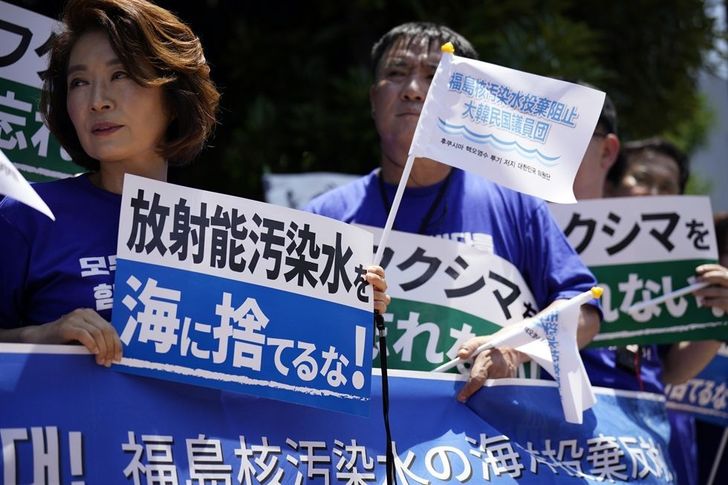
Lawmakers of the main opposition Democratic Party of Korea (DPK) hold banners protesting Japan's plans to release treated wastewater from the damaged Fukushima nuclear power plant, during a rally in front of Prime Minister Fumio Kishida's office in Tokyo, Monday. AP-Yonhap
Choi Eun-mi, a research fellow at the Asan Institute for Policy Studies, viewed that the Korean government should convey several demands to Japan, such as a promise to allow Seoul to conduct close monitoring of the overall process of the wastewater discharge.
“Sending a local expert panel to Fukushima on a regular basis can be considered as an option. And Japan, for its part, should remain transparent about the discharge process, which will be carried out in the next few decades,” she said.
Choi also said the two governments could also consider including a Korean official in a new IAEA permanent office which will be set up in Fukushima to help monitor the process.
The government and lawmakers were also advised to come up with a compensation plan for the local fisheries industry, which is already reeling from plunging sales. Concerned about the wastewater's potential effect on the marine environment and seafood, people here are already shunning seafood products sold in local markets.
“Both ruling and opposition lawmakers should refrain from politicizing the issue and focus on practical measures that will help the fisheries industry,” Yang said, mentioning that the Japanese government has proposed an 80 billion yen ($561 million) fund to deal with the potential effects on its fisheries industry.
On Monday, 10 members of the main opposition Democratic Party of Korea (DPK) and two independent lawmakers flew to Tokyo to stage protests against Japan's planned wastewater release.
During their three-day stay, the lawmakers plan to hold a rally in front of the prime minister's office, the National Diet of Japan, and visit the Japanese office of the IAEA.