IAEA gives greenlight to Japan's plan to release Fukushima wastewater

Rafael Grossi, left, director general of the International Atomic Energy Agency (IAEA), presents IAEA's comprehensive report on Fukushima Treated Water Release to Japanese Prime Minister Fumio Kishida at the prime minister's office in Tokyo, Tuesday. AP-Yonhap
UN nuclear chief to visit Seoul on Friday to discuss water discharge issue
By Lee Hyo-jin
Japan's plan to discharge treated wastewater from the crippled Fukushima Daiichi Nuclear Power Plant into the Pacific Ocean got the nod from the International Atomic Energy Agency (IAEA), Tuesday, despite lingering concerns from neighboring countries, including Korea and China.
Based on a safety assessment of the plan that took almost two years, the IAEA concluded that Tokyo's plan to release the treated water is consistent with the agency's safety standards. In addition, the United Nations nuclear watchdog said that the discharge of the treated water “would have a negligible radiological impact to people and the environment.”
The IAEA stated that its review addressed all key safety elements of the water discharge plan in three major areas ― assessment of protection and safety; regulatory activities and processes; and independent sampling, data corroboration, and analysis.
The conclusion came hours after IAEA Director General Rafael Grossi arrived in Tokyo and met with Japanese Prime Minister Fumio Kishida to submit his agency's final report in person.
The Japanese government has yet to announce exactly when it will begin the discharge process, which will be carried out over the next three to four decades. Last week, Japan's nuclear regulation authority finished inspections on its system to release the treated wastewater, and is expected to make the final call as early as this week.
Political parties in Korea gave contrasting responses to the IAEA's endorsement of Japan's wastewater discharge plan.
The ruling People Power Party (PPP), which believes that much of the concerns about the Fukushima wastewater are “groundless rumors,” welcomed the IAEA report as “appropriate.” It added, “Korea, as a global pivotal state, should humbly accept the results.”
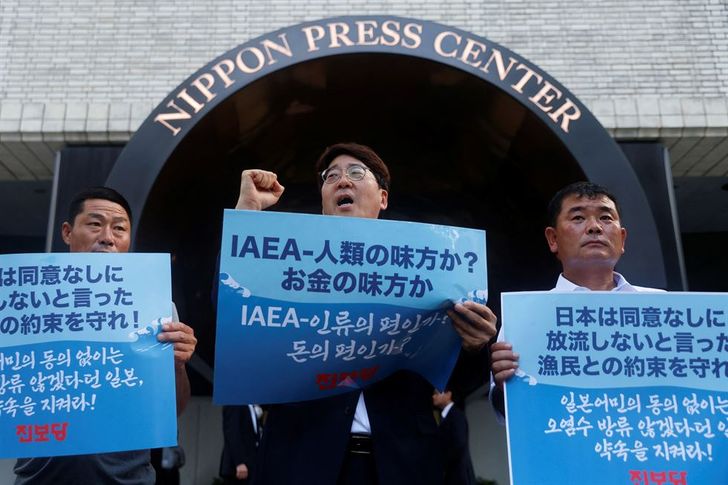
Korean lawmakers of the minor liberal Jinbo Party and fishermen stage a protest denouncing Japan's Fukushima water release outside Japan National Press Club in Tokyo, Tuesday, before the press conference by International Atomic Energy Agency IAEA chief Rafael Grossi. Reuters-Yonhap
On the other hand, the main opposition Democratic Party of Korea (DPK) is seeking to scale up its ongoing protest against the wastewater release. About 10 DPK lawmakers plan to travel to Tokyo from July 10 to 12 to hold rallies in front of the prime minister's office.
Korea's presidential office did not issue a statement on the IAEA's decision, saying that the Nuclear Safety and Security Commission will do so.
Amid ongoing controversies, the IAEA chief is set to visit Seoul this Friday to explain his organization's position on the water discharge to Korean officials.
Grossi's visit, which comes just three days after the publication of the IAEA's comprehensive report, appears to be part of the U.N. nuclear watchdog's efforts to alleviate the Korean public's concerns regarding the matter.
Korea's Office for Government Policy Coordination announced, earlier in the day, that the IAEA chief's three-day trip to Korea ― from Friday to Sunday ― will include a meeting with the head of the Nuclear Safety and Security Commission.
“The director general is scheduled to meet with Yoo Guk-hee, head of the Nuclear Safety and Security Commission, during which he will explain the details of the comprehensive report,” Park Ku-yeon, the first deputy chief of the office, said during a daily briefing on the Fukushima water issue.
Yoo was the head of a 21-member Korean inspection team that traveled to Fukushima in late May to conduct an on-site safety inspection of Japan's water discharge plan. Park added that Grossi will also have a meeting with Foreign Minister Park Jin.
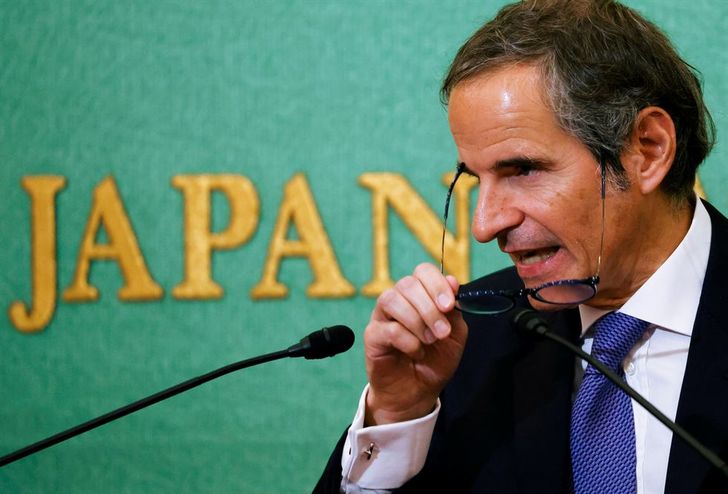
International Atomic Energy Agency chief Rafael Grossi attends a news conference at Japan National Press Club in Tokyo, Tuesday. Reuters-Yonhap
Following his trip to Korea, the IAEA chief is expected to travel to New Zealand and the Cook Islands, which are also among the nations that have been protesting Tokyo's plan to discharge the treated radioactive wastewater into the Pacific Ocean. Some countries such as China have been calling on the IAEA to take a “responsible” stance on the issue.
The series of visits by Grossi to the affected nations is viewed as an effort by the U.N. nuclear watchdog to ease their concerns over the wastewater release issue, amid ongoing controversy over the treatment process, which still leaves the water slightly radioactive.
At the same time, the Korean government is also wrapping up its own safety review that has been conducted separately from the IAEA's inspection.
“Our government has been conducting scientific and technological reviews of Japan's water discharge plan through our own inspection activities as well as participation in the IAEA monitoring taskforce. We are now in the final stage,” said Park of the Office for Government Policy Coordination, adding that a report of the inspection will soon be made public.