INTERVIEW Hassan Wirajuda sheds light on role of Korea, Indonesia in global community

Hassan Wirajuda, former foreign minister of Indonesia, speaks during an interview with The Korea Times at the Shilla Seoul, June 26. Korea Times photo by Choi Won-suk
Former Indonesian foreign minister suggests comprehensive peace agreement to resolve nuclear issue
By Kwon Mee-yoo
With a resume rich in diplomatic endeavors and a robust understanding of international relations, Hassan Wirajuda, former Foreign Minister of Indonesia, provided insight into Indonesia's international policy, the ever-evolving role of Indonesia and Korea in the Indo-Pacific and the potential for future cooperation between the two countries.
Wirajuda is the longest standing and former foreign minister of Indonesia, serving from 2001 to 2009. He supported the ASEAN Political and Security Community of the three pillars of ASEAN Community. He now serves as chair of the Study Centre on Indonesian Nationhood (PSKI) and dean at the School of Law and International Studies at Prasetiya Mulya University.
Having studied law and international politics, Wirajuda believes that intellectual leadership can surpass the influence of military or economic power.
"The idea, or concept, matters and others follow leadership that has good concepts which are applicable to other countries as well," Wirajuda said during an interview with The Korea Times at a hotel in Seoul, Monday, as he visited Korea to take part in a forum commemorating the 50th anniversary of the diplomatic relations between Korea and Indonesia.
Wirajuda, whose experience spans crucial years of Indonesian diplomacy, said the country has established a policy of independence and active engagement in foreign affairs since the beginning of the Republic.
"The nature of our policy emanated from the experience of Indonesia in the first five years struggling to maintaining our independence. We consistently maintain an independent and active foreign policy. For example, during the Cold War, we didn't take sides, either with the Western world or the Soviet Union. But in our principle, we should be able to decide, to make positions of policy solely dictated by our national interests, meaning we are not neutral but that depends on our self-interest," he explained.
This principle applies to Indonesia's position on Russia's aggression against Ukraine.
"What has transpired is not just simply a war in Ukraine, but to us, it is a clear act of aggression from one country against another in violation of the United Nations charter. We made this position very clear, including when Indonesia fought in favor of the resolutions adopted by the General Assembly, a similar position we took when the United States launched aggression against Iraq," Wirajuda said.
"That's an example of Indonesia's independent active foreign policy and we hope that all member countries of the U.N., respect their commitment to the U.N. Charter, which outlaws the war."
With the current global order ineffective, the diplomat suggested that countries should establish their own regional order to maintain stability, such as the Association of Southeast Asian Nations (ASEAN) which Indonesia is a member of.
"Because of ASEAN we enjoy relative peace and security continuously in the past decades that allowed us, in the end, to focus our time, energy and resources on economic development, as well as the region," he said.
“As prescribed in the ASEAN Charter, ASEAN aims to be people-centered. However, I don't think we are at this stage yet. While we have implemented visa-free travel for ASEAN citizens across member states, we still have a long way to go. We need to address this and encourage more people-to-people contact and boost the ASEAN socio-cultural aspect, which currently seems overly focused on the economic side.”
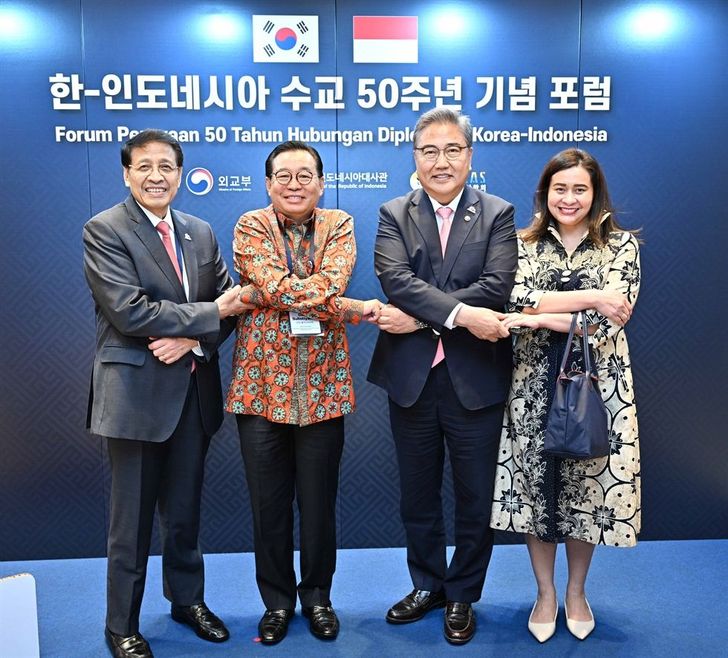
From left, former Foreign Minister of Indonesia Hassan Wirajuda, Indonesian Ambassador to Korea Gandi Sulistiyanto, Korea's Foreign Minister Park Jin and Minister Counselor for Economic, Trade and Investment Affairs at the Indonesian Embassy Seoul Adhyanti Wirajuda perform ASEAN handshake during a forum commemorating the 50th anniversary of diplomatic ties between the two countries at the Shilla Seoul, June 26. Courtesy of Ministry of Foreign Affairs
'Indonesia, Korea are complementary'
Wirajuda said he is proud of the progress made between Indonesia and Korea, which evolved into special strategic partnerships with a new focus of shifting to the next 50 years.
"At this meeting, we identified what we should do in the coming 50 years and beyond. Our relations are complementary in nature. Indonesia is a country endowed with rich natural resources, while Korea has been successful in human resource development and made great progress in technology, more importantly, innovations. So I think in terms of complementarity, we could support each other," he said.
The seasoned diplomat noted that Korea's new Indo-Pacific Strategy was designed to strengthen relationships with key countries and promote cooperation in various areas such as digital transformation, infrastructure development and green energy initiatives.
"On the Indo-Pacific political perspective, one point relates to democracy and human rights, which have been somewhat deficit in our regions. Korea wants to work closely with countries of democracy and that respect human rights. I know it is more sensitive politically, but nevertheless, we should not forget this because it is an important foundation for countries or regions if we wish to see the region more peaceful and enjoy political stability," Wirajuda said.
In terms of regional security, Wirajuda suggested that the solution to the North Korean nuclear issue lies in a comprehensive peace agreement that guarantees security for all parties involved.
"During my time as foreign minister, I developed close friendships with my counterpart (in North Korea) and at one point I asked him 'Didn't you learn from the Soviet Union? The Soviet Union had, and still has, nuclear weapons but it didn't collapse because of lack of nuclear weapons, but lack of economic development.' His response was that 'Look, we're still at war. The Korean War was closed only by an armistice agreement, not ended by a peace agreement, so legally we are at war,'" Wirajuda said.
"I think the solution to the nuclear issue in the Korean peninsula has to address the proper conclusions of the Korean War, meaning a comprehensive peace agreement that provides security guarantee for all and so that countries in the region are not tempted to develop nuclear weapons themselves," he said.
He emphasized the importance of creating a world that is stable, prosperous and secure to discourage countries from feeling the need to develop nuclear weapons.
"When you stand in Jakarta and look north, you will see visible lines of (nuclear) proliferation from West Asia to East Asia ― Israel, Iran, Pakistan, India, China and North Korea. I'm afraid that some others in the region are interested to try it," he said, noting that the situation is subduing in other regions as Ukraine and South Africa have given up their inherited nuclear weapons, as well as Argentina in South America.
He explained why this concern is especially relevant in politically unstable regions as countries may feel insecure, prompting them to pursue nuclear development.
"That's why I say clear, visible lines of nuclear proliferation are frightening … That's why it is important to create a world that is stable, prosperous and secure, which will lessen the need to develop nuclear weapons."
Wirajuda believes that mid-power countries like Korea and Indonesia have significant roles to play in global society.
"Even though they aren't superpowers, we can still promote not only our national interest but also the interests of the region, of the world. And now when the two superpowers are practically in conflict with each other, I think mid-powers can work together to fill the gap, in the absence of global order," he said.