6 European firms pledge $940 mil. in total investments in Korea

President Yoon Suk Yeol speaks during a ceremony where six European firms announced a combined $940 million in investments into Korea at a hotel in Paris, Wednesday (local time). From left behind Yoon are CIP Managing Partner Jakob Baruel Poulsen, Continental Korea CEO Marin Kueppers and Equinor Chairman of the Board Jon Erik Reinhardsen. Yonhap
Yoon proposes creation of international organization for digital order
By Nam Hyun-woo
Six European firms have pledged to invest $940 million (1.2 trillion won) in Korea during President Yoon Suk Yeol's visit to France, Wednesday (local time), as part of their efforts to enhance partnerships with Korean companies in rechargeable battery, eco-friendly vehicle and renewable energy businesses.
The companies reported their investment plans to the Korean government during a ceremony in Paris, where Yoon visited to attend the general assembly of the Bureau International des Expositions a day earlier to promote Busan's bid to host the World Expo 2030.
Of the companies, France-headquartered Imerys will make investments to build facilities for carbon black, which is used as additives for cathode materials in rechargeable batteries, and Belgium-headquartered Umicore will build anode materials facilities and an R&D center in Korea.
Automobile parts giant Continental will invest in advanced electronic component facilities in Korea, the U.K.'s Nylacast will allocate investments into advanced polymer facilities, and energy firms Equinor and CIP will invest in offshore wind power generation systems in Korea.
The Korean government did not reveal the amounts of each company's investment, but noted that the combined $940 million accounts for 12 percent of $8 billion that European companies announced as investments in Korea last year.
“The Korean government will create the world's best environment for foreign businesses to invest and create jobs in Korea,” Yoon said. “I will abolish regulations that do not meet global standards and will provide incentives for companies contributing to a stable supply chain and advanced industries. Please let me or the Korean government know if you face difficulties or need assistance,” he added.
Before the investment ceremony, Yoon attended an event called the Paris Digital Vision Forum at Sorbonne University and proposed the “Paris Initiative,” aimed at setting up an international organization tasked with enacting and executing global rules and order in digital space, including artificial intelligence ethics.
“The most important condition for digital order is that the international community should closely cooperate for the operation and execution of regulation systems,” Yoon said. “I propose an international organization that can apply basic principles of digital ethics to our digital economic and social activities and serve as a benchmark for setting standards and regulations.”
During his speech, Yoon floated the idea that the world's debates on digital norms should encompass not only technological and economic aspects, but also include the perspectives of humanism, law and philosophy.
Yoon proposed basic principles to govern the norms of digital order ― expanding freedom and well-being, ensuring free trade, bridging the digital divide, ensuring fair access and compensation, possessing appropriate risk regulations and sanctions against illegal activities, and facilitating close international cooperation.
The president added that various discussions should take place to explore ways to establish the organization, while the talks should take place under the United Nations to draw international agreements.
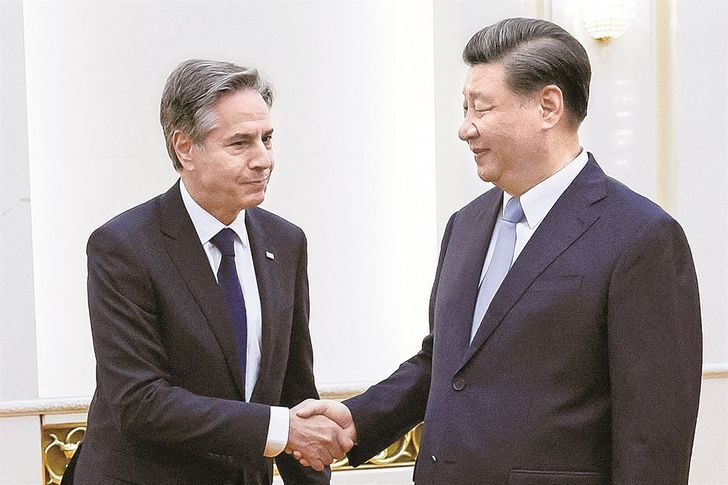
U.S. Secretary of State Antony Blinken, left, shakes hands with Chinese President Xi Jinping in the Great Hall of the People in Beijing, China, Monday. Reuters-Yonhap
Decoupling from China 'unrealistic'
During a press briefing, a senior official at Korea's presidential office said Korea agrees with the idea that decoupling from China is neither realistic nor appropriate both politically and diplomatically.
“Many countries, including Korea and France, are agreeing that decoupling is unrealistic and an inappropriate expression in terms of political and diplomatic perspectives,” the senior official said answering a question about how Seoul views U.S. Secretary of State Antony Blinken's recent trip to Beijing.
“In line with such a view, not only Korea but also France is sensing the necessity of supply chain diversification for the sake of each country's economic security.”
Blinken and Chinese President Xi Jinping met, Monday, and agreed to stabilize their intense rivalry, in order to prevent a major conflict. Blinken told reporters that the United States is “for de-risking and diversifying,” adding that there is “a profound difference” between de-risking and decoupling.
“We understand that Secretary Blinken's visit to China implies that (the U.S.) will compete with China, but will not sever its ties of conversation, maintaining political and diplomatic dialogue on matters including the Korean Peninsula, the Indo-Pacific and Ukraine,” the official said. “And the U.S. provided us with detailed explanations on the results of the Blinken-Xi meeting.”
Blinken's trip came as Korea ponders how to manage rising tensions with China, after Beijing put pressure on Seoul recently for echoing Washington's stance in matters that China finds sensitive. Concerns were raised that Korea could find itself in an awkward position stuck between the U.S. and China, while the two superpowers show signs of moving quickly to mend ties.
Against this backdrop, Blinken's explanation to Korea about his meeting with Xi is being interpreted as Washington assuring Seoul that there will be no abrupt change in the U.S. stance on China, which means that Seoul will not be left out in the cold.