INTERVIEW ASEAN secretary-general calls on N. Korea to return to dialogue

Kao Kim Hourn, secretary-general of the Association of Southeast Asian Nations (ASEAN), speaks during an interview with The Korea Times and its sister paper The Hankook Ilbo, at the Ministry of Foreign Affairs in Seoul, Friday. Korea Times photo by Lee Han-ho
South Korea, ASEAN expected to forge comprehensive strategic partnership in 2024
By Lee Hyo-jin
Escalating tensions on the Korean Peninsula due to Pyongyang's repeated missile provocations are a worrisome development, not only for Seoul, but also for countries in the neighboring Southeast Asian region, according to Kao Kim Hourn, the secretary-general of the Association of Southeast Asian Nations (ASEAN).
But at the same time, he saw that ASEAN, with its ability to function as a neutral facilitator in global conflicts, could play a role in denuclearization efforts on the Korea Peninsula.
“The DPRK has been test firing their missiles and improving their weapons. This is not just a concern to ROK, but a concern to the regional community and the global community,” Kao said during an exclusive interview with The Korea Times and its sister paper The Hankook Ilbo in Seoul, Friday.
ROK stands for South Korea's official name, the Republic of Korea, and DPRK is the acronym of the Democratic People's Republic of Korea, North Korea's official name.
“We have been engaging with the DPRK from very early on through the ASEAN Regional Forum (ARF). Every year, ASEAN always invited the foreign minister of the DPRK to attend the meeting,” he said, adding that the door is open for North Korea to take part in this year's event which is set for July 13 to 14 in Jakarta, Indonesia.
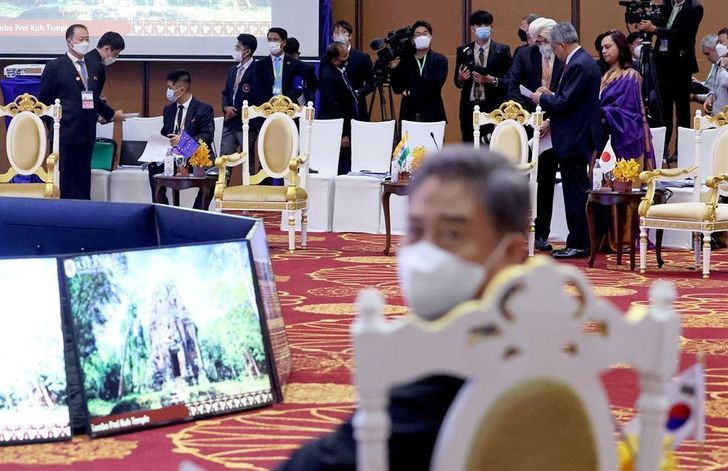
South Korean Foreign Minister Park Jin, front, and North Korean Ambassador to Indonesia An Kwang-il, seated third from left in the background, attend the 2022 ASEAN Regional Forum in Phnom Penh, Aug. 5, 2022. Yonhap
The ARF is one of the few multilateral platforms that the reclusive North Korean regime regularly engages with. Speculation is rising that Pyongyang may send its top diplomat Choe Son-hui to the upcoming forum.
“We would like to see the participation of the DPRK in the ARF, where they can engage in the diplomatic dialogue but also can have other bilateral engagements on the sidelines of the event,” Kao said.
The ASEAN leader, who was on a four-day visit to South Korea from Thursday to Sunday, was able to see the growing nuclear tensions on the peninsula.
On Thursday evening, Pyongyang fired two short-range ballistic missiles into the East Sea in protest of the South Korea-U.S. joint live-fire drills carried out earlier in the day. On the next day, the 18,000-ton USS Michigan submarine arrived in the southern port city of Busan for a joint drill with the South Korean Navy, in a major show of force against the North's growing nuclear threats.
“Our desire is to support the ROK because we believe that we want to see a peaceful, stable and secure Korean Peninsula, also a denuclearized Korean Peninsula.”
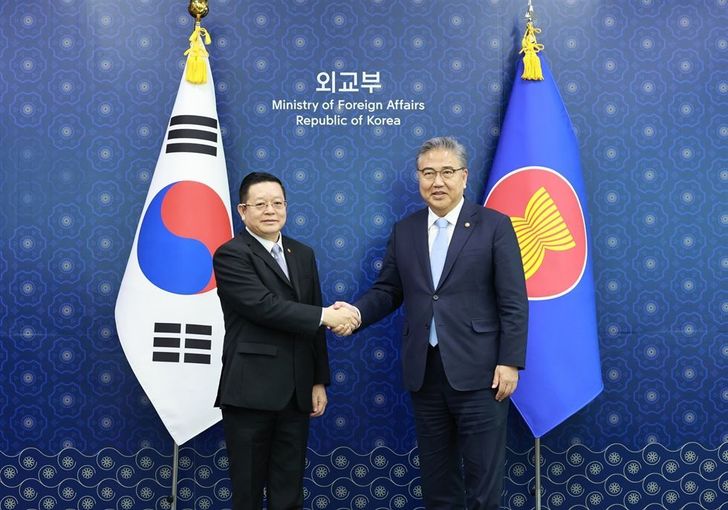
South Korea's Foreign Minister Park Jin, right, shakes hands with ASEAN Secretary-General Kao Kim Hourn during a meeting at the foreign ministry in Seoul, Friday. Yonhap
Bright future for South Korea-ASEAN cooperation
During a meeting with South Korea's Foreign Minister Park Jin earlier in the day, Park and Kao discussed forging a comprehensive strategic partnership in 2024, which marks the 35th anniversary of the establishment of South Korea-ASEAN dialogue.
Kao positively assessed the Korea-ASEAN Solidarity Initiative (KASI) unveiled by the Yoon Suk Yeol administration in November last year. The initiative aims to strengthen political and security cooperation, on top of the economic, social and people-to-people exchanges that the previous governments have focused on.
The secretary-general said KASI is important, because the initiative is in line with the goals and aspirations and commitment of the regional organization, particularly within the ASEAN Outlook on the Indo-Pacific (AOIP). The AOIP consists of four pillars ― maritime cooperation, connectivity, the Sustainable Development Goals, as well as economic and other possible areas of cooperation.
“We are working very hard now on the economic agenda, which is really one of the bright and more promising areas. And this is something that we hope to work with (South) Korea very closely on, given (South) Korea's very strong capacity in digital technology.”
The ASEAN leader also picked climate change as another front for possible cooperation with Seoul, mentioning South Korea's leading technology in electric vehicles (EV), food recycling systems and nuclear power plants.
Such a willingness from ASEAN may be a major opportunity for the Yoon administration in fulfilling its pledge to rebuild South Korea's nuclear power industry through active engagement in the global market.
“I believe that nuclear energy is one of the options that may be considered by our ASEAN member states. It would be good if (South) Korea can share its technology and know-how with us,” Kao said.
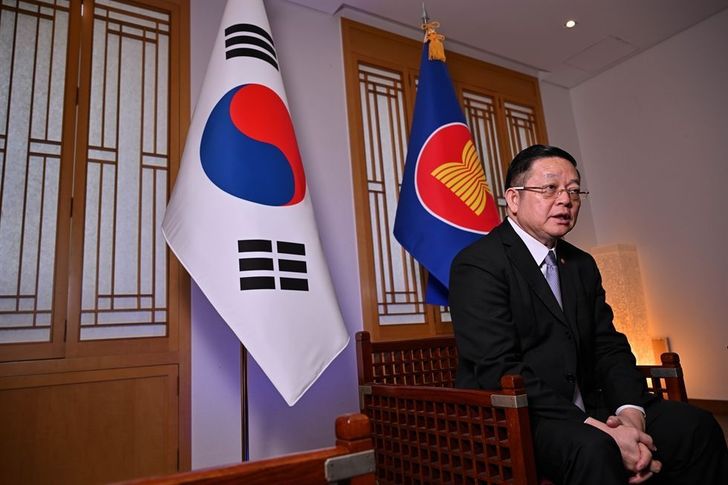
Kao Kim Hourn, secretary-general of the Association of Southeast Asian Nations (ASEAN) speaks during an interview with The Korea Times and its sister paper The Hankook Ilbo, at the Ministry of Foreign Affairs in Seoul, Friday. Korea Times photo by Lee Han-ho
Global challenges facing ASEAN
The ongoing civil strife in Myanmar remains one of the biggest challenges for ASEAN. Many international observers have been criticizing the regional bloc for making little progress in addressing the Myanmar issue, due mainly to its principles of non-interference in other countries' domestic affairs and consensus-based decision-making process.
But Kao viewed otherwise.
“In fact, we have made some progress,” he said, noting that several visits were made by ASEAN's special envoy to the strife-torn nation.
“Although people say 'it's too slow,' or 'there is no progress,' I think we should not expect to have a perfect result or a quick fix for the complex matter. Myanmar is a very complicated country dating back to the colonial period,” he explained, stressing that ASEAN remains deeply committed to the complete cessation of violence in Myanmar.
The ASEAN leader also took a cautious stance on the intensifying U.S.-China rivalry.
Founded during the Cold War, ASEAN has so far distanced itself from getting involved in major power competitions. But the ongoing strategic competition between Washington and Beijing is forcing Southeast Asian countries to make a binary choice.
“The role of ASEAN, of course, is not to take sides. They are all our friends and partners,” Kao said.
But he added, “We certainly would like to see the rising tensions and the increasing rivalry be reduced through the ASEAN mechanism, where they can meet together on the sidelines of our meetings, including the upcoming ministerial meetings in July, and the upcoming summit-level one in September.”