G7 condemns North Korea's nuclear ambitions

Ukrainian President Volodymyr Zelenskyy, center rear, joins G7 world leaders at a working session on the final day of the G7 Summit in Hiroshima, Japan, Sunday. From left to right are: Japan's Prime Minister Fumio Kishida, U.S. President Joe Biden, German Chancellor Olaf Scholz, Britain's Prime Minister Rishi Sunak, European Commission President Ursula von der Leyen, Zelenskyy, European Council President Charles Michel, Gianluigi Benedetti, Italian ambassador to Japan, Canada's Prime Minister Justin Trudeau and France's President Emmanuel Macron. AP-Yonhap
Fukushima wastewater discharge should meet IAEA safety standards, says G7 leaders
By Lee Hyo-jin
The leaders of seven of the world's most powerful countries condemned North Korea's nuclear ambitions and called on the reclusive regime to refrain from conducting further nuclear tests using ballistic missile technology.
“We strongly condemn North Korea's unprecedented number of unlawful ballistic missile launches, each of which violated multiple UN Security Council Resolutions,” read a joint statement announced by the Group of Seven (G7) leaders during their summit held in Hiroshima, Japan, Saturday.
“We demand that North Korea refrain from any other destabilizing or escalatory actions, including any further nuclear tests or launches that use ballistic missile technology, which undermine regional stability and pose a grave threat to international peace and security.”
The seven major states vowed swift, united and robust international measures against Pyongyang's “reckless actions,” which would include further significant measures by the UN Security Council.
The leaders also urged North Korea to accept repeated offers of dialogue from neighboring countries, including South Korea, Japan and the United States.
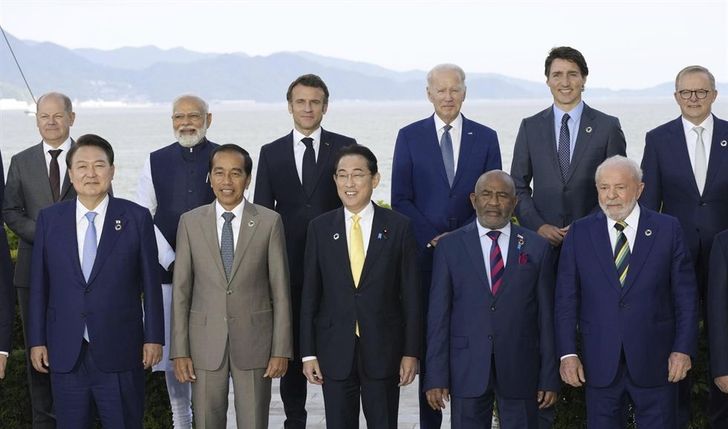
World leaders from G7 and invited countries, top row from left to right, German Chancellor Olaf Scholz, India's Prime Minister Narendra Modi, France's President Emmanuel Macron, U.S. President Joe Biden, Canada's Prime Minister Justin Trudeau, Australia's Prime Minister Anthony Albanese, bottom row from left to right, South Korea's Yoon Suk Yeol, Indonesia's President Joko Widodo, Japan's Prime Minister Fumio Kishida, Comoros President Azali Assoumani, and Brazil's President Luiz Inacio Lula de Silva, pose for a group photo of leaders of the G7 and invited countries during the G7 Leaders' Summit in Hiroshima, Japan, Saturday. AP-Yonhap
Such calls from G7 leaders come amid the Yoon Suk Yeol administration's efforts to enhance international cooperation to deal with the North's increasing belligerence. South Korea has been scaling up military cooperation with the U.S. and Japan to respond more effectively to Pyongyang's evolving nuclear threats.
In April, the three nations held a trilateral naval missile defense exercise in the East Sea after the North tested a new solid-fuel intercontinental ballistic missile (ICBM), in a major show of force of its nuclear weapons development. The allies are also eyeing the launch of a three-way sharing of real-time data on North Korea's missile launch.
During his speech at Sunday's G7 expanded session, Yoon called for attention to North Korea's serious violations of international laws.
“North Korea's nuclear and missile threats are in direct violation of U.N. Security Council resolutions and international law. The international community should no longer turn a blind eye to the human rights violations committed by the North Korean regime that are crimes against humanity,” he said.
The G7 communique also touched on Japan's planned release of wastewater from the damaged Fukushima Daiichi Nuclear Power Plant. Tokyo is taking steady steps to release into the Pacific Ocean starting as early as this summer the treated water that still contains tritium, a radioactive form of hydrogen. As a result, the release of the water has sparked backlash from neighboring countries, including South Korea, China and Pacific Rim nations.
“We welcome the steady progress of decommissioning work at Tokyo Electric Power Company Holdings' (TEPCO) Fukushima Daiichi Nuclear Power Station, and Japan's transparent efforts with the International Atomic Energy Agency (IAEA) based on scientific evidence,” the joint statement read.
The leaders voiced support for the IAEA's ongoing review to ensure that the discharge of the treated water will be conducted in line with the safety standards of the agency and international law.
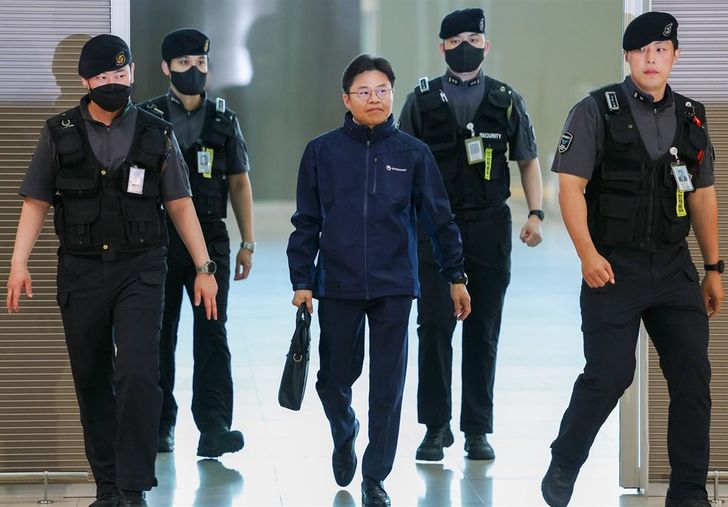
Yoo Guk-hee, head of the Nuclear Safety and Security Commission, center, arrives at Incheon International Airport, Sunday, to board a plane to Japan for a safety inspection of the Fukushima Daiichi Nuclear Power Plant. Yonhap
On Sunday, South Korea dispatched an inspection team to Fukushima for a separate safety review of the treated water. The 21-member expert panel, headed by Yoo Guk-hee, chairperson of the Nuclear Safety and Security Commission, embarked on a six-day visit to inspect the operation of Japan's advanced liquid processing system (ALPS).
Prior to departing for Japan, Yoo told reporters that the inspection team will “conduct a thorough inspection purely based on scientific data,” stressing that the experts have decades of experience in safety regulations involving radiation and nuclear power plant facilities.
But the inspection team is facing mixed reactions from the South Korean public, with many expressing skepticism that it is too late to change the course of Japan's planned water discharge.
Tokyo is apparently using the G7 summit as an opportunity to dispel international concerns about the Fukushima wastewater. During his bilateral summits with the Italian and German leaders, Japanese Prime Minister Fumio Kishida reiterated his request for cooperation in the early lifting of import measures on Japanese food products by the European Union (EU).