Interpreter shares insights into Yoon's US state visit
By Lee Hyo-jin
Behind every high-stakes summit are interpreters. Tasked with overcoming language barriers between leaders, interpreters often become the closest witnesses to historical moments of international relations.
Hong Sul-young, an adjunct professor of the Korea-English Department at the Graduate School of Interpretation and Translation (GSIT) at Hankuk University of Foreign Studies, accompanied President Yoon Suk Yeol last month on his state visit to Washington, D.C. The six-day visit from April 24 to 30 was the first trip of its kind by a Korean leader in 12 years.
Hong served as the simultaneous interpreter throughout the visit and took part in major events, including the summit between Yoon and U.S. President Joe Biden; the joint conference of the two leaders; the Korea-U.S. business roundtable; the state luncheon hosted by the U.S. Vice President Kamala Harris and Secretary of State Antony Blinken and Yoon's speech at Harvard University.
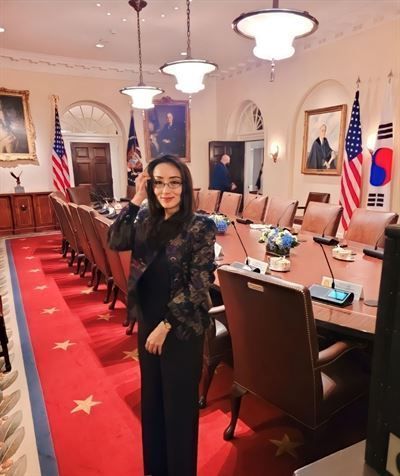
Interpreter Hong Sul-young poses at the White House in Washington, D.C., April 26 (local time), where the summit between President Yoon Suk Yeol and U.S. President Joe Biden took place. Courtesy of Hong Sul-young
Interpreting the meeting between Yoon and Biden was challenging even for the veteran interpreter who possesses 23 years of experience.
“One of the most challenging aspects of my role was the necessity to swiftly adapt to varying text formats for diverse events. Owing to the nature of presidential events, the manuscripts were often provided moments before the commencement of each event,” Hong told The Korea Times, Tuesday.
She added, “Countless sleepless nights were spent awaiting the president's speech manuscripts. The manuscripts undergo revisions up until the last minute, so it is difficult to foresee when they will be delivered to the interpreter.”
The task of an interpreter during a summit is not just about translating one language into another. The person has to have a deep understanding of the fundamental issues and remain laser-focused so as not to miss even the most subtle nuances in communication, Hong said.
As such, prior to the summit, she dedicated extensive time to study the main agendas of the meeting such as extended deterrence, the Inflation Reduction Act (IRA) and the CHIPS and Science Act.
The summit was divided into a small group meeting followed by an extended summit. Hong was tasked with interpreting the latter.
“As we anxiously awaited the leaders' entrance, tension filled the meeting room. The small group meeting ran much longer than anticipated, raising concerns that the presidents might bypass the extended summit meeting altogether and proceed directly to the Rose Garden press conference,” she said.
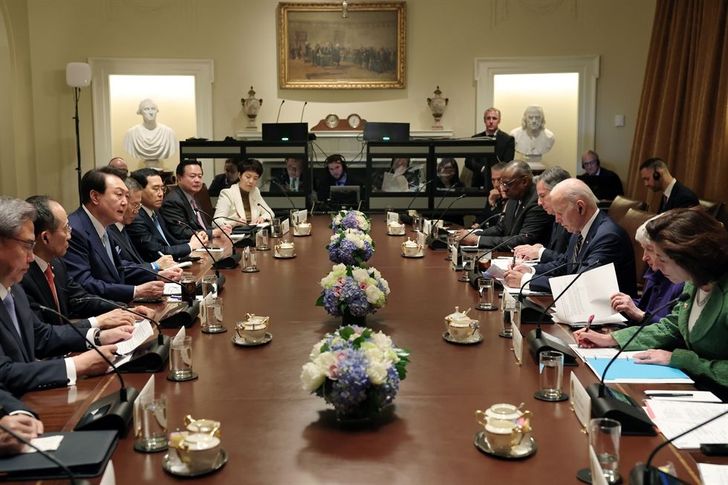
President Yoon Suk Yeol speaks during an extended summit with U.S. President Joe Biden at the White House in Washington, April 26 (local time). Korea Times photo by Seo Jae-hoon
Despite the unnerving moments, witnessing Yoon and Biden in the same room, hearing their language and witnessing the decision-making processes of heads of state was a truly fascinating experience for Hong.
Hong described Yoon's style of speaking as “unpretentious in his tone yet powerful in his messages,” calling him a “powerful communicator” with a manner balanced between sociability and authority.
Hong began her career as a staff interpreter at the U.S. Embassy in Seoul. Throughout her two decades career, she interpreted multiple high-profile conferences, such as the Korea-Ethiopia summit during former President Moon Jae-in's tenure, the Korea-Australia Summit when former President Lee Myung-bak was in office, as well as the Asia-Europe Summit (ASEM) during former President Roh Moo-hyun's tenure.
“Interpreting is similar to solving a mathematical equation using language or performing linguistic surgery. Many concepts, logic and expressions are interwoven to form a fabric of a message and it is the interpreter's responsibility to swiftly unravel these enigmatic elements in a matter of seconds,” she said.
“I feel like a shape-shifter or a chameleon sometimes, as I must seamlessly blend into a diverse range of content, situations and text formats as I interpret … As an interpreter, I do not perceive the language I speak to be my own, but as something that belongs to the audience.”