Korea to attend new round of negotiations for IPEF this week
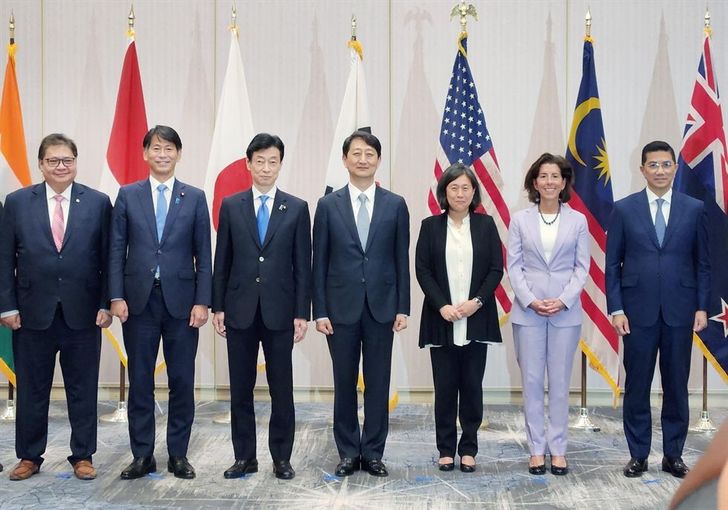
Trade Minister Ahn Duk-geun, center, and other representatives pose for a group photo at the Indo-Pacific Economic Framework talks in Los Angeles, Sept. 22, 2022, in this photo provided by the trade ministry. Yonhap
Korea will participate in the third round of official negotiations for the United States-led Indo-Pacific Economic Framework (IPEF) to be held in Singapore this week, the industry ministry said Monday.
During the upcoming session, set to take place from Monday through May 15, the member nations will work to make progress in setting details of its four key pillars ― trade, supply chain resilience, clean economy and fair economy, according to the Ministry of Trade, Industry and Energy.
Korea sent a delegation led by senior ministry official Roh Keon-ki and involving officials from the industry, finance, foreign and other related ministries for working-level and chief delegate meetings, it added.
"This negotiation will be crucial in terms of making concrete progress in the four sectors. We will do our best to set forth our stance proactively and seek cooperation with nations in a similar position with Korea," the ministry said in a release.
The IPEF was launched in May last year with a goal to promote resilience and fairness, and fuel sustainable economic growth and investment in the region, and the first rule-setting meeting was held in the Australian city of Brisbane in December.
The member nations had a special session in India in February before holding the second negotiating round in March in Bali.
The fourth round will take place in Korea's southern port city of Busan, the ministry said.
'The 14 IPEF partner nations, including Japan, Australia, India and Vietnam, represent 40 percent of global gross domestic product and 28 percent of global goods and services trade, according to government data.
As of 2021, trade volume between Korea and the remaining 13 IPEF member nations came to $498.4 billion, accounting for 39.6 percent of Seoul's total trade that year. (Yonhap)