Kishida urged to show reciprocity in forced labor compensation

Participants of a weekly Wednesday rally protesting Japan's wartime sexual slavery of Korean women hold placards criticizing the Yoon Suk Yeol government for its compensation plan for Korean forced labor victims in Jongno District, Seoul, March 8. Korea Times photo by Ha Sang-yoon
Japanese PM unlikely to address historical issues during summit with Yoon: experts
By Lee Hyo-jin
Japanese Prime Minister Fumio Kishida should show reciprocal steps in response to Seoul's efforts to compensate Korean victims of Japan's wartime forced labor, according to analysts, who pointed out that the Korean public will keenly watch his remarks on the issue in the upcoming summit with President Yoon Suk Yeol.
But at the same time, the experts were skeptical whether the Japanese leader would directly address Japan's wartime atrocities during the meeting as the two nations are expected to focus on bolstering bilateral ties in the fields of security and the economy.
The Yoon government has been stressing the importance of bolstering future-oriented cooperation with the neighboring country, especially in addressing shared security challenges posed by Pyongyang's evolving nuclear prowess, despite criticism from opposition lawmakers of ignoring the demands made by the Korean victims for a sincere apology from Tokyo.
Kishida will arrive in Seoul this Sunday for a summit with Yoon, which will be the fourth face-to-face meeting between the two leaders. The two-day visit by the Japanese prime minister comes less than two months after Yoon traveled to Tokyo for a summit.
For the last couple of months, the neighboring countries have been scrambling to normalize bilateral relations that were frozen for several years due to historical grievances stemming from Japan's 1910-45 colonial occupation of the Korean Peninsula.
Daniel Sneider, a lecturer in East Asian Studies at Stanford University, viewed that Korea played a major role in mending the frayed ties, and thus it is time for Japan to show some corresponding gestures.
“President Yoon made an important step toward dealing with the legacy of unresolved issues from the wartime and colonial past by proposing a unilateral solution to the problem of Korean forced labor,” Sneider told The Korea Times in an email interview.
He was referring to a plan unveiled by the Korean government in March to compensate Korean victims of Japan's wartime forced labor through a public foundation that will be funded primarily by Korean companies, instead of responsible Japanese firms.
While Tokyo welcomed the arrangement, victims and liberal civic groups here denounced the government for completely ignoring the victims' calls for a fresh apology and direct payment from Japan.
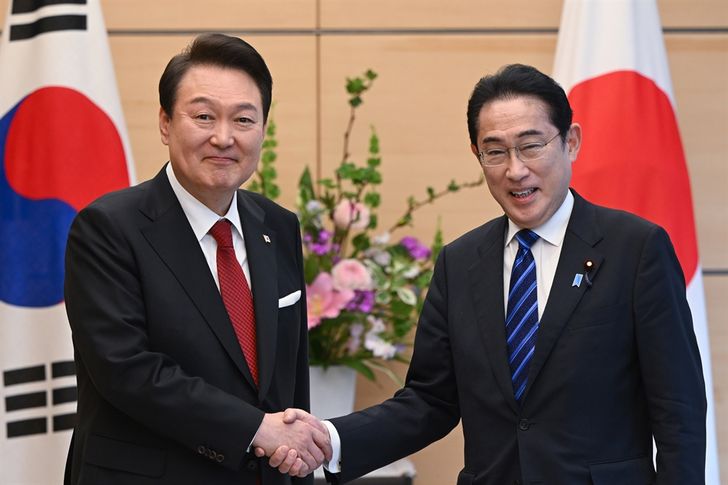
President Yoon Suk Yeol shakes hands with Japanese Prime Minister Fumio Kishida after a summit in Tokyo, March 16. Korea Times photo by Seo Jae-hun
Sneider viewed that the plan to offer compensation through a Korean fund does not fully address the need for justice and compensation.
“For that, Japan must also offer its own acknowledgement of responsibility for the injustices of the past, and Japanese companies need to both apologize and offer contributions to the fund, which recognizes their responsibility for the use of forced labor and compensation for unpaid labor,” Sneider said.
He added, “I would hope that Prime Minister Kishida would speak clearly, and in his own voice, on Japan's wartime and colonial crimes and encourage Japanese companies to step up.”
However, Sneider viewed it unlikely for Kishida to make such moves in the upcoming summit, saying, “Unfortunately, I don't see any sign at this moment that the prime minister is prepared to take those steps during his visit.”
In response to Seoul's compensation plan, the Kishida Cabinet said it will uphold the spirit of the 1998 joint declaration signed by then Korean President Kim Dae-jung and then Japanese Prime Minister Keizo Obuchi, without directly referring to the “heart-felt remorse and sincere apology” mentioned in the statement.
Naoko Aoki, an associate political scientist at the RAND Corporation, also viewed that Yoon took a major step in trying to resolve a thorny dispute between the two countries, which opened the path for the bilateral summit held in Tokyo in March.
“Prime Minister Kishida's visit is an opportunity to build on this momentum to strengthen relations further between the two countries on all fronts. This means that there needs to be a lot of sensitivity toward South Korean feelings about the steps that President Yoon took regarding the forced labor issue,” she said.
She commented that Kishida should be well aware of the domestic criticism that Yoon has faced regarding the forced labor issue, and thus the Japanese leader's words on the topic during his visit to Korea will be closely watched by many people.
But it remains to be seen whether the two leaders will bring up the sensitive issue during the meeting.
In an interview with the Washington Post in April, Yoon said that he cannot accept the idea that Japan should “kneel because of our history 100 years ago,” a comment widely interpreted as meaning that his administration will no longer seek a fresh apology from Tokyo about historical grievances.