Two Koreas take opposing sides in Ukraine war

North Korean leader Kim Jong-un, left, shakes hands with Russian President Vladimir Putin during a post-summit dinner at the Far Eastern Federal University in Vladivostok, Russia, in this April 25, 2019 photo released by the North's state-run Korean Central News Agency. Yonhap
Seoul joins US-led sanctions; Pyongyang needs Moscow's food supply
By Lee Hyo-jin
South Korea and North Korea have positioned themselves on opposite sides of the protracted war in Ukraine, with the South supporting Kyiv and the North siding with Moscow.
The calculated involvements of the two Koreas in the war taking place more than 6,500 kilometers away from the Korean Peninsula reflect their own geopolitical interests, according to analysts.
The Ukraine war seems to have served as an opportunity for North Korea to deepen its alignment with the Kremlin. Throughout last year, the two countries have drastically strengthened their bilateral ties that have had their ups and downs since the collapse of the Soviet Union.
South Korea has joined U.S.-led economic sanctions against Russia, as well as banning the exports of strategic items to the country. And it has been assisting Kyiv by providing various aid packages and non-lethal weapons.
As the conflict in Ukraine drags on with no end in sight, the two Koreas are expected to increase support for their respective sides.
North Korean leader Kim Jong-un's younger sister, Kim Yo-jong, recently slammed Ukraine for attempting to retain its status as a nuclear state.
“If the Zelenskyy authorities calculated that they can avoid the powerful fire of Russia only when they go under the U.S. nuclear umbrella, which had already been perforated, they are going to the wrong path, the last path,” she said in a statement via the North's state-run Korean Central News Agency (KCNA), Saturday.
Her remarks came two days after the U.S. government raised speculation that North Korea is seeking to covertly provide artillery shells to Russia in return for supplies of food and other commodities. Washington also suspects that Moscow obtained over two dozen types of weapons and munitions from Pyongyang last year, in exchange for raw materials and commercial aircraft.
Park Won-gon, a professor of North Korean studies at Ewha Woman's University, viewed that Pyongyang has much to gain from standing alongside Moscow, a path it has been pursing since Russia's invasion of Ukraine in February 2022.
“North Korea needs Russia on its side in order to continue avoiding international sanctions, as the regime plans to expand its nuclear capabilities and conduct a possible seventh nuclear test,” he said.
In May last year, Russia and China vetoed a U.S.-drafted United Nations Security Council resolution to strengthen sanctions on North Korea after it launched a series of missile provocations in violation of U.N. resolutions.
Park said Pyongyang seems to be increasingly counting on Russia rather than China as its backer, given that Beijing has been showing an ambiguous stance on the Kim regime's push for nuclear tests.
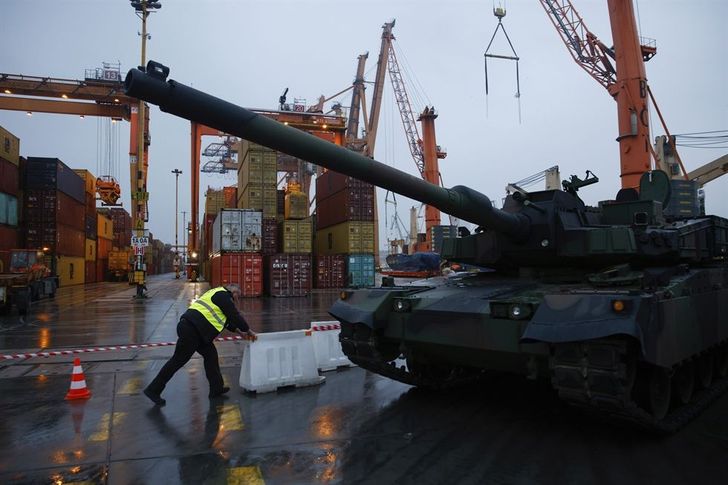
A harbor worker pushes a barrier next to the South Korean Black Panther K2 tank in the Polish naval port of Gdynia, in this Dec. 6, 2022 photo. AP-Yonhap
On the other hand, South Korea has been condemning Russia's invasion of Ukraine. Foreign Minister Park Jin said South Korea supports international efforts to seek justice for the atrocities perpetrated in Ukraine.
On March 31, Park delivered a video speech at a ceremony held to commemorate the first anniversary of Russia's withdrawal from the Ukrainian town of Bucha, where he expressed grave concerns over the deaths of civilians and the humanitarian crisis in Ukraine.
The South Korean government has been showing solidarity to Ukraine through various ways, including a $100 million (132 billion won) humanitarian aid program in 2022, with more to come in 2023. But Seoul has so far rejected calls from Ukraine for lethal weapons, to avoid spoiling amicable relations with Russia.
Nevertheless, South Korea has been indirectly supporting Ukraine's military. Last year, the defense ministry approved Poland's exports of Krab howitzers ― which included South Korean components ― to Ukraine. Also, it agreed to sell 100,000 rounds of artillery ammunition to the United States, knowing that they will be transferred to Ukraine.