Fukushima water, Sado mines next hurdles for Yoon to restore Korea-Japan ties

President Yoon Suk Yeol shakes hands with Japanese Prime Minister Fumio Kishida during their summit in New York, Sept. 21, 2022. Courtesy of presidential office
By Lee Hyo-jin
Following Korea's recent decision to compensate South Korean victims of Japan's wartime forced labor with its own money, Tokyo may be expecting Seoul to make more concessions in resolving other pending issues that are clouding bilateral relations, according to diplomatic observers, Wednesday.
Earlier this week, the Korean government announced a plan to compensate victims of wartime forced labor by Japanese firms by using a public foundation funded by Korean companies, without direct payment from Japan.
The government said the arrangement is aimed at strengthening future-oriented partnerships, but some experts see it as setting a “worrisome precedent” in Korea's future diplomacy with Japan.
“Japan has done virtually nothing to settle the dispute, while a large concession came from Korea's side, despite backlash from its public. And by doing so, the government has set a worrisome precedent that similar decisions could be made throughout the incumbent administration,” said Yang Ki-ho, a professor of Japanese studies at Sungkonghoe University.
Although the solution to the forced labor issue is a major step forward in mending years-long strained ties, the two countries still have an array of ongoing disputes to untangle.
Japan's planned release of radioactive wastewater from Fukushima Daiichi Nuclear Power Plant is one of the most urgent tasks Korea is trying to address. The Japanese government is seeking to discharge the contaminated water stored at the tsunami-hit nuclear power plant into the Pacific Ocean as early as this spring.
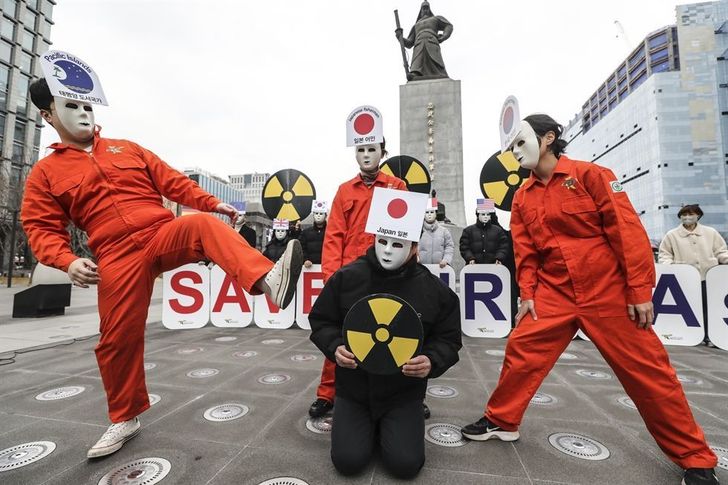
Environmental activists stage a rally at central Seoul's Gwanghwamun Square, Feb. 28, denouncing Tokyo's decision to release contaminated wastewater from the damaged Fukushima Daiichi Nuclear Power Plant into the Pacific Ocean. Newsis
Japan claims that the filtered water has been tested for concentration levels of radioactive nuclides. But Korea ― along with China and other Pacific Rim countries ― has been demanding Tokyo cancel the planned dumping of tons of liquid radioactive waste.
Korea's Second Vice Foreign Minister Lee Do-hoon met with International Atomic Energy Agency (IAEA) Director General Rafael Grossi in Austria, Tuesday (local time), asking the agency to continue its thorough safety review of the wastewater.
But Yang was skeptical of whether such efforts would lead to fruitful results. “In future discussions, the government will be extra cautious not to sour the relations again,” he said.
“As seen from the latest discussions about the forced labor issue, the presidential office has too much control over Korea's diplomatic decisions. This may undermine our foreign minister's role as a trustworthy partner to his counterpart.”
Another concern for Korea's foreign ministry is Japan's bid to add Sado mines ― a controversial site due to their wartime history ― to the UNESCO World Heritage list.
The gold mines on the island of Sado were used for manufacturing war-related materials during World War II. Historical documents show that nearly 2,000 Koreans were forced to work there for Imperial Japan during its 1910-45 colonial occupation of Korea.
After a failed attempt at registration last year, the Japanese government recently resubmitted its application letter to the World Heritage Committee.
According to Kyodo News, Tuesday, Japanese Minister of Education, Culture, Sports, Science and Technology Keiko Nagaoka said, “The forced labor issue and Sado mines are two separate issues,” reaffirming Japan's goal to enter the mines on the World Heritage list in 2024.
Regarding the issue, Lim Soo-suk, spokesperson for Korea's foreign ministry, said during a regular briefing that the ministry will “continue discussions with Japan and UNESCO until the organization makes its final decision in October this year.”
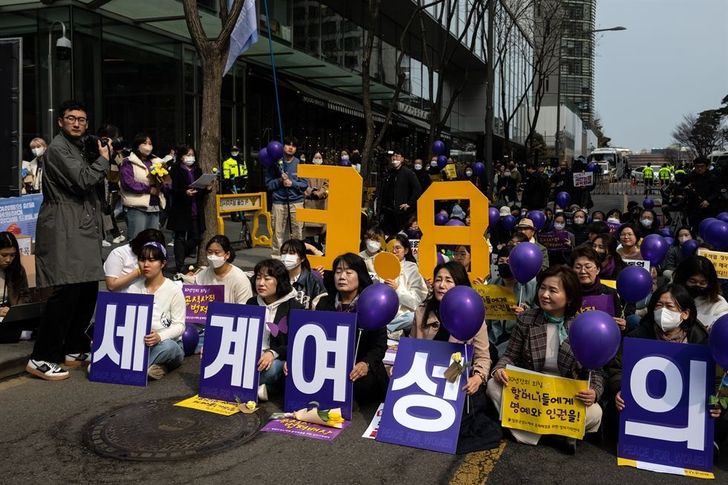
Civic activists stage a Wednesday rally calling for Japan's official apology and due compensation to victims of wartime sex slavery, near the Japanese Embassy in central Seoul, on International Women's Day which falls on March 8. The 1,586th weekly protest took place two days after the government's announcement of a plan to compensate victims of Japan's wartime forced labor by a public fund, without direct payment from responsible Japanese firms. Korea Times photo by Choi Won-suk
Meanwhile, Yang anticipated that the envisaged summit between President Yoon Suk Yeol and Japanese Prime Minister Fumio Kishida, which is likely to take place this month, will focus on restoring mutual partnerships, and that both leaders will refrain from discussing sensitive topics.
“Bold actions such as a 'sincere response' on forced labor issues from Kishida are highly unlikely given his sluggish approval ratings,” he said.
According to Kyodo News and other Japanese media outlets, Yoon could visit Japan on March 16 and 17 for his third bilateral meeting with Kishida.