Exploring Ghana's rich heritage and potential for tourism growth

Kakum National Park in Ghana / Courtesy of Embassy of Ghana in Korea
Ghana celebrates 66th anniversary of independence
By Charis Obetsebi-Lamptey Zwennes

Ambassador of Ghana to Korea Charis Obetsebi-Lamptey Zwennes / Courtesy of Embassy of Ghana in Korea
As Ghana celebrates its 66th year of independence, our government would like to pay tribute to its relations with Korea and highlight the potential benefits of further cooperation between the two countries.
Today, Ghana has become a beacon of democracy and stability in West Africa and its success has inspired similar movements for independence and self-rule in other countries across the continent. Our country has also?remained committed to the ideals of freedom and self-determination, which were at the core of the struggle for independence.
The Republics of Ghana and Korea established diplomatic relations in 1977 by signing a joint communique to that effect. Since then, the two countries have maintained strong, mutually respectful and cooperative relations,?characterized by political, economic and technical cooperation. In the 1990s, the two countries expanded their cooperation to include cultural and educational exchanges. Ghanaian students began to study in South Korea and South Korean cultural groups started to perform in Ghana.
Ghana attaches great importance to the friendly relations it enjoys with Korea. Therefore, on this 66th anniversary of our independence, we are seeking to enhance cooperation by expanding exchanges in all fields, particularly the tourism industry.
Tourism is presently the third largest contributor to Ghana's Gross Domestic Product (GDP), demonstrating the effectiveness of Ghana's marketing initiatives. The objective of the Akufo-Addo administration is to make tourism the largest contributor to Ghana's GDP?and a tourism hub in West Africa.
Ghana boasts of more UNESCO world heritage sites than any other country in Africa. Our country hosts 32 historic forts and castles and 13 traditional Ashanti buildings. Another six are currently nominated for approval to be added to the magnificent list of UNESCO world heritage sites.?These castles and forts are important reminders of Ghana's past in the transatlantic slave trade and the colonization of Africa.
The Elmina Castle, renowned for being the first notable European structure in tropical Africa, is located in Elmina, a city in the central region of Ghana. The Portuguese constructed the fortress in 1482, and it provided them with a trade monopoly and access to the region's wealth. The castle was constructed in a favorable location near the Atlantic Ocean and the Benya River, the low headland giving a natural harbor. The fortress of St. George also housed slaves. When taking a tour of this majestic castle, you must visit the dungeons to observe where the slaves were held.
Originally constructed by the Swedes in 1653 for the trading and fortification of timber and gold, Cape Coast Castle later served as the last hub or depot from which Ghanaian slaves were put onto ships and transported to the Americas and the Caribbean. Today, visitors can tour the castle and learn about its history, as well as pay their respects at the neighboring "Door of No Return," the final halt before the long voyage over the Atlantic.
The Asante Traditional Buildings are a collection of 13 buildings (Abirim, Asawase, Asenemaso, Bodwease, Ejisu Besease, Adarko Jachie, Edwenase, Kentinkrono, Patakro and Saaman) in 10 places that are authentic and distinctive. These exquisitely embellished structures from 100 to 200 years ago are likely the remaining original architectural remnants of the opulent Asante Empire. The Empire's golden age occurred in the 18th century. During the 19th-century British raids, sadly, the majority of shrines were destroyed. The Asante Traditional Buildings have been inscribed on the list of World Heritage Sites since 1980. These are not merely structures, but religious and spiritual history that has been preserved.
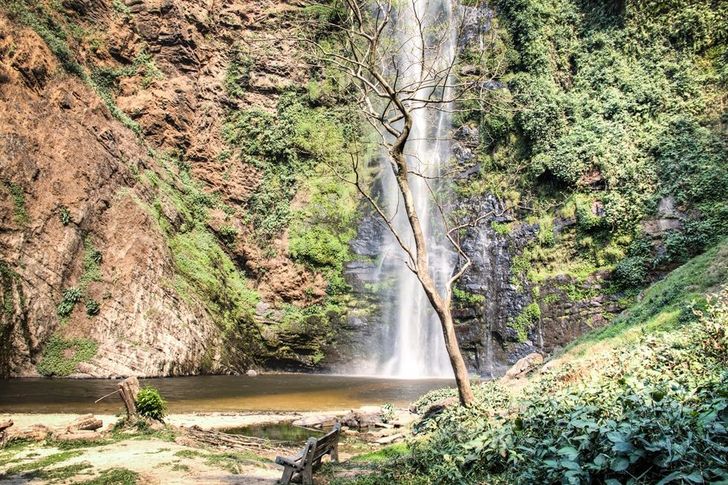
Wli waterfall in Ghana / gettyimagesbank
In?addition?to?Ghana's?castles?and?forts,?there?are?a?number?of?additional?UNESCO?World?Heritage?Sites?that?are?worthy?of?a?visit.?Being Ghana's largest wildlife refuge in the country's Savannah region, the Mole National park is an excellent escape from your mundane routine. Mole National Park, located about 200 km north of Salaga, is a natural heritage site that is home to several species of wildlife, including elephants, antelopes, and baboons.
The Nzulezu Stilt Settlement is located in the western region of Ghana. This watery community is remarkably self-sufficient, with its own chief, stores, schools, churches, and movie theater, among other amenities. The homes are constructed on stilts composed of coconut trees and other hardwoods. A trip to Nzulezu begins in the village of Beyin, where, following a safety briefing, life jackets are provided along with a guide who will accompany you on the 150-meter hike to the wooden boardwalk where you will board rafts to tour the settlement.
Kakum National Park is a 357-kilometer unspoiled rainforest national park. This conservation area is comprised of Kakum National Park and the adjoining Assin Attandaso Resource Reserve, which is one of the oldest national parks in the physical center of the world. Due to its proximity to Cape Coast and Elmina Castle, Kakum is a must-see for all tourists in Ghana's central region, the indisputable tourism hub of the country. It was founded in 1932 and is a must-see for all animal and environmental enthusiasts. There are approximately 500 butterfly species, seven primate species, including the Diana monkey, 253 bird species, including five hornbill species, the Frazer-eagle owl, and the African grey and Senegal parrots, plus over 100 species of mammals, reptiles, and amphibians, and forty kinds of larger animals.
Shai Hills Resource Reserve is located in the Greater Accra Region of Ghana and is home to a diverse range of wildlife, including baboons, antelopes, and several species of birds. The reserve also features several caves and rock formations that are of historical and cultural significance.
Wli Waterfalls is located in the Volta Region of Ghana, near the border with Togo. It is the highest waterfall in Ghana, with a drop of over 60 meters. Visitors can hike through the lush forest to reach the base of the falls, and swim in the natural pool.
As?these?are?only?a?few?of?the?culturally?rich?sites?and?experiences?that?await?tourists?on?Ghana's?coast,?it?is?clear?that?the?country's?coastline?is?brimming?with?opportunities?for?cultural?immersion.
I wish to reaffirm our government's commitment to promoting our country's tourist attractions to the government and people of Korea. I am confident that cooperation between our two countries has the potential to generate substantial economic, cultural, and environmental benefits for both countries.
Charis Obetsebi-Lamptey Zwennes is the ambassador of Ghana to Korea since July 2021.