US chip subsidies program to test President Yoon's diplomacy

President Yoon Suk Yeol, right, shakes hands with U.S. President Joe Biden during a visit to Samsung Electronics' semiconductor plant in Pyeongtaek, Gyeonggi Province, May 20, 2022. Courtesy of presidential office
New incentive plan could be 'poisoned chalice' for Korean chipmakers
By Nam Hyun-woo
The upcoming U.S. CHIPS for America Funding Opportunity program is becoming a new test for President Yoon Suk Yeol's diplomacy, as Washington's strings-attached incentive program is forcing Korean chipmakers, such as Samsung Electronics and SK hynix, to pick a side between the U.S. and China.
Given the chipmakers' influence on the Korean economy, the Korean government said related ministries are joining efforts with the companies to explore appropriate responses, but calls are growing to address this issue through summit-level diplomacy.
“Our companies, government and the local embassy there are all joining together to respond properly to the subsidies program,” an official at Korea's presidential office said. “Though the U.S. announced its incentive program, the U.S. government appears to be in the process of setting detailed guidelines, and we should see how the situation unfolds.”
The program, launched on Feb. 28, is aimed at providing $50 billion in subsidies to chipmakers investing in the U.S. It is an incentive program but comes with major strings attached, as recipients will be required to enter into agreements restricting their ability to expand semiconductor manufacturing capacities in China and other countries of concern for 10 years after winning the funding. Also, chipmakers winning subsidies are required to share excess profits.
This is interpreted as the U.S.' blatant demand that Korean chipmakers make political decisions on whether they will apply for the incentive program and decouple from China to join the U.S.-centric supply chain. If they chose not to, it may give a signal to Washington that the companies are not part of the chip alliance with the U.S. and are siding with China.
In this regard, the subsidies program can be considered a “poisoned chalice” for Samsung Electronics and SK hynix, which are heavily reliant on their Chinese facilities in manufacturing memory chips. Samsung Electronics produces approximately 40 percent of its total NAND flash at its plant in Xi'an, China, while SK hynix produces 50 percent of its total DRAM in Wuxi, also in China.
Given this reliance, Kim Sun-woo, a chip analyst at Meritz Securities, said, “Samsung Electronics and SK hynix may have to consider whether they will maintain the operation of Chinese plants and what could be their exit strategies.”
Despite the gloomy forecast, both Samsung and SK are cautious about making statements on the issue, reiterating they are “thoroughly reviewing the program.” Industry officials say this is because the companies are seeing this as a matter of diplomacy, which requires a state-level strategy.
The Yoon administration is taking a clear stance in terms of economic security, as Yoon agreed with U.S. President Joe Biden last May that the two countries will elevate their relations to “a global comprehensive strategic alliance” encompassing economic and technological cooperation.
However, this came under scrutiny as the U.S. implemented the Inflation Reduction Act (IRA), which provides tax credits to buyers of new electric vehicles assembled in North America and with batteries made using a certain amount of critical minerals produced in the region as well. This is anticipated to have negative effects on South Korean carmakers' electric vehicle sales in the U.S. unless the carmakers dramatically increase production there.
With the IRA remaining a concern for carmakers, the pressure coming from the CHIPS program is intensifying the necessity for Yoon to make diplomatic efforts to protect Korean industries.
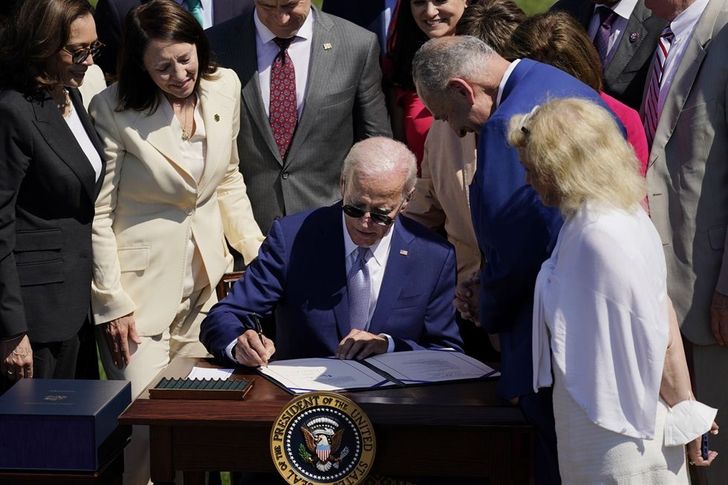
President Joe Biden signs the CHIPS and Science Act into law at the White House in Washington, Aug. 9, 2022. AP-Yonhap
A possible occasion for Yoon to make his diplomatic pitch is his anticipated visit to the U.S. this year.
Last month, Bloomberg reported that Yoon will likely make a state visit to the U.S. in late April. Korea's presidential office immediately denied the report, stating that it is not the official government stance, but given this year marks the 70th anniversary of the Korea-U.S. alliance, chances are high that Yoon may visit Washington in response to Biden's visit to Seoul last year.
Government officials say they are focusing on explaining to the U.S. that Korean chipmakers' Chinese plants are mostly for manufacturing memory chips, which have a slimmer chance of being weaponized and thus making them of lower strategic importance.
“South Korean companies are not investing in China with American subsidies, and the truth is that the incentives will not be enough to make up the companies' cost increases in the U.S.,” said Jang Young-jin, Korea's first vice minister of trade, industry and energy. “I have explained to the U.S. that Korean companies are making money from China to finance their investments in the U.S.”