UK, S. Korea collaborate to defend against cyberattacks

Participants of the Cyber Week forum, hosted by the British Embassy in South Korea, pose at Four Seasons Seoul, Thursday. Korea Times photo by Kwon Mee-yoo
By Kwon Mee-yoo
The British Embassy in Seoul hosted Cyber Week, which consisted of a series of events aimed at promoting collaboration between South Korea and the United Kingdom on cybersecurity, bringing together experts from the U.K. and South Korean governments as well as the private sector.
British ambassador to Seoul Colin Crooks noted how the pace and scale of global digital development have transformed our societies, businesses and organizations over the past decade during a two-day seminar on U.K. cybersecurity policy at Four Seasons Seoul, Wednesday.
"Rapid technological advancements and associated cost reductions have brought the world closer together than ever before, granting increased access to prosperity and innovation in free-market democratic systems. However, our societies are now threatened by malicious actors who seek to use technology to undermine democracy and disrupt free markets," Colins said.
"As a responsible nation, we must work closely with our friends and allies, and South Korea has a big role to play in this. The threats in cyberspace are the same for everyone. The British Embassy hopes to demonstrate the U.K.'s interest in building a partnership with South Korea across the full range of cybersecurity areas."
On Wednesday, experts discussed secure and resilient digital service providers and designing secure smart cities and connected places.
Gemma Ungoed-Thomas, director of State Threats and Cyber Security in the U.K. Cabinet Office, gave a keynote speech on the British vision for responsible cyber power, Thursday.
"It is probably quite natural that when I say cyber power, many of you immediately think of offensive cyber capabilities or military action. However, U.K.'s 2021 National Cyber Strategy acknowledges that in the modern digital age, the concept of cyber power is far more multifaceted than are offensive or defensive” Ungoed-Thomas said.
She explained how the U.K. and South Korea's presence and actions in cyberspace have become crucial to the success of foreign policy interests.
“The U.K. deliberately used the narrative 'responsible cyber power' in order to put focus on setting up the type of country we want to be both for our systems and on the world stage. It is a signal that U.K. has made a conscious decision to connect our cyber strengths and our engagement with cyberspace with our national mission to champion and uphold our political values.”
According to Ungoed-Thomas, the U.K.'s ultimate vision for cyberspace is a shared space for all.
"We want to ensure that the design development and broader human engagement in cyberspace supports global stability, prosperity, and human rights," she said.
"To live up to this vision and to realize the full range of benefits that cyberspace offers for our collective systems, we need to continue to enhance collaboration with our closest allies like South Korea."
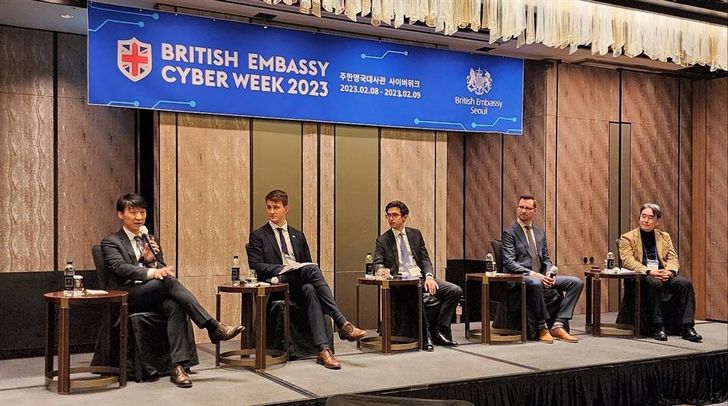
Panelists discuss ways to deter North Korean cyberattacks during the Cyber Week forum hosted by the British Embassy in South Korea at Four Seasons Seoul, Thursday. Courtesy of British Embassy in Korea
Deterring North Korean cyberattacks
The session that received the most attention was a panel discussion on countermeasures against cyberattacks from North Korea.
Chai Kyung-hoon, director of the North Korean Nuclear Policy Division at Korea's Ministry of Foreign Affairs, detailed how North Korea is financing its nuclear program through cyber operations.
"We have found that, especially in the past five years, North Korea has dramatically ramped up its cyber capability and has been utilizing that capability to create loopholes in the sanctions regime and also to generate huge amounts of revenue which most of which we believe are funneled towards nuclear missile development," Chai said.
"So we have come to the conclusion that if we do not clamp down on North Korea's illegal cyber activities, then we have a very little chance of deterring the further advancement of their nuclear missile program."
Chai stated that his division has two key responsibilities: to impede and minimize North Korea's cryptocurrency theft and to track down the vast amounts of money generated by North Korea's overseas IT workforce.
Joe Murphy, deputy head of State Threats & Cyber Deterrence at the U.K. Foreign, Commonwealth and Development Office, said the U.K. takes the cyber threats posed by North Korea very seriously, as they are tangible and persistent.
"It is incumbent upon us ― the U.K., ROK (South Korea) or other responsible sovereign powers ― to respond to that and to seek to deter this kind of behavior. In the U.K. view, we should do this across three main points. One is raising awareness on building transparency, the second is on imposing meaningful costs and the third is on building our collective resilience," Murphy said.
Referring to the cyberattacks against Britain's National Health Service's IT system, which were attributed to North Korea, Murphy noted that reckless and indiscriminate cyber activity can have tangible consequences, putting people's lives in danger and threatening the global community.
He added that collective response is crucial in deterring North Korea from continuing its offensive cyber operations.
"What we can do is, over time, change their decision calculus, so that the weighting of the costs and benefits of pursuing malicious cyber activity, raising the costs reducing the prospect of gaining benefits and ultimately getting to a place where they less and less see this kind of behavior as a as a beneficial path for them to pursue," Murphy said.
"While the DPRK continues to show what states should not do in cyberspace, we should exemplify a responsible state behavior, we should act within accordance of international law, we should operationalize and implement the U.N. norms with responsible state behavior and we should uphold and protect the international rules-based system."