75 years of progressive India
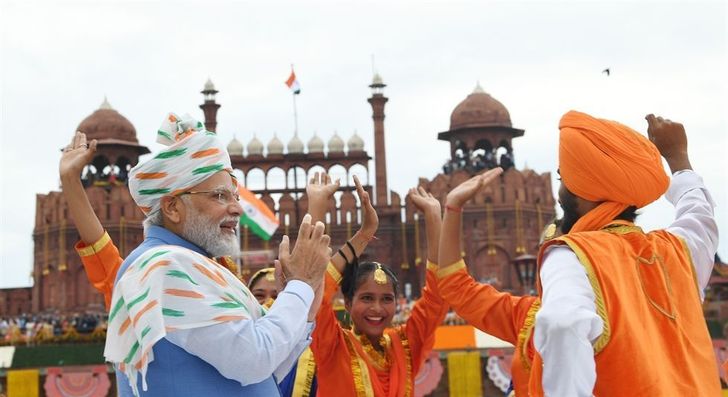
India's Prime Minister Narendra Modi, left, celebrates the country's 76th Independence Day at a ceremony at Red Fort in Delhi, India, Monday. Captured from Twitter
By Anil Trigunayat
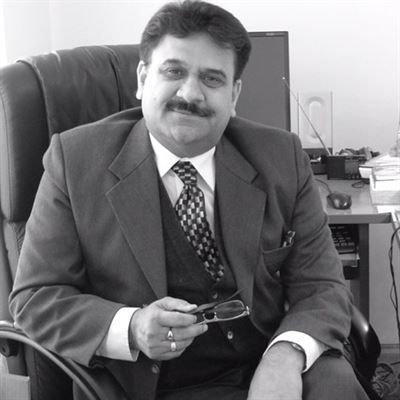
Anil Trigunayat
The seventy-five years of free and independent India are replete with stupendous achievements. These become more remarkable because the country had to make a “tryst with destiny,” bringing out an exploited one-sixth of humanity from the vagaries of the colonial yoke. Hence, the major challenges included socio-economic development and nation-building through education and industrial development, the eradication of poverty, food self-sufficiency in a drought-hit era, with a nation left divided by colonial masters who were forced to release their colonial shackles by the Gandhian non-violent movement.
India's situation was even more difficult as the world was divided into Cold War adversaries and bloc politics, which India could not have subscribed to. Hence, India not only stood and helped in the emancipation of a large number of colonized countries, but also created a third way with a more equitable force in the form of the NAM (Non-Aligned Movement) to serve national interests and the causes of peace and development, especially for the developing and underdeveloped world. It became a champion for the rights of oppressed people at international fora while discharging its obligations as a responsible international actor and a voice of reason.
India, before the advent of the colonial powers, contributed to over a quarter of the global GDP. This figure went down to less than 4 percent by the time colonizers left, with India's industry decimated and its administrative system geared to serve the interests of the colonial masters.
In the last seven decades, India has engineered green, yellow and white revolutions with the continuous upgrading of technology in agricultural and food processing fields, not only to meet the demand of its burgeoning population, but also because the nation has emerged as a net exporter and helper to the world. India has also emerged as credible nuclear and space power for the global good.
While speaking at the inauguration of curtain raiser activities of the Azadi Ka Amrit Mahotsav series of events celebrating the 75th anniversary of India's independence, Prime Minister Narendra Modi reiterated and reaffirmed that “We are proud of our Constitution. We are proud of our democratic traditions. The mother of democracy, India is still moving forward by strengthening democracy. India, rich in knowledge and science, is leaving its mark from Mars to the Moon. Today, India's startup ecosystem has become a center of attraction in the world. Today, India is moving out of the darkness of scarcity to meet the aspirations of more than 130 crore (1.3 billion) people.”
India has the largest young aspirational population and the fastest-growing market economy, which is ready to cater to the needs of the billion-plus people who take pride in the Indian story.
As a result of umpteen initiatives by the present government, hundreds of archaic laws have been dispensed with. India's global ranking for DBI (Doing Business with India) has moved up significantly, even as more needs to be done. India has become a favorite investment destination garnering the highest annual FDI inflow of $83.57 billion in 2021-2022, despite the pandemic. Computer software and hardware became the top recipient sector of FDI equity inflow with a share of around 25 percent, which indicates that India figures prominently for investors, as the AI-driven Fourth Industrial Revolution moves into a higher orbit.
India also boasts fast growth in billionaire unicorn startups globally. Moreover, the FDI equity inflows in manufacturing rose by 76 percent in 2021-2022, well supported by the Indian policy framework, the Make in India initiative and the PLI (Performance Linked Initiative) schemes. This is a remarkable achievement and a testament to Indian economic and political resilience.
Likewise, for the first time, Indian exports of goods and services reached over $600 billion in 2021-2022 despite global problems and supply constraints due to the pandemic and the ongoing European war. India has always been a trading nation and is working hard to reclaim that status once again.
India is also focusing on self-reliance with a global footprint ― Modi's “Atmanirbhar Bharat,” or “Self-reliant India,” concept ― especially in the manufacturing sector, and being an integral part of alternate value and supply chains, which are resilient and reliable for national interests and the global good. In this context, India's participation in the I2U2 Group, the Quad, the Indo-Pacific Economic Framework (IPEF) and other regional and sub-regional connectivity-oriented frameworks acquires renewed salience and focus.
Likewise, vigorous moves expeditiously to implement the INSTC (International North-South Transport Corridor), strategic connectivity projects ― such as from Chabahar in Iran to Afghanistan to Central Asia and Europe, or northeastern India to ASEAN corridors ― aim at providing crucial trade and economic linkages for India's global supply chains.
As India wishes to lead the AI-driven Fourth Industrial Revolution, its “Innovate for Digital India” and “Startup India, Stand up India” campaigns have become the hallmarks of a unique digital footprint. Some initiatives like access to the internet, banking at one's doorstep and direct payments into accounts to nearly a billion Indians are game changers and are giving a leadership position to India in the comity of nations. Recently while speaking at the inauguration of the first bullion exchange, Prime Minister Modi claimed that India already accounts for 40 percent of global digital payments.
India's foreign policy has become more robust and confident with impeccable credentials, as the country pursues a value-based foreign policy clearly driven by strategic autonomy to sub-serve its own national interests, which are aligned with global welfare, and has emerged as a voice of reason on the global stage. India at the U.N. Security Council no longer pleads for a place on the horseshoe table, but claims it on the basis of its credentials.
Meanwhile, India continues to play a global leadership role as a voice of the developing and underdeveloped countries, be it in the proposal to waive intellectual property rights for vaccines, at the WTO negotiations on fishing and agriculture, or in the reforms of multilateral institutions.
India is also at the forefront of the fight against climate change. The International Solar Alliance (ISA), Coalition of Disaster Resilient Infrastructure (CDRI) and One Planet One Health are initiatives that India has launched with and for the global community, as it has emerged as a first responder in crises from natural disasters to the pandemic.
With a clear focus on multilateralism and the primacy of the U.N. Charter, India navigates its foreign and security policy with dignity and confidence as the country engages with diverse partners across various groupings like the Quad, BRICS, SCO, G20 and Indo-Pacific Economic Framework (IPEF), where India becomes a pivot. Her “Neighborhood First,” “Act East” and “Link West” and “Africa for Africans” policies provide her with an effective fulcrum for mutually beneficial partnerships.
India's capacity-building assistance under the ITEC (Indian Technical and Economic Cooperation) to over 160 countries and supply of essential medicines, medical supplies and deputing professionals and paramedics during the pandemic have given it unparalleled heft as a responsible global-centric power always rising to the occasion.
India has emerged as a first responder during crises with the “Share and Care” attitude, immensely adding to its soft power, which has translated into unprecedented support for India at international fora, including with the declaration of June 21 as International Yoga Day.
As a new global order emerges out of the current churn and transition, India is all set to take up a benign leadership role during the “Amrit Kaal” ― the next 25 years of independent India ― with a strong polity, stronger economy and efficient foreign policy that are robust, resilient and result-oriented and with the global good at its core.
Anil Trigunayat is the former Indian ambassador to Jordan, Libya and Malta.