Moving past old grudges: Yoon faces tall task of restoring relations with Japan

President Yoon Suk-yeol and first lady Kim Keon-hee leave a theater in eastern Seoul, Sunday, after watching "Broker," a film written and directed by Japanese director Hirokazu Kore-eda. Yonhap
President praises Japanese film director in another sign of rapprochement
By Jung Min-ho
President Yoon Suk-yeol and first lady Kim Keon-hee made headlines on Sunday for going to the theater for the first time since taking office a month ago, to watch the Korean film “Broker.”
What drew less attention was the person who made it. Japanese director Hirokazu Kore-eda explores what makes a family, through teamwork with Korean actors including Song Kang-ho, Gang Dong-won and Lee Ji-eun, better known as singer IU.
In a message to the director and cast, Yoon congratulated them for winning the Best Actor Award and the Ecumenical Jury Award for Best Film at the 2022 Cannes Film Festival. “I give my respect for the hard work director Hirokazu Kore-eda, the cast and crew put into the film,” he said.
It remains uncertain whether Yoon's praise of the Japanese filmmaker was intended to be interpreted politically as a sign of his openness in trying to solve touchy issues with Japan and thereby improve bilateral ties.
The move appears to be the latest sign of rapprochement between Korea and Japan from the president, who has criticized his predecessor, Moon Jae-in, for undermining the countries' relations “to the worst point” throughout his term.
With Pyongyang growing more aggressive in recent months, top-level diplomats and military officials from Seoul, Washington and Tokyo have stepped up their security cooperation.
During their talks in Singapore on Saturday, Defense Minister Lee Jong-sup and his U.S. and Japanese counterparts ― Lloyd Austin and Nobuo Kishi ― agreed to hold regular tripartite military drills, including missile warning exercises. The meeting came just days after trilateral vice foreign ministerial talks were held in Seoul on the same agenda.
Yet, minister-level talks between the Asian neighbors have not been held during that period, which shows that diplomatic tensions and challenges still remain.
“There have been signs that Yoon is willing to improve relations with Japan,” Jo Yang-hyeon, a professor at the Korean National Diplomatic Academy, told The Korea Times. “But how he will do it remains unclear. Given the complicated domestic politics surrounding Korea-Japan relations in both countries, it will be challenging.”
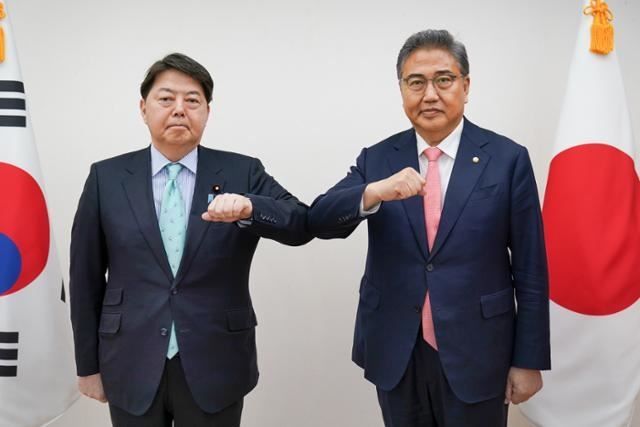
In this May 9 file photo, Foreign Minister nominee Park Jin, right, and Japanese Foreign Minister Yoshimasa Hayashi bump elbows during their meeting in Seoul. Courtesy of Ministry of Foreign Affairs
Buffeted by a number of old and fresh issues, including compensation for victims of forced labor and wartime sex slavery during Japan's colonial era as well as consumer boycotts of Japanese products in Korea, their relations turned sour during the previous administration.
Resentment toward Japan had long been shared by both the right and the left in Korea; it was conservative former President Lee Myung-bak who visited ― as the first sitting leader to do so ― Dokdo, a group of islets also claimed by Japan, and his conservative successor, Park Geun-hye, clashed initially with former Japanese Prime Minister Abe Shinzo over the sex slavery issue. But after liberal politicians openly led massive anti-Japan campaigns during Moon's term, diplomacy with Japan became polarized and even more difficult to resolve.
Yoon has said that he will take lessons from liberal former President Kim Dae-jung, who successfully improved relations with Japan through his forward-looking partnership with Japanese Prime Minister Keizo Obuchi.
Experts say any hasty moves could become a target of political attacks, urging Yoon to sincerely listen to the victims of Japan's past wrongdoings as a first step.
“The Yoon administration should listen to them with an international perspective. The sex slavery issue, for example, is not just a diplomatic problem between Korea and Japan but also an international one. The government should tread very carefully as it handles universal human rights issues. Many countries are paying attention to them,” said Doh See-hwan, a senior research fellow at the Northeast Asian History Foundation.
According to a recent survey conducted by Mainichi Shimbun, a Japanese daily, 55 percent of respondents said they expected improved relations with Korea. In a March poll by Kyodo News, a Japanese news agency, 72.2 percent said they believed Korea-Japan relations would not change.