Photography, embroidery breathe new life into traditional Greek costumes

From left, embroidery artist Anatoli Georgiev, Greek Ambassador to Korea Ekaterini Loupas and photographer Vangelis Kyris pose in front of "Costume of Dimitrios Mavromichalis, 19th century" at the "Raiment of the Soul" exhibition at the KF Gallery in central Seoul, March 29. Korea Times photo by Choi Won-suk
By Kwon Mee-yoo
Greece is well-known in Korea for its ancient civilization which gave birth to the Olympic Games and classical Greek philosophers such as Socrates and Aristotle. However, the country also has a vibrant modern history, including the 1821 Greek Revolution, also known as the Greek War of Independence, which helped shape the modern political landscape of Europe.
A photo exhibition at the KF Gallery in central Seoul, held under the auspices of the Embassy of Greece in Korea, brings a piece of Greek modern history, interpreted through the lens of Greek photographer Vangelis Kyris and the needle of Bulgarian embroidery artist Anatoli Georgiev.
The exhibit weaves Greek modern history exquisitely with a contemporary perspective, featuring a series of portraits by Kyris, taking inspiration from the costume collection of the National Historical Museum of Athens. The photos are printed on cotton canvases and then adorned by Georgiev's embroidery of gold and metal cords and sequins.
Greek Ambassador to Korea Ekaterini Loupas began by explaining the origins of Greece's Independence Day on March 25, which commemorates the start of Greece's war of independence against the Ottoman Empire.
"In 1453, the Ottomans occupied Constantinople (Istanbul), ending the Byzantine Empire. After 400 years of occupation, the Greeks started the independence war in 1821. We celebrated 200 years from that war last year. In the frame for this celebration, I had an opportunity to see an exhibition and thought that could be very nice for Korea," Ambassador Loupas said, March 24, explaining how she brought the exhibition here.
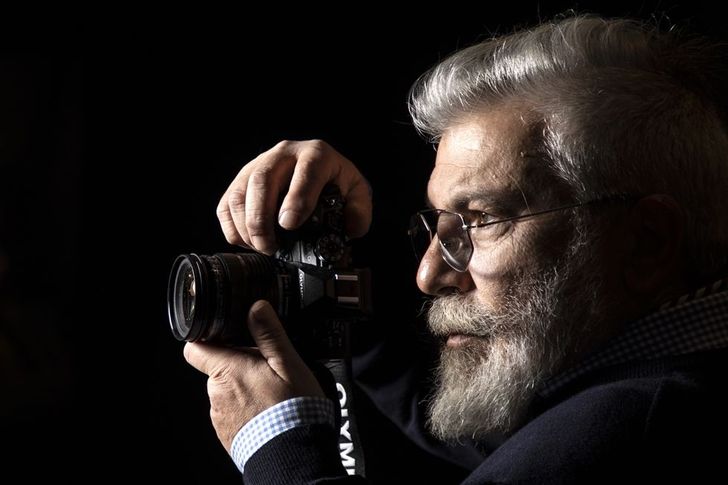
Greek photographer Vangelis Kyris poses with his camera at the "Raiment of the Soul" exhibition at the KF Gallery in central Seoul, March 29. Kyris reinterprets traditional Greek garments from the Greek Independent War era from the collection of the National Historical Museum of Athens. Korea Times photo by Choi Won-suk
As the National Historical Museum of Athens had shut down due to the COVID-19 pandemic, it commissioned Kyris to reinterpret traditional costumes, and he pulled off them off with a modern twist.
Kyris photographed models wearing garments from the museum's collection, mostly created in the 18th and 19th centuries, including those worn by prominent figures of the Greek Revolution such as Otto, the first modern king of Greece, and other generals and political leaders.
Kyris, dubbed a “fashion world rebel refusing to compromise his personal vision for the sake of commerciality,” makes the moment important again by feeling it and capturing something from it.
"When he captures the image, somehow he captures also the psychology of the person... So you can see this (figure) has hope, has belief, but you also can see that it has all the bad moments of the past. This is the talent of Vangelis," said Haik Kourdoglanian of the Kourd Gallery in Athens, which manages the artistic duo.
"Costume of King Otto" emphasizes the young king's ambition to become the first king of Greece at the age of 17 in a grand red costume with delicate gold embroidery.
Another highlight is the "Costume of Kyra Frosyni" from 18th-century Ioannina city. Wearing the oldest surviving such dress in Europe, the model's gaze captures the strength of Greeks under the Ottoman rule after the fall of Byzantium.
The costume style is closely related to the turbulent history of modern Greece and its geography of having thousands of islands. One example is "Costume from Zante Island, 18th century." Zante Island was not under Ottoman rule during the time and the costume is more in Victorian style, closer to Europe.
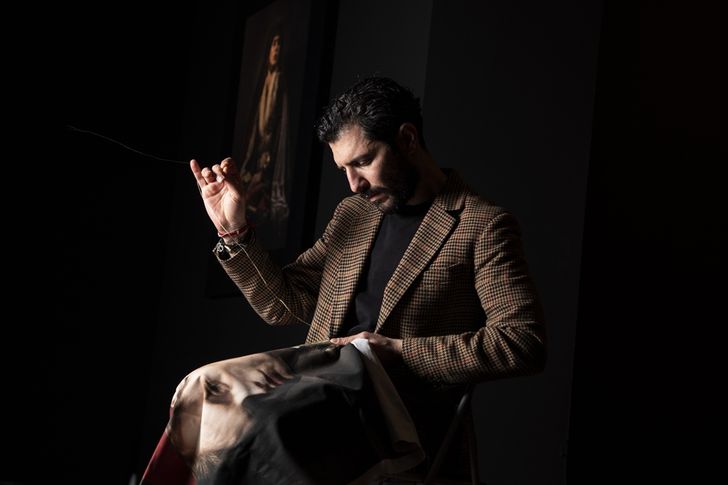
Bulgarian embroidery artist Anatoli Georgiev embroiders a photo by Vangelis Kyris printed on a cotton canvas at the "Raiment of the Soul" exhibition at the KF Gallery in central Seoul, March 29. Georgiev breathes new life into the traditional costumes by adding embroidery on the photo inspired by the original garment. Korea Times photo by Choi Won-suk
"Costume from Roumlouki, Macedonia," is from the region in northern Greece that is the home of the ancient king, Alexander the Great.
"During the years of Alexander the Great, he was away with all the army ― all the men ― and the women kept the villages safe. He gave the woman the helmet and that's why in this outfit, you see head garments look like helmets, which is very interesting," photographer Kyris said.
Georgiev's embroidery starts with highlights where the light hits the embroidered costumes. He uses different types of techniques from various eras and countries, among which he chooses the best to suit the costumes.
"He is like a priest in a way. Whatever he does, he does it very accurately because it's very difficult to play with this needle," Kourdoglanian explained.
The exhibit also comes as a belated yet elegant celebration of the 60th anniversary of diplomatic relations between Greece and Korea in 2021.
"It offers to the Korean public an opportunity to admire the originality and the craftsmanship of the traditional Greek costumes and travel back to an important time that shaped the modern Greek state... It is a good reminder of how our duty to preserve, to study, to reflect on and be inspired by our heritage can lead to magnificent new works of art,” the ambassador said.
The exhibit runs at the KF Gallery through June 3.