Three Baltic States present similarities, differences in new exhibition

From left, Latvian ambassador to Korea Aris Vigants, National Library of Korea chief executive Suh Hye-ran, Estonian ambassador to Korea Sten Schwede and Lithuanian charge d'affaires Vilijus Samuila take part in the opening ceremony of "The Baltic Way" exhibition at the National Library of Korea in southern Seoul, March 14. Courtesy of National Library of Korea
By Kwon Mee-yoo
The geographic term, “the Baltic states,” refers to three European countries, Estonia, Latvia and Lithuania, which are all located on the eastern shores of the Baltic Sea. Sharing a similar history ― regaining independence after the collapse of the Soviet Union, joining the United Nations and later the European Union ― the three countries have been building diplomatic relations with Korea since 1991.
Though less familiar to Koreans, the ties between Korea and the Baltic states have been flourishing more recently as Estonia opened its embassy in Korea in late 2020 and Lithuania in 2021, highlighting for each the growing significance of relations with Korea. Latvia was the first to open its embassy here back in 2015.
The three embassies of the Baltic states have joined hands with the National Library of Korea (NLK) to give a glimpse into their scenic beauty and rich culture, as well as state-of-the-art innovation and technology, through the exhibition, "The Baltic Way.”
Suh Hye-ran, chief executive of the NLK, noted the beautiful natural environment and abundant cultural resources of the three Baltic countries, where visitors can experience towns and streets dating back to the middle ages as well as of modern Europe.
"Although the Baltic countries are far from Korea, we have a lot in common. Historically we have in common that we were once occupied by stronger nations before, but we then became free, which makes us close friends," Suh said during the exhibition's opening ceremony, March 14.
"This exhibition is part of various cultural exchanges celebrating the 31st anniversary of the establishment of diplomatic relations. I hope, through this opportunity, that we can expand our understanding about our culture and literature and that this leads to more prosperous cooperation in the future."
Though they share similar historical experiences, Estonia, Latvia and Lithuania have their own distinctive cultures, heritage and landmarks and the exhibit offers a series of photos to sample the characteristics of each country.
Lithuania is in the south of the Baltic region and is a country with a diverse landscape, from its eco-friendly capital, Vilnius, to the UNESCO World Heritage Curonian Spit.
"We are very proud that we have possibility to present what we have reached throughout 30 years of independence as well as how we are similar and how we are different. The similarities and differences just make us even more beautiful," Lithuania's charge d'affaires in Korea, Vilijus Samuila, said.
Latvia is the middle country of the three, known for preserving its pristine natural environment as well as for possessing some impressive examples of Art Nouveau architecture in its capital, Riga.
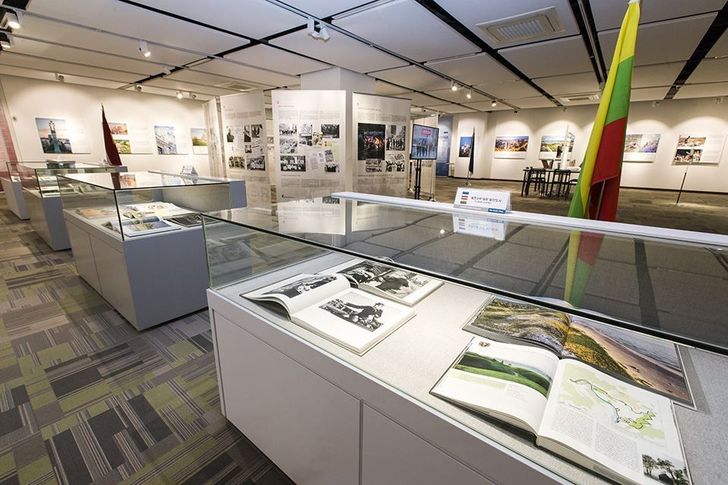
Installation view of the exhibition, “The Baltic Way,” at the National Library of Korea / Courtesy of the National Library of Korea
Latvian ambassador to Korea Aris Vigants emphasized that this exhibition is the first event organized jointly by the three Baltic embassies in Korea.
"Despite the geographical distance between our nations, Korean people can relate to the historical past of the Baltic nations, sharing the history of the loss of nationhood and the struggle for regaining our rightful independence. It's a pleasant coincidence that we opened this exhibition this month as Koreans commemorated the independence moment just two weeks ago on March 1," Vigants said.
The exhibit also showcases the role of one of the most influential Baltic grassroots organizations, the Baltic Appeal to the United Nations (BATUN).
"Baltic communities in exile ― after they have fled from the terror of the World War II ―established the organization to remind the world about the three Baltic countries being still occupied by Soviet Russia at the time. Diverse photos and documents related to the countries trace their struggle for human rights and the Baltic states' hope for freedom. BATUN's efforts made a significant contribution to the Baltic states in the process of regaining their independence and joining the United Nations in 1991," Vigants explained.
Estonia is the northernmost of the three Baltic countries, with one of the most advanced e-governments in the world, providing 99 percent of government services online.
Sten Schwede, Estonia's first ambassador to Korea, echoed the significance of the BATUN's story of the three nations pursuing freedom and democracy, which is still relevant today and the three countries' innovative present.
"We want to tell the story of three modern and prosperous countries. We have photos and videos that will show you how the countries are doing three decades on after regaining their respective independence. We are doing well. And we want Koreans to visit our countries and experience it for themselves," Schwede said.
Literary highlights of the exhibit include Korean myths and folktales, as well as Kim Young-ha's short story collections translated into Lithuanian from the NLK's collection, translated by Seo Jin-seok of the Korea-Baltic Association.
The exhibit also showcases Estonian, Latvian and Lithuanian literature translated into Korean, such as Estonian writer Oskar Luts's "Kevade" (Spring).
The exhibition runs until April 10 at the National Library of Korea.