Latvian ambassador to Korea reflects on 1st year of appointment and anticipates stronger ties

Latvian ambassador to Korea Aris Vigants speaks during an interview with The Korea Times at the country's embassy in Yongsan District, Seoul, Wednesday. Korea Times photo by Kwon Mee-yoo
By Kwon Mee-yoo
Aris Vigants, the second resident ambassador of Latvia to Korea, was appointed earlier this year as the two countries celebrate the 30th anniversary of diplomatic relations and their membership in the United Nations.
The ambassador had a very busy year, organizing events to introduce Latvia to Korea despite restrictions due to the COVID-19 pandemic.
"We have tried to do our best to show the Korean public what Latvia is about. There's always chances to speak with people, and as feedback we receive, they are getting more interested in our country. We try to increase our visibility in Korea as much as we can," the ambassador said in an interview with The Korea Times at the embassy, Wednesday.
In May, the embassy hosted the "World We Meet Again, Latvia" exhibition at Gimpo Arts Center, introducing Latvian culture, centering on architecture, traditional folk costumes and children's book illustrations.
"On the occasion of the Korean national holiday Children's Day, I was happy that my son has joined me in reading children's book in the Latvian language, while the same book was also read by a kid in the Korean language. We have quite a collection of Latvian children's books that have been translated into Korean and have gained recognition from international book fairs," he said, bringing back the memory of reading Latvian author Martins Zutis' "The Discovery That Never Was" at the exhibition.
The ambassador also recently traveled to Korea's southern port city of Busan to open another exhibition titled, "A New Beginning ― Latvia," at Geumjeong Cultural Centre there in October, shedding light on Latvia's history and architecture, as well as introducing the diversity of its culture and traditional folk costumes. Additionally there was an exposition of illustrations and sketches by the Latvian artist illustrator Gundega Muzikante with vivid characters from various Latvian books.
In November, the "BATUN ― Baltic Appeal to the United Nations" exhibition was held at Damda Museum of Art and Contemporary History in Yongin, Gyeonggi Province, commemorating Latvia's membership in the U.N. along with other Baltic states.
Last but not least, the ambassador opened Latvian ceramic artist El?na Titane's exhibition, “Interaction,” at Jangsu Arts Museum in North Jeolla Province, showcasing a collaborative project called "The Path of Symbiosis" with Korean artist Choi Kyu-rak.
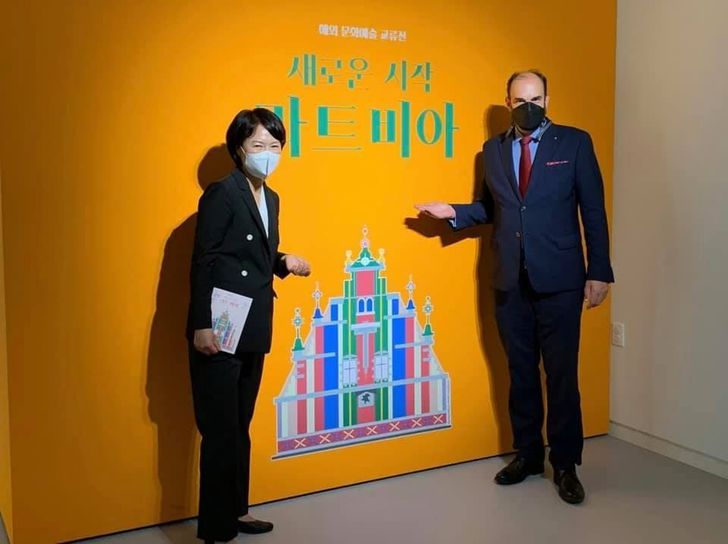
Latvian Ambassador to Korea Aris Vigants, right, poses with Jeong Mi-yeong, head of Busan's Geumjeong District, at the opening of the "A New Beginning ― Latvia" exhibition at Geumjeong Cultural Centre in the southern port city in October. Courtesy of the Latvian Embassy in Korea
"We feel proud that we were able to showcase Latvia throughout the whole year," he said.
"Our similarities go back in time in the ways that Korean people still through generations remember invasions by foreign countries. The same goes for Latvians in that we have been ruled by different rulers throughout our history. So, in this sense, I think our similarities in our pasts give some kind of common understanding and knowledge of historical awareness."
Latvia and Korea established diplomatic ties relatively late, as the two countries' turbulent modern histories resulted in them missing the opportunity to do so earlier. Located in a strategically important part of northern Europe, Latvia was often invaded and occupied by neighboring powers. Latvia proclaimed independence in 1918 when Korea was under Japanese rule. When Korea gained independence, Latvia was under the Soviet occupation.
After establishing diplomatic ties, it took over 20 years for the countries to set up embassies. Latvia opened one in Korea in 2015 and Korea opened a diplomatic representation in Latvia in 2012, and later upgraded it to a full-fledged embassy in 2019.
"After regaining our independence in the 1990s, Latvia, along with the other Baltic states, had to restructure our economy completely from a centrally-planned economy, which had existed during the Soviet Union times, to a market economy, and a lot of effort was made in reorganizing all daily life," the ambassador explained.
"I wish we have been earlier here in Korea, but (opening an embassy requires) mutual recognition from both sides. When the time was ripe, both of our countries established diplomatic representations in both of our countries. There is a Latvian saying: 'that which comes slowly has a better result.'”
After this productive year, the ambassador envisions more ambitious projects during his term in Korea. First up is boosting economic cooperation.
Currently, trade between Latvia and Korea is concentrated on traditional items such as wood, minerals and glass from Latvia, and machines and electronic equipment from Korea, but the ambassador sees more possibilities in innovative fields as well.
"We export mostly wood and mineral products to Korea, which are steadily getting more innovative and have added value. Our innovative biofood industries are getting noticed more in Korea,” he said.
“Interesting products like innovative and healthy vegan meat, organic baby food, birch tree sap, chocolate with no added sugar and sustainable caviar are among the things that we are offering to Korea. I think Korean people could be surprised by the variety and richness of our different products that haven't been available here.”
Vigants also noted Latvia's startup-friendly business environment, suggesting further cooperation in innovative fields.
"Latvia has the best environment in the world for startups according to Index Ventures. So Latvia should be on the list for the most ambitious Korean companies. We are also proud to be a stable democracy and part of important international organizations or cooperation frameworks ― not only the U.N., but also the European Union, NATO and of course the OECD. I think these represent a kind of label of quality for political, economic and business environments where one can be sure that rules and legislations are in place," the ambassador said.
"As a central country of the Baltics, near the Baltic Sea, we are naturally a logistics hotspot, with the biggest airport and best cargo and rail links."
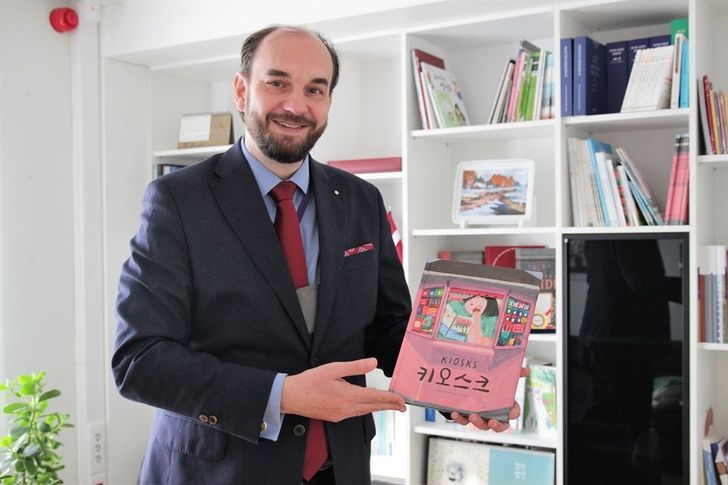
Latvian Ambassador to Korea Aris Vigants introduces the Korean edition of Latvian artist Anete Melece's book, "Kiosks," one of the works of Latvian children's literature translated into Korean, at the country's embassy in Yongsan District, Seoul, Wednesday. Korea Times photo by Kwon Mee-yoo
The ambassador also spoke of the country's ambition to become the hub of the blue economy ― or the sustainable use of ocean resources ― by 2030, looking for more cooperation with Korea.
"So, technologies related to water and the digital transformation will be especially supported in Latvia. We also plan to open up new support schemes for investment, especially in our priority sectors, such as ICT, smart mobility and smart cities,” he said.
"In Latvia and Korea, the most valuable resources are people, therefore we see a lot of potential in developing cooperation in innovations research and development. Latvia is one of the pioneers in telecommunications technology in Europe. Building on this success, there is no doubt that future collaboration opportunities exist, especially in technology fields.
“As a comparably small country, we have a clear focus on our niche products and we are more agile than bigger economies. Therefore, we can give Korean companies tailor-made help with their expansion to Europe, as well as offer specialized solutions to worldwide problems. I very much hope that Koreans will be able to notice Latvia as very attractive for doing business, and also in terms of investments.”
Another task of the ambassador is enhancing political dialogue between the two countries. The Latvian President visited Korea during the 2018 PyeongChang Winter Games and the speakers of the National Assembly of Korea and Latvia's Parliament visited each other in 2019 and 2020, respectively.
"A political visit from the Korean side to Latvia on the level of the president or prime minister, together with a business delegation, would allow them to see how attractive Latvia is with their own eyes," he said.
As interest in the Baltic states increases in Korea, there were three fully booked chartered direct flights to Latvia's capital of Riga in 2019, but in 2020 those were suspended due to the pandemic.
"I hope that next year, if the pandemic is over, we will be able to have more interaction and develop more direct flights, as a next step in the following years, taking into account the great interest from the Korean side. We hope that many Latvian people will also be interested in coming to Korea."
The ambassador also hopes to expand educational opportunities for the Latvian language in Korea.
"I hope that a possibility for learning the Latvian language will be established on a more permanent basis at Hankuk University of Foreign Studies. Now it's being taught, but not every semester. I've seen so much interest from Korean students that they want to learn more, but unfortunately, it's not yet there," he said.