INTERVIEW Costa Rican president hopes to boost cooperation in green economy

Carlos Alvarado Quesada, president of Costa Rica, speaks during an interview with The Korea Times at a hotel in Seoul, Tuesday. Korea Times photo by Choi Won-suk
By Kwon Mee-yoo
Carlos Alvarado Quesada, president of Costa Rica, a leading country on climate issues in Latin America, said he admires Korea for its history, capability for growth and for having created wellbeing for its people in past decades.
Last year, when addressing his country's Legislative Assembly, Alvarado said that Costa Rica should aspire to become the "South Korea of Latin America."
"I want to picture the positive ambition of what Costa Rica needs to become in the years to come. This year, Costa Rica became a part of the OECD, such as South Korea. We have similar values, such as innovation, technology, human rights, democracy and also sustainability," Alvarado said during an interview with The Korea Times at a hotel in Seoul, Tuesday, during his four-day visit here.
"The pillars for Costa Rican growth are very similar to what Korea has been doing in past years, but obviously, with great success, with great growth and with admirable innovation. So I want Costa Ricans to also take a look at what's going on here, so we can have an example and an inspiration for ourselves."
Costa Rica is one of the few countries which has been making efforts consistent to the Paris Agreement. President Alvarado said that fighting climate change is important not only for the current generation but also for future generations.
"If we don't fix this, there won't be a planet for our generation and for our children's and grandchildren's generations. Perhaps it's the only generation in human history that has faced the challenge to save life on the planet. Then we must act so morally and ethically," Alvarado said.
In 2019, Costa Rica launched one of the world's first decarbonization plans, which shares similarities with Korea's Green New Deal. Today, 99.5 percent of Costa Rica's electricity comes from clean and renewable energy. The country's challenge is to electrify transportation.
"Our fossil fuel footprint is mostly on transportation. We still use a lot of gasoline and diesel for transportation. But there is a great opportunity and a very big alliance that we can build between Costa Rica and South Korea, because South Korea is a world leader in the technologies of vehicles and smart cities," President Alvarado said.
"Costa Rica has a clean electric matrix and green hydrogen. So if we join together those conditions of Costa Rica and the technologies of Korea on electric vehicles, hydrogen transportation and digital innovation ― it's the perfect match. Working together, Costa Rica and Korea can demonstrate that we can have 100 percent electric or hydrogen mobility without having a carbon footprint and show the world that it is possible.”
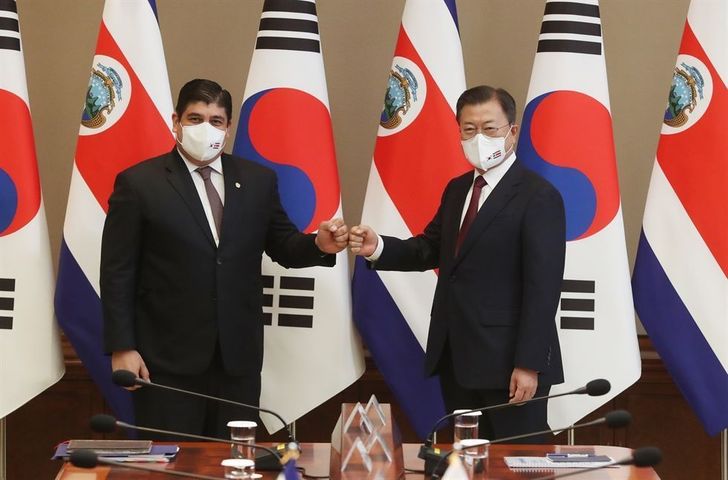
Costa Rican President Carlos Alvarado Quesada, left, bumps fists with Korean President Moon Jae-in prior to their talks at Cheong Wa Dae in Seoul, Tuesday. Yonhap
Costa Rica is also known for being a peaceful country in Central America, with its armed forces having been abolished back in 1948. This peaceful state could inspire the Korean Peninsula to also take a step toward peace, he said.
"Though in different contexts, my country is in a long fight for peace and in that struggle, we are together. We support fully taking nuclear weapons out of the Korean Peninsula, because that's something Costa Rica is trying not only here, but all around the world. Imagine a world that, instead of investing in nuclear weapons, were invested in reversing climate change. That would be a better world and that's our approach," he said.
Alvarado showed support for Korean President Moon Jae-in's efforts to create permanent peace on the Korean Peninsula.
"If you think about the great human accomplishments, those have come from leaders and ideas that have defended peace. If you think of Nelson Mandela, if you think of Martin Luther King, if you think of Gandhi ― those are movements and ideas of love and peace. I can relate a lot to what currently President Moon Jae-in is going for, creating peace on the peninsula, and we really admire those efforts, because we also recognize it is not easy.”
"What we believe is that peace is something that enhances the life of people and improves the quality of life. It's worth fighting for."
As South Korea and Costa Rica celebrate their 60th anniversary of diplomatic ties next year, the Costa Rican president emphasized that it is the time to "seize the opportunities."
"What we need to do is seize the opportunities to have a joint and stronger voice in the multilateral arena. And that is to support our common values: democracy, human rights, sustainability. Also commercially, we're just grasping the tip of the iceberg. The opportunities are huge. So working together can allow us to open even more opportunities," Alvarado said.
Alvarado held a summit meeting with President Moon, Tuesday, and vowed to boost cooperation in post-pandemic economic recovery, especially in the green and digital sectors.
The relationship between the two countries will be upgraded to an "action-oriented comprehensive partnership" upon the upcoming 60th anniversary.
After the summit, Korea and Costa Rica signed MOUs in the fields of science and technology, digital government, environment and triangular cooperation with other Central American and Caribbean countries.