Hanok-inspired Swiss Embassy opens up for photo exhibition

Artist Yoo Young-jin's "Nowhere" series is on display at the Swiss Embassy in Seoul, which is open to the public for the "Breathing Walls" exhibition through Nov. 10. Courtesy of Embassy of Switzerland in Korea
By Kwon Mee-yoo
Most embassies are designed with security as top priority, considering their diplomatic significance. Often surrounded by high walls and guards on alert, it is not easy for the general public to visit embassies without a purpose or advance appointment.
However, the Embassy of Switzerland in Seoul, located in the historic Donuimun area near Gyeonghui Palace, offers the "Breathing Walls" exhibition, open to the public through Nov. 10.
"We always wanted to be an embassy open to the city. Embassies are no longer fully-closed high security compounds. This is an embassy of a democratic state in a democratic country. So we thought we could really use the central courtyard as a platform for showcasing Switzerland but also as a platform for meaningful cooperation," Linus von Castelmur, ambassador of Switzerland to Korea, told The Korea Times.
The Swiss government purchased the land back in 1974 and the neighborhood went through redevelopment starting in 2011. Instead of selling the lot, the Swiss government decided to build a new embassy building to go with the new surroundings.
This is the first embassy building in Korea designed taking inspiration from "hanok," or Korean traditional architecture. Designed by Swiss architect Nicolas Vaucher of Burckhardt+Partner, the gray roof is reminiscent of "giwa" (traditional Korean roof tiles) and there are structures inspired by traditional Korean eaves and wooden crossbeams.
"This embassy is not only a jewel of architecture and a landmark building in Seoul, but it is also a very functional place, a tool we could use for hosting events," ambassador said.
The ambassador said the "luxury of having a courtyard" made the exhibition possible.
"If you are on the 21st floor of a building, you have an office where you can receive people, but you cannot receive 160 visitors of an art exhibition. This is really linked to the decision of Switzerland to maintain our embassy where we are to rebuild it, not (moving to) a high-rise building to maximize profit," von Castelmur said.
"This allows us to be much more open ― you can be an open embassy and you can communicate and exchange openly. So the beauty of this embassy is exactly this kind of platform that allows us to do things that other embassies perhaps cannot do so easily."
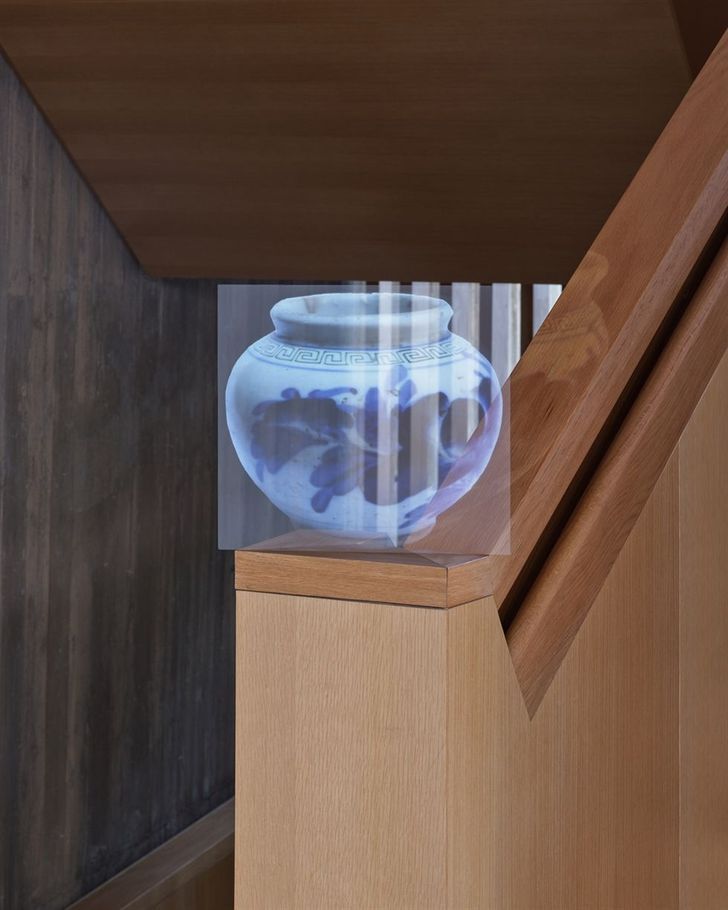
Lee Hyeon-woo's “Soft Echo” / Courtesy of Embassy of Switzerland to Korea
The embassy created a nice portfolio of the new embassy building, but the ambassador wanted to explore it in a different way.
"It was really nice, but it was all us ― the ambassador and the people responsible in Switzerland ― talking about the embassy. After two years, we thought it would be appropriate to give it another perspective."
The ambassador asked artist Chun Kyung-woo, who presented a performance when the embassy reopened in 2019, to organize an art exhibit featuring young Korean artists to reinterpret the embassy building.
"We thought we could do something in the embassy building, celebrating the building and giving a voice to artists," von Castelmur said.
The ambassador welcomed eight young Korean artists to the embassy building, allowing them to exercise their artistic freedom fully.
"They had access 24 hours and could see all the rooms of the embassy. They had really got the feeling of the embassy building and that is why they discovered the building in a different way than what we saw," he said.
"In the evening, there is no janitor. So when they came in the evening, I was to volunteer to open the door to let them out at 11 or 12 o'clock. So we became friends.”
The result of exploring every nook and cranny of the embassy came out in various styles.
Lee Hyeon-woo superimposed traditional Korean objects on the interior of the embassy, creating illusion-like images and tracing the lives of people who lived in the neighborhood, while Lim Sung-jun traced the day-to-day movements of embassy staff members and drew lines around the building to visualize the flow in "Orbiting."
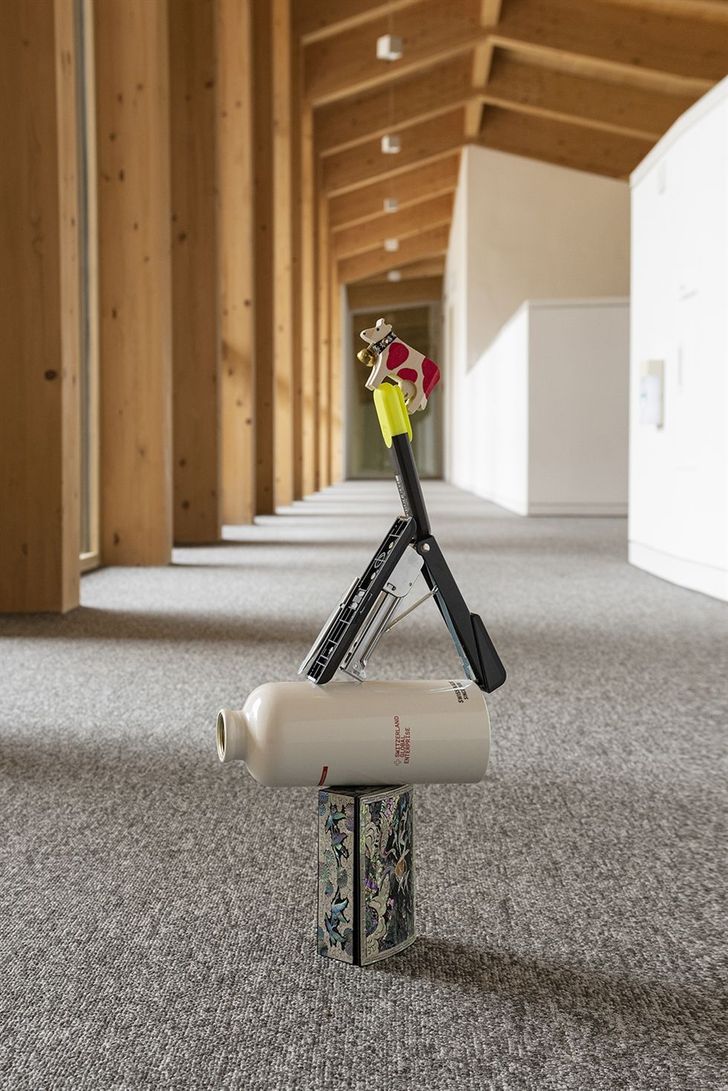
Lee Ye-eun's "Space Building" / Courtesy of Embassy of Switzerland to Korea
Lee Ye-eun's "Space Building" series takes inspiration from neatly-stacked piles of rocks, commonly found in Korean mountains and created by passers-by making wishes. The artist asked embassy staffers to provide ordinary or special personal objects and constructed delicately balanced towers using them.
Kim Ji-hee explores ever-changing relative relationships by placing two identical tapes in various spaces of the Swiss Embassy, including the ambassador's private residence and a fallout shelter.
Ambassador von Castelmur described Jung Young-don's "Double Negative" series as "poetic" because it portrays the embassy's foreign staffers' peripheral identities. The artist asked expats working at the embassy to draw their home, shredded the drawings and took pictures of the torn pieces. Then the film was recaptured against the backdrop of the sky taken from the Swiss Embassy, juxtaposing the infinite airspace and personal memories.
The exhibit is a huge success with over 4,000 people visiting as of Sunday and 2,700 more making reservations to see the artworks as well as the embassy building. The ambassador was happy to see many visitors to the embassy, who add another layer of memory to the building.
"It will really give an impression of the embassy with refreshing art and the embassy building will be a different building in a way with the memory of people. A building is not only a building. There are many emotions attached to the building and they are collective. I think the collective remembrance that will be linked (to the building) will make it precious," he said.
"We have many young Korean couples coming. They are fascinated by the exhibition, but also they can peek in and get the feeling of an embassy that makes it also very special. We try to blur the borders. We try to make the walls open, reachable, so that exchange can really happen."