New Munch Museum offers unseen side of Norwegian artist

The Munch Museum in Norway, dedicated to Edvard Munch, opened its new building in Oslo's seaside Bjorvika neighborhood, Oct. 22. Courtesy of Munch Museum
Plans for another Munch exhibit in Korea
By Kwon Mee-yoo
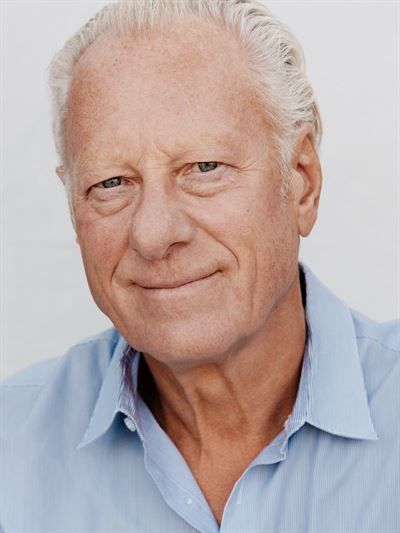
Stein Olav Henrichsen, director of Munch Museum / Courtesy of Munch Museum
The Munch Museum, or MUNCH, in Oslo, Norway, opened its highly-anticipated new building to the public last month, and it lived up to expectations.
The museum, home to some 27,000 works of art by the Norwegian expressionist painter Edvard Munch (1863-1944), originally opened in Toyen, Oslo. It recently moved to the 13-story building dedicated to the artist in the neighborhood of Bjorvika.
Frode Solberg, Norwegian Ambassador to Korea, spoke about the significance of Munch to Norway as well as to the world.
"As Norwegians, we find this very important, of course, but I think also as global citizens. I think Edvard Munch belongs to the greatest, not only the greatest Norwegians, perhaps also among the greatest artists. His works, as you probably know, are among the most valuable and highly-priced artworks out there," Solberg said as he introduced the Munch Museum director to the Korean media, Nov. 1.
The ambassador also mentioned how the Munch Museum is changing the cityscape.
"It's changing the seaside and into a very exciting area. When I was a kid, it was always containers and ships there. Now it's a very nice neighborhood where I think the Munch Museum will be an important additive to the architectural design, turning Oslo into one of the most exciting design and architectural cities in Europe," Solberg said.
The new museum, designed and built using sustainable and environmentally-friendly methods by Spanish architecture studio Estudio Herreros, is contributing to changing the cityscape, especially in the port city of Oslo.
"With this new building, we think that we can be in the center of society and we want the city and all our visitors to enjoy our museum and to participate in developing our programming and our activities," Stein Olav Henrichsen, director of the Munch Museum, said during the meeting with the media.
"We are also looking forward to having visitors from other countries. We know there is a lot of interest (in Munch) in South Korea. We had an exhibition in South Korea a few years back that was very well attended. And in fact, we are also looking into the possibility of doing an exhibition in Seoul again with Edvard Munch."
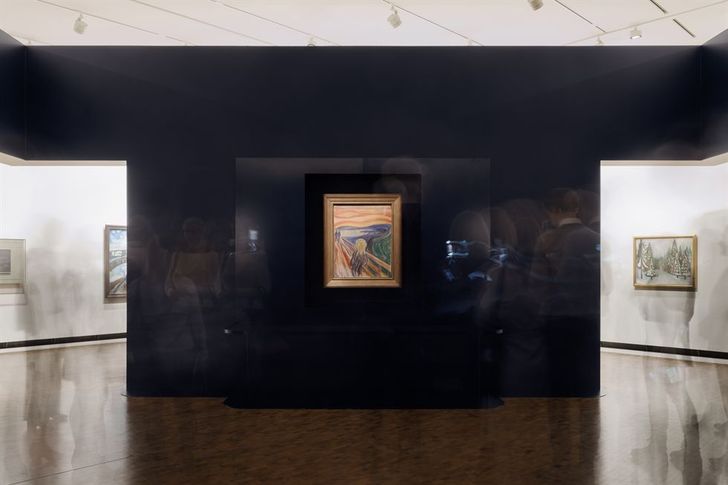
Edvard Munch produced several versions of “The Scream” and at least one of them will be on view at the new Munch Museum on a rotation basis. Courtesy of Munch Museum
The new museum's 11 gallery spaces will allow more of Munch's work to be on display, along with contemporary artworks that reflect his legacy and influence.
"We are going to show a lot more from Edvard Munch works. We have almost 27,000 artworks in our museum that is two thirds of his total production, which is almost 40,000. So we can do a lot of exhibitions at the same time to show more from our collection, like a collection presentation," the director said.
Munch is best known for "The Scream" and "Madonna," but the museum has much more to offer about the Norwegian artist.
"We know his scream, we know his melancholy vampire and all kinds of difficult aspects of life. But Edvard Munch was also very much concerned with brighter sides of life. So you really have to visit our museum to get an insight into the depth and breadth of Edvard Munch's collection,” Henrichsen said.
"But we cannot show all these 27,000 artworks in one go, so we are continuously changing our exhibitions and our collection presentations as well. But I think that in our museum, you can see a very wide part of his works.”
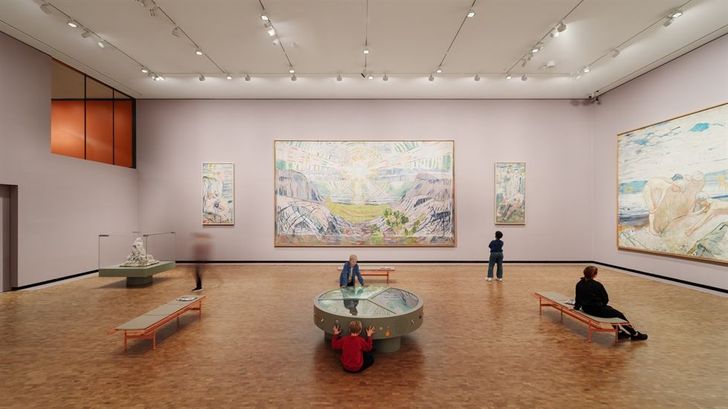
"Edvard Munch: Monumental" exhibition features some of the largest paintings created by Edvard Munch including "The Sun" and "The Researchers." Courtesy of Munch Museum
Munch was an artist for more than 65 years and produced a large body of work in various mediums including drawings, paintings, sculptures, watercolors, prints, photographs and film.
"He was dealing with all kinds of aspects connected to existential questions of human beings. ... He was dealing with all kinds of possibilities to communicate his insight and his knowledge and his art to the viewer and to the public. So this new building gives us the possibility to do that," Henrichsen said.
For the opening program of the new building, five Munch shows exploring different parts of the artist's oeuvre are on show ― "Infinite," "Monumental," "Shadows," "Up Close" and "All Is Life."
In "The Loneliness of the Soul," British artist Tracey Emin's works are shown alongside pieces by Munch, showing his influence on the leading contemporary artist.
The upcoming exhibition, "The Savage Eye," focuses on the relationship between surrealism and symbolist artists including Munch, while another future exhibit, "Satyricon and Munch," will explore the connection between metal music and visual art through Norwegian black metal band Satyricon.
"But we also want to emphasize contemporary art in our museum. So a lot of the space will be used for contemporary artists, not only local artists, but also artists from the rest of the world that can come and bring their reflection and their art and their knowledge into our community and our society," Henrichsen noted.
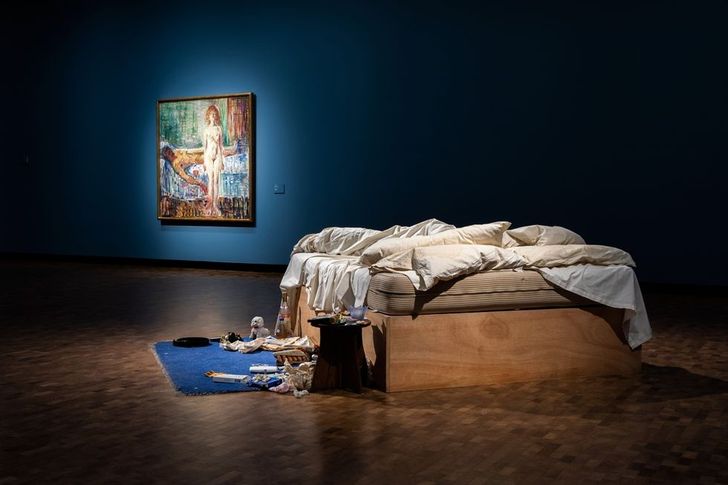
"The Lonelyness of Soul" explores Edvard Munch's influence on British artist Tracy Emin's artistic career. Emin's painting, sculpture and neon text works are on display alongside 16 Munch works, handpicked by Emin. Courtesy of Munch Museum
The new Munch Museum, which opens from 10 a.m. to 10 p.m. daily, has a lot to offer, differentiating from traditional museum experiences.
"This museum gives you the possibility of having a more, let's say, fulfilling museum experience. It is not only going to exhibitions, but also going to have activities like talks and concerts and spending some time with friends. (Whether they are) being here, looking at the wonderful view or taking a rest, we really want people to come back frequently and want them to feel at home here. We want this to be a lively, active museum that is open from 10 in the morning to 10 at night," he said.
"I think even if you are visitors from, let's say, Korea, they might visit the museum more than once because it's not possible to see all seven exhibitions or visit 11 exhibition spaces at one time. You really need to spend some time in this museum. I'd like to say that forget everything you think you know about museums, this is totally different."
Norway still imposes COVID-19 quarantine measures for visitors from Korea, but the director hopes to receive visitors from around the world soon.
"We look forward to invite people from all over the world. Still the coronavirus pandemic is influencing travel and tourism industry, but we already see there are people coming from outside of Norway. So we really hope that this current situation will be terminated and that we can open the country and the museum," Henrichsen said.