Japan's new leadership unlikely to resolve ties with Korea: experts

Former Japanese Foreign Minister Fumio Kishida attends a press conference at the Liberal Democratic Party (LDP) headquarters in Tokyo, Japan, Wednesday, after being elected the LDP president. He will become next prime minister of the country. EPA-Yonhap
Tokyo may wait for Korea's next administration to be launched
By Kang Seung-woo
The leadership change in Japan with a new prime minister to be appointed next week is unlikely to reverse the current downward spiral of bilateral ties with Korea anytime soon, according to diplomatic observers, Thursday.
On Wednesday, Japan's former Foreign Minister Fumio Kishida won the ruling Liberal Democratic Party's (LDP) leadership election and is set to be become the next prime minister, Oct. 4. Kishida is known here for his role in the now-scrapped “comfort women” deal in 2015 to resolve the thorny historical issue of sexual slavery.
In response to Kishida's election, Cheong Wa Dae issued a statement, hoping for cooperation with the new Japanese Cabinet for the development of forward-looking relations between the two countries, which have reached their lowest point in years over historical and territorial issues. Outgoing Prime Minster Yoshihide Suga never held a summit with President Moon Jae-in after taking office a year ago.
“While a new leadership is always an opportunity for change, I think that Kishida's victory to lead the LDP will not have much impact on Korea-Japan relations in the near term,” U.S. Naval War College Professor Terence Roehrig said.
Roehrig also noted that the new premier faces a heap of domestic issues to focus on, including upcoming parliamentary elections, ahead of addressing the feud with Korea.
Japan is scheduled to hold a general election in November and the election of the House of Councillors, the upper chamber of parliament, next summer.
Robert Manning, a senior fellow at the Atlantic Council, said the tensions in Korea-Japan relations were historical and structural in nature and that the distrust was very difficult to reverse.
“Unfortunately, I think that the dangerous downward spiral in Korea-Japan relations has its own momentum,” he said.
“The recent decision to seize and sell Mitsubishi assets by the Moon administration, for example, would have a very negative reaction in Japan regardless of who might be prime minister, as it goes against Japanese views on previous Korea-Japan agreements.”
Earlier this week, the Daejeon District Court ordered the sale of Mitsubishi Heavy Industries' assets here to compensate victims of forced wartime labor.
“I think in light of the current situation, any Korea-Japan rapprochement will be difficult and a long-term issue, though cooperation in the face of mutual threats from North Korea should continue,” Manning added.
Roehrig said if Kishida survives the November election, his Cabinet will await the outcome of Korea's presidential election in March 2022, rather than reaching out to the Moon administration, which has been making last-ditch efforts to normalize its relations with Japan before his term ends in May 2022.
“Kishida will assess the new Korean administration's position on improving ties. There may be an opportunity for progress then, but the obstacles remain huge,” he said.
Amid growing China's assertiveness in Indo-Pacific, the United States is seeking to rally its regional allies to counter Beijing and as part of its efforts, Washington is trying to enhance trilateral cooperation with Seoul and Tokyo.
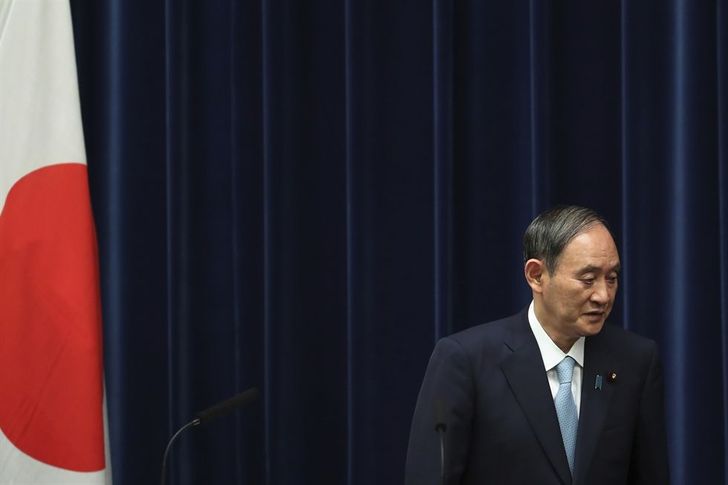
Japanese Prime Minister Yoshihide Suga leaves after a news conference at his office in Tokyo in this Sept. 9 photo. The outgoing prime minister has never held a summit with President Moon Jae-in since taking office about a year ago. AP-Yonhap
In that respect, there is speculation that the administration of President Joe Biden may try to do something to mend ties between its two key Asian allies on the occasions of Kishida's inauguration.
The experts admitted that the U.S. will make some efforts toward such a reconciliation although it stands little chance of success.
“I expect the Biden administration will quietly make efforts to reverse the momentum of Korea-Japan relations which continue to sink,” Manning said.
“But I suspect U.S. efforts will be limited ― beyond strong pressure to enhance U.S.-Korea-Japan strategic cooperation.”
Roehrig echoed Manning's view.
“The U.S. government will continue to attempt to quietly encourage improved Korea-Japan ties for the sake of trilateral cooperation,” he said.
“However, Washington recognizes the difficulty of this task and its expectations for improvement anytime soon will remain low.”