ROUNDTABLE Guest countries to bring diversity to G7 Summit

The Korea Times' President-Publisher Oh Young-jin, left, and Korea Foundation President Lee Geun, right, pose with ambassadors to Korea from guest countries that will participate in the 2021 G7 Summit in the U.K., during a roundtable at The Korea Times' office in central Seoul, May 25. From the left are Oh, Korea's Ambassador for International Cooperation on G20/G7 Affairs Choi Kyong-lim, Australian Ambassador to Korea Catherine Raper, Indian Ambassador to Korea Sripriya Ranganathan and Lee. Korea Times photo by Choi Won-suk
This article is the second in a two-part series of roundtables to discuss Korea's planned participation in the G7 Summit 2021, produced in collaboration with the Korea Foundation. ― ED.
By Kwon Mee-yoo
The seven leaders of the world's democratically and technologically advanced nations, also known as the Group of Seven (G7), will soon gather in Cornwall, the U.K., to address global challenges, such as recovering from the COVID-19 pandemic, fighting climate change and sharing values among open societies.
At this year's G7 Summit, slated for June 11 to 13, under the U.K.'s presidency, four countries ― Australia, India, South Korea and South Africa ― are invited as guests to bring more diversity and commitment to the table.
The Korea Times and the Korea Foundation (KF) co-organized a roundtable of diplomatic representatives of the guest countries May 25, and the representatives presented what each country can bring to international relations and cooperation.
Participants in the roundtable were Indian Ambassador to Korea Sripriya Ranganathan, Australian Ambassador to Korea Catherine Raper and Korea's Ambassador for International Cooperation on G20/G7 Affairs (also known as the G20/G7 Sherpa) Choi Kyong-lim. A representative from South Africa, another G7 guest country, could not attend the event.
"Today's roundtable is a follow-up to the one that was held on May 13 with ambassadors from G7 countries. Both events are organized to give a preview of what to expect at the Cornwall summit of the leaders of the G7 countries and four guest nations," The Korea Times' President-Publisher Oh Young-jin said in his welcoming remarks.
"The G7 ambassadors meeting raised issues from the vaccine divide to the post-COVID-19 world order and China's wolf warrior diplomacy. The climate crisis also dominated our discussion. These issues cannot be solved overnight as positions differ from one country to another. Today's participants may bring to the table a different set of priorities, even on the same issue, than G7 representatives. Being different is not wrong, but it can diversify our choices and make our life more inclusive,” Oh stated.
Lee Geun, president of the KF, presided over the roundtable and commented on the guest countries' commitment to and expectations for the upcoming summit: "This year, the U.K. invited four more liberal democracies from other regions: South Korea from East Asia, Australia and India from the Indo-Pacific and South Africa from Africa. I think the invitation of these four countries is a very timely move by the U.K.”
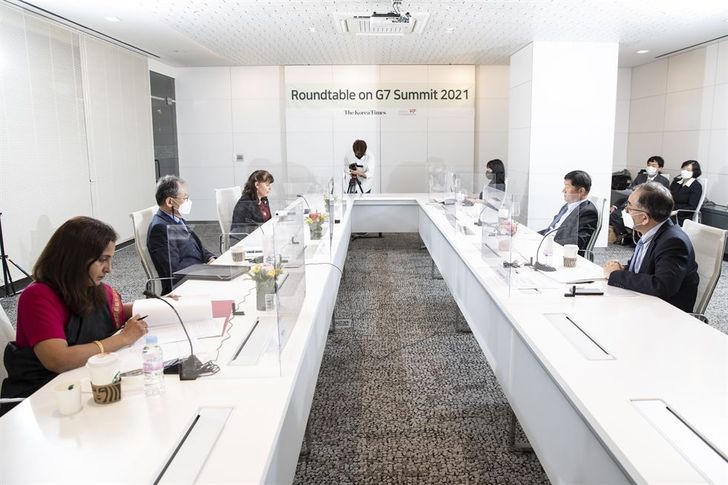
From left, Indian Ambassador to Korea Sripriya Ranganathan, Korea's Ambassador for International Cooperation on G20/G7 Affairs Choi Kyong-lim and Australian Ambassador to Korea Catherine Raper, participate in a roundtable on the G7 Summit to be held in the U.K., hosted by The Korea Times and the Korea Foundation at the former's office in central Seoul, May 25. Korea Times photo by Choi Won-suk
Choi reported on why this G7 Summit is important and what priorities Korea carries to the table as a guest country. "The world is now faced with fundamental challenges and problems, such as climate change, the pandemic crisis and the rise of authoritarian governments across the globe. These challenges pose great threats to economic prosperity and democratic values," Choi said.
"No country can cope with these challenges alone, as they demand coordinated global action. But unfortunately, for the last few years, the international community has been lacking in leadership to mobilize such concerted action. The G7 has usually played a very important role in providing this kind of leadership. This year's G7 meeting is the first in-person meeting among the G7 leaders since the pandemic as well as the first one since the change in the U.S. administration. I think it provides a unique opportunity for the G7 to reassert its solidarity and leadership in addressing global challenges.
“Korea certainly welcomes the invitation. We think that participating in this year's G7 Summit will provide a valuable opportunity to discuss with the leading democracies on how to deal with global challenges."
Ranganathan of India showed how guest countries can enliven the discussion by bringing in diverse perspectives.
"I think there are a lot of areas in which our approach and Korean's approach are very much alike, but there are nuances in our understanding and appreciation from your perspective,” Ranganathan said.
"We have to make sure that we all have climate justice. But I guess this is an area where the Indian position is somewhat different from that of some of the developed countries, because we do see the need for developed countries to play their part in bringing about responsible consumption and production.
"The global community is battling an unprecedented COVID-19 pandemic situation in which more than 150 million people have been pushed into extreme poverty. We believe that now is the time for the global community to come together and review its commitments to pledge tangible support in achieving these goals," Ranganathan added.
Among the many agenda points on the table, Australian Ambassador Raper emphasized gender equality and women's empowerment.
"This is based on a long-standing view that unless we have full and equal participation by women in our economies and our societies, we're not achieving gender equality or our societies' or economies' full potential. This also helps companies maximize their bottom line. So in Australia, we have spent many years eliminating formal legal discrimination, and now we're working on less legal-based, more unconscious biases that prevent women's participation in economies and societies," Raper said.
"We're keen to continue this discussion with the partners of the G7. This issue is also linked to the COVID-19 pandemic, because it had a disproportionate impact on women. When you look at the economic impacts of the pandemic on employment, it's been particularly the services industries ― retail, hospitality and tourism ― in which a large proportion of the employees are women, where we are seeing the loss of job security and prospects. So we think it's very valuable to have a discussion about these issues in this forum and, as leaders, to demonstrate that we're committed to tackling this issue."