'More Koreans in Georgia, more Georgians in Korea'

Georgian Ambassador to Korea Otar Berdzenishvili holds an amber-colored natural wine from Georgia, created through the country's 8,000-year-long winemaking tradition that continues to this day, at the Embassy of Georgia to Korea in Yongsan District, Seoul, May 18. Korea Times photo by Choi Won-suk
Georgia celebrates independence on May 26
By Kwon Mee-yoo
Located at the crossroads of Europe and Asia, Georgia is a country of rich history and diverse culture.
The South Caucasian country is home to the Homo georgicus, the first European human fossils dating back some 1.8 million years, and is also known as "the cradle of wine" as the world's oldest wine from 8,000 years ago was found in Georgia.
Georgia celebrates its Independence Day on May 26, commemorating the Act of Independence and the establishment of the Democratic Republic of Georgia in 1918, after the Russian Revolution.
Georgian Ambassador to Korea Otar Berdzenishvili felt sorry that the embassy could not make the celebration bigger due to the COVID-19 pandemic.
"Instead, we became a little bit smarter. In this new normal, we started to come up with smarter ideas to celebrate our national days, not only in Georgia, but in the rest of the world," Berdzenishvili said during an interview with The Korea Times at the Embassy of Georgia to Korea in Yongsan District, Seoul, May 18.
"We ask all friends of Georgia, especially from the art and culture dimension and students and professors who have been involved with Georgia in the last 30 years and those who created important milestones in terms of increasing awareness, to make congratulatory videos. The video will be posted on our social media. That's how we became more creative this year, compared to last year's shutdown."
This year marks the 103rd anniversary of the Democratic Republic of Georgia.
"The first Democratic Republic of Georgia was short-lived, but this is a very important milestone in our history,” the ambassador said, citing the establishment of Georgia's first state 103 years ago, the foundation of its current Constitution and the start of the country's direction to become part of the European family and the Euro-Atlantic Integrations.
While Georgia is one of the leading countries in the region in terms of establishing democratic institutions and a liberal economy after the collapse of the Soviet Union, it has much more in store with regard to its ancient history. Georgia is one of the oldest countries in the world and Ambassador Berdzenishvili poured out on the country's rich culture and history.
"We are counting around 8,000 years while speaking about our wine, culture and history. That's how we are counting our dates. And we are very proud to have our own language, which is among the world's 14 alphabets and the seventh-oldest manuscript in the world," he said.
The Georgian ambassador emphasized that the South Caucasus country is the most reliable partner for the Asian region and is trying to be a significant player among the international community, referring to Georgia's stand for the support of the major principles of the U.N. Charter and the international rules-based order.
"I think there is a lot of things in common with Korea in this regard, because Georgia and Korea, both of our countries, are democratically based, and a lot of things on our historic pages are similar when it comes to the defending of our democratic institutions," he said. “The two countries also have geographical similarities ― a small country surrounded by big empires.”

Kazbegi Mountain in Georgia / Courtesy of Georgian Embassy to Korea
Birthplace of wine
Earlier in March, the embassy held an exhibition titled "Georgia ― the Cradle of Viticulture" in cooperation with the Korea Foundation, which greatly increased awareness on Georgia itself and as the birthplace of wine where winemaking is believed to have started some 8,000 years ago.
"We had a fantastic exhibition regarding the Georgian wine-making tradition. I think it was a very big success ― the Korea Foundation offered both offline and online exhibitions and a lot of interesting articles came out. It is part of the celebration of our 30th anniversary of our anniversary of referendum on independence from the Soviet Union,” the ambassador explained.
“We have more than 500 species of indigenous grapes in Georgia, which means that each square feet of the land has different types of grapes and different types of wine. And wine is part of our culture," he said.
"We are making wine with the same tradition that has been done since 8,000 years ago. I am holding this amber-colored wine, which is made in Georgia in big clay vessels, called qvevri in Georgian, and buried below ground."
Georgia's winemaking tradition was inscribed in the UNESCO Intangible Cultural Heritage of Humanity list in 2013.
"It was at the same time when Korean kimjang (culture of making and sharing kimchi) was acknowledged by UNESCO. It is interesting that we have similar food culture despite geographical distances between each other. Both of us have clay vessels buried under the ground and both go through a natural fermentation process. Koreans took cabbage and applied the idea of fermentation to make kimchi and we took grapes to make organic wines," he said.
Before it was hit by the COVID-19 pandemic, Georgia was seeing an increase in Korean tourists, who have been discovering this hidden gem between Europe and Asia.
"Georgia has very interesting landscape that starts from the Caucasus Mountains, which is almost 5,000 meters high, and ends with the Black Sea coastline, and everything is within a one- or two-hour drive. There is even a place you could both ski and swim. There is fantastic nature for hiking, which Koreans love," the ambassador said.
"On the other hand, we have fantastic cuisine and wine, which is also an important part for Korean tourists. We are one of the friendliest people and prices are cheap too."
A photo exhibition of Georgia's Protected Areas from June 7 to 21 will give a glimpse of the country's natural beauty.
"The cooperation between our national parks will boost our existing relations. We will show Georgian national parks at the Korea National Park Service headquarters in Wonju (in Gangwon Province) and Korean national parks will be introduced in Georgia simultaneously," he said.
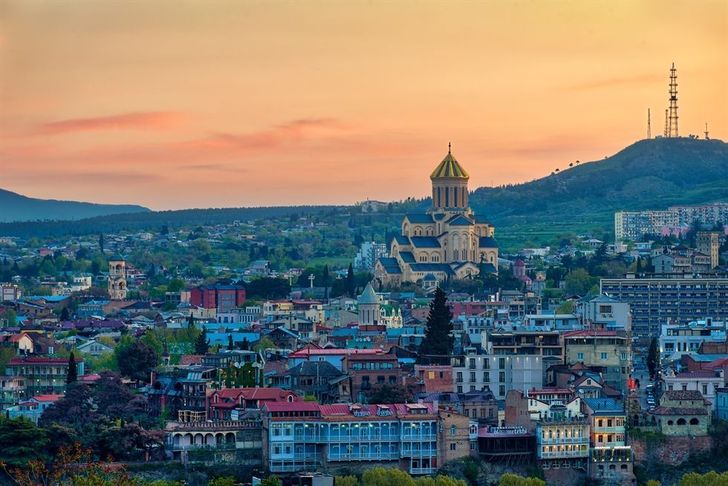
Tbilisi, capital of Georgia / gettyimagesbank
Paving way for FTA
Georgia opened its embassy in Korea in 2011, marking its 10th anniversary this year, and Berdzenishvili is the second ambassador to Korea.
"My motto is to have the more Koreans in Georgia and more Georgians in Korea. I am so happy that in my four-year tenure here, I achieved the Air Agreement and started the feasibility study on the free trade agreement (FTA) this year, which will be concluded in the end of July," he said.
The six-month-long feasibility study on the FTA between Georgia and Korea is a starting point of what the Georgian ambassador described as “one of the major milestones in terms of the deepening our relations.”
"When it comes to the free trade market, it is about the partnership, regionally and beyond, in a bigger picture. I think Georgia is one of the most reliable partners in the New Northern Policy in the Eurasian continent, sharing the ideas of democracy and liberal economy," Berdzenishvili said.
"Korea is a very important player (in the international economy) and the Korean market is one of the most reliable, stable and important markets for us. I think that there is a vast potential for Korean products in our part of the world. I think the FTA could play a crucial role to give the boost for existing relations when it comes to the entrepreneurial relations and people-to-people connections.”
Ambassador Berdzenishvili sees a large potential in the bilateral economic relations.
"There is a lot of room as Georgia geopolitically connects Asia and Europe. A lot of international projects are passing through Georgia, starting from the energy sector and ending with railroads and traffic and so on. I think that Korean companies have a lot of opportunities in terms of expanding their businesses in Georgia and beyond," he said.
"Korean companies looking to establish their headquarters and their representations in Georgia can start business in a day and cover more parts of the world using Georgia's FTAs."