ROUNDTABLE G7 prepares for post-COVID-19 world
The following are summaries of statements from the seven ambassadors to Korea from the G7 countries ― the United Kingdom, Canada, France, Germany, Italy, the United States and the European Union ― during a roundtable co-hosted by The Korea Times and the Korea Foundation ahead of the G7 Summit slated for June 11-13. ― ED.
British Ambassador Simon Smith
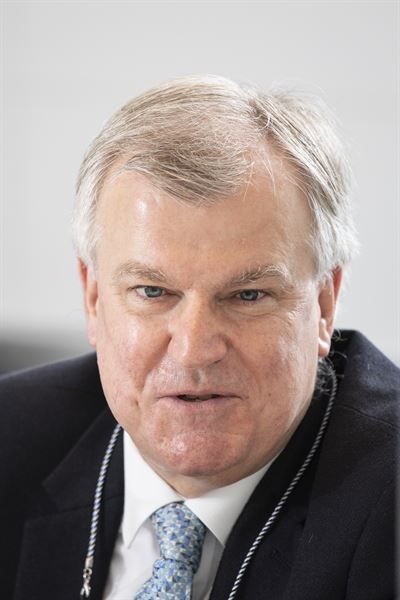
British Ambassador to Korea Simon Smith / Korea Times photo by Choi Won-suk
In the U.K. presidency, we decided to invite the Republic of Korea, the Republic of South Africa, India and Australia to this year's G7. It is an invitation with expectations. It means when you are invited to the G7, you are not invited just to sit in a chair and watch; you are invited to participate in not all but in many of the activities and the various policy strands of the G7. And you are expected to participate actively and with ideas.
The G7 needs to be relevant and topical. There have been some years when it has been more difficult to establish exactly what theme would grab the world's attention. This year, it has not been so difficult. We are facing an immediate global crisis tied up with the coronavirus. And clearly one of the focuses of G7 has to be on how we continue a successful response to that crisis.
There will be a specific focus on health in the G7. On the one hand is a focus on the mechanisms of cooperation that we need, including how we ensure that the vaccines are distributed equitably and efficiently. We need to look at ways in which the World Health Organization and other international mechanisms work better. We need to look at how better intelligence sharing will help us deal and avoid a similar crisis in the future.
It also needs to look at the principles. The first and foremost among those principles is ensuring that the response is an equitable one and ensuring that vulnerable countries with less capacity to deal with the problems under their own resources are not left out and behind.
Another focus is what kind of world in which we want to live once the coronavirus is behind us. On top of the list in answer to that question, we have to put climate change. We will have survived one crisis but we will bring upon ourselves a much bigger and probably fatal crisis if we have still not designed effective measures to limit the rise in global temperatures by when we pull out of the coronavirus crisis.
We are very keen for the G7 to build on the recent momentum we've seen in the last year, including the setting of 2050 carbon neutrality targets by many countries. I would mention here also the immense boost that we have had from the U.S. administration's positive reengagement on the climate agenda. We need to use that momentum to accelerate our progress and take it further.
What brings the G7 and the plus countries together is shared commitment to democracy, to open societies, to fundamental freedoms, and so on. The G7 Foreign and Development Ministers' Meeting communique will give you a very clear idea of what are those important issues on our agenda for the creation and promotion of a world effective in responding to crises. And it makes sense for all of us, including the representatives of the Republic of Korea, to engage in that agenda with gusto, commitment and resources.
Canadian Ambassador Michael Danagher
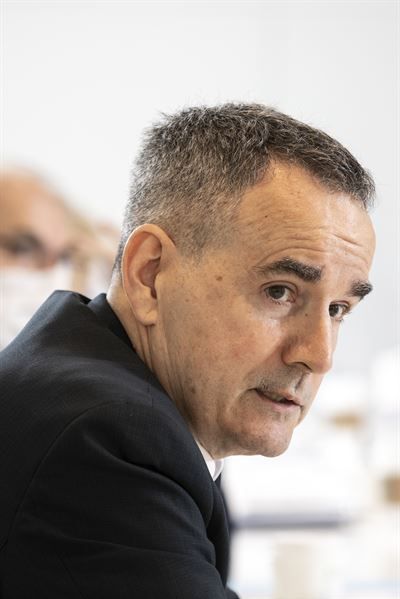
Canadian Ambassador to Korea Michael Danagher / Korea Times photo by Choi Won-suk
I'd like to congratulate the U.K. for hosting the G7 Foreign Ministers Meeting. I think, for us, it was a signal of a return to normality in international diplomacy.
The G7 Foreign Ministers' Meeting communique represents the aspirations and the concerns of our open and democratic societies that are represented around the table including the guest countries.
G7 has been around for 45 years and the governance has evolved somewhat, but much of the subject matter that was discussed this year reflected those discussed in previous G7 meetings in France in 2019 and in Canada in 2018. But obviously, the object of COVID-19 was an important new element.
I am going to focus on a few points of particular interest to Canada, not only at this G7, but as general foreign policy concerns. First of all is the role of the COVAX facility. We're all members and we've all made very significant contributions. But we're still seeing this issue that the vaccine is not yet reaching those low-income countries. This is not just a moral concern, but it's a public health concern, because we've seen how variants can affect our countries.
Something that's near and dear to Canada's heart is the rules-based international order. I'd like to mention the reform of the World Trade Organization (WTO) in particular, which has great importance to Canada and Korea. We're both members of the group looking to create some productive suggestions for the reform of the WTO. I think we all recognize that there have been failings of the international trade regime in recent years and we need to rebuild the trust and effectiveness of that organization.
I was particularly pleased to see the communique mention arbitrary detention, which is an important issue for the global community. And this is a recognition that states should not be practicing what is essentially hostage diplomacy and leveraging the movement of individuals for state interests.
We have a particular concern on the impact of climate change on the Arctic as well. We need to pay special concern that some of the impacts on our maritime environments are not repeated as the Arctic becomes more and more accessible to economic development.
We're facing an unprecedented crisis with COVID-19, but this is hardly the first pandemic in global history. But it is the first time that we have come up with a global response in such a quick time. For those who have contributed to vaccine development, it's a near miraculous result. It shows the strength of our technology in finding solutions to problems. However, it also underscores that the technology itself is not enough and we need to have the function of bringing these vaccines to those who need them. And that is where our global governance needs to be to stepped up and all the countries which have a common purpose need to exercise a common leadership.
Italian Ambassador Federico Failla

Italian Ambassador to Korea Federico Failla / Korea Times photo by Choi Won-suk
I hope the year 2021 marks a slow return to normality. In this year, we have important events that could accelerate the return to life as we knew it. In addition to the G7 Summit, there are the G20 Summit in October and the COP26 (2021 United Nations Climate Change Conference) in November. Italy is the chair of G20 and co-organizer of the COP26 with the U.K.
Environment and climate change are the priorities. In our G20 program, we have identified what we call the three Ps ― people, planet, prosperity ― meaning that the three things are equally important and you cannot have one without the other. It is a chain that links these three concepts.
I personally think that it would be a mistake to believe that we are just going back to normality. We said we can start where we left before the pandemic. Well, possibly not. It is an unprecedented challenge that we face. We are faced with changes in our life and we need to give unprecedented answers.
So we have seen global efforts and regional efforts like never before. I'm thinking, for instance, of the EU initiatives ― in this case, the Green New Deal and the recovery plan, which are the things we have never thought of before the crisis. This change will affect all the countries involved and the game is set to focus solely on the recovery of the industrialized countries or the emerging countries.
This is the moment in which we have to rethink what has been done in the past. We had global challenges in the past, but there are new challenges like the pandemic. Other things on the plate such as cybersecurity also need global response and concerted efforts. Regional responses or possible confrontation probably is not the best way. We need global answers for the global issues. For challenges like climate change, we try to keep everybody in the debate.
I'd like to offer a personal reflection. In a new paradigm, we break away with the past in a way. Some changes probably are likely to stay the same for a long period of time. So the more active role of a government and stronger policies probably are there to stay. I believe that this doesn't pertain only to economics, but it could be also a shift in international policies.
French Ambassador Philippe Lefort

French Ambassador Philippe Lefort / Korea Times photo by Choi Won-suk
The first G7 Summit was held in 1975, in Chateau de Rambouillet near Paris, by the initiative of then-French President Valery Giscard d'Estaing, who passed away last year.
Actually that was not an alternative to the meeting of the head of states trying to deal with complicated global issues. At the time, we didn't speak of globalization or global issues. Rather it was the time of the first oil crisis in 1973 and the world was full of tensions.
We don't claim to be inventors of G7, but I think the initiatives are still quite relevant. There was already an informal grouping before G7, the G5 (France, Japan, the U.K., the U.S., and West Germany). We first met in the library of the White House, so it was called the Group of Library. That was the very origin of the event which turned into something like the G7.
And then Italy joined the group and then Canada. Since then we have this rotating presidency in the order of France, United States, United Kingdom, Germany, Japan, Italy and Canada. And then the leaders of the European Union joined representing the interests of the European community.
There has been all the time a bit of tension between the focus on the economic, social and political issues. The agenda, built by the U.K. presidency, reflects different priorities.
We are facing the COVID-19 crisis and we need to overcome it. This is a global issue in which we have to facilitate vaccination all over the world. In France, like in Germany or the U.K., the situation is slightly better now. Because we will have vaccinated about half the population in June, probably the whole population in summer, and we will be ready to resume physical meetings at the time.
But we have to think of other countries, especially poor countries, because if the virus stays somewhere and it continues to travel, we'll have to deal with that again and again. We have to support the COVAX initiative.
Another important factor for France is the digital economy. We believe that we can rebuild the strong economy through the free flow of data, but we also need to protect privacy. We're going to rebuild our economy after the COVID-19 crisis. We have to rebuild it better, in a way which is more environmentally friendly.
Those priorities actually connect with the Korean issues. Korea indeed is a country very important in terms of global effects. Important common policies go beyond conflict, disputes and sometimes different interests so that we have to ask for a certain sense of responsibility.
When you do this sort of cooperation, nobody asks any country to abandon its own national interests, but there is a sense of communality and compromise needed.
German Ambassador Michael Reiffenstuel

German Ambassador to Korea Michael Reiffenstuel / Korea Times photo by Choi Won-suk
The G7 is an informal meeting of the seven major industrial nations, but it's also a community sharing values of liberal democracy. We are economic powerhouses, but we also share the same ideas. That's why I think it was an excellent idea to invite partners for this meeting, including Korea, because we clearly have a feeling that Korea is a country that is not only one of the biggest economic powerhouses worldwide now, but is also sharing our ideas. There also is an expectation from this (invited partner) role. We think if a country does have a certain economic power, there also comes responsibility with regards to international affairs.
We think the two most urgent and important topics are the recovery from COVID-19 and joint efforts to overcome the pandemic, and secondly, the most pressing issue of climate change.
We think the COVID-19 crisis is one excellent example where we can see we have global ascendancy in global issues, where we have to act coherently together, where we do need a functioning multilateralism.
From our point of view, we have to keep in mind, basically we will only overcome this crisis if not only some countries have vaccinated people, but only if vaccination has been done worldwide. So we think we are doing this for COVAX like many other countries ― we have contributed 2 billion euros. And we think we should do everything that speeds up the availability of vaccines. This is the most important point in this regard.
We would like to commend the U.K. for the passages with regard to climate ambitions. We think finding agreement in many of the key climate ambition commitments that the G7 set out in the communique this year has actually been achieved.
We have the U.S. back and I think this is crucial. From our side, this is most welcome as we need the U.S. for this kind of effort we want to undertake globally.
With regard to climate change, we think we need concrete commitments for the medium term. We know this is sometimes difficult and sometimes very painful. But we think this is actually the only way we can achieve the prevention of a climate catastrophe.
I will explain one example that is very dear to us ― the phase-out of coal. I think Korea and Germany have quite similar challenges in this regard. We are both industrialized economies, living from export-driven, energy-intensive industries. So we both want to phase out nuclear energy and phase out coal.
Our parliament passed a law that should build the framework for this phase-out and also for achieving 2050 greenhouse gas neutrality. Our Constitutional Court said this is not sufficient and Chancellor Angela Merkel took this as an opportunity and increased our level of ambition. We now say we will achieve greenhouse gas neutrality by 2045. We all should try to increase our level of ambition, but also to have concrete roadmaps so this can actually be implemented.
EU Ambassador Maria Castillo Fernandez

EU Ambassador to Korea Maria Castillo Fernandez / Korea Times photo by Choi Won-suk
As (the representative of) the European Union, I have to follow my European member states. So whatever they have said is part of our common language and common message. The EU is the third-largest economy in the world, representing such an important number of countries ― 27.
We are all key strategic partners of Korea, and Korea is an active player in diplomacy. We want Korea to shoulder responsibilities with us, expecting Korea to play a more active role in international affairs. The message we are asking them on climate change is to have a more concrete and more ambitious target. All our leaders, every time we put out a mission, they come up with ambitious targets.
We want to show the world that we want the international rules-based order back, that we want multilateralism back. We are also here to safeguard and reinstate an international order that has served the principles of human rights and freedoms and democracy and rule of law. We have to continue to work as we have a lot at stake in all parts of the world's foreign policy issues.
What is more important is, as discussed in the G7 Foreign and Development Ministers' Meeting, that we are reaching out in these recovery efforts. We are working green, digital and we are reaching out to all our partner developing countries to help them. EU member states are the biggest donors in the world. We want to also reach out to other countries for the recovery of health systems and of their economy. We are also trying to introduce digitization to these countries. There was a failure of multilateralism, global cooperation and rules-based order, so we want to see that back.
Another important issue is digital convergence and new standards. We all have to work on this now. Data is a public good and this is going to be very important in the next years ahead. We need to start preparing for that. Threats to cybersecurity is one of the key issues we have to cooperate on and I think social data and data protection are going to be of huge importance.
Another important element is regional institutions. There is ASEAN and the African Union, very important key partners for us, also for Korea. Korea is reaching out also to us, but note that regional institutions are very complicated.
The direction EU countries are going in will be the basis of our strategic autonomy. This concept is not only about putting our defense capabilities together and cooperating more to defend ourselves, but also about the economy. It is about working with our like-minded partners to do whatever we can do to safeguard our values and our interests.
U.S. Charge d'Affaires ad interim Robert Rapson

Charge d'Affaires ad interim at U.S. Embassy Seoul Robert Rapson / Korea Times photo by Choi Won-suk
This is an opportunity for all of us to reflect on where we are and where we're going. And it's all immediate, it's all now; it's happening now.
We share all the same concerns and the prioritization of issues as laid out. Climate change and COVID-19 are right at the top and G7 has taken grip of that and we're firmly addressing it.
The big message from our side is ― to use a catchphrase ― is “the U.S. is back.” The President (Joe Biden) has stated that and we're matching our words with actions. It starts with engaging on the global scene again in a robust, proactive leadership way.
COVID-19 has been going on for 15 months and we've been living it and developing responses to it. Vaccines have now emerged and Korea is playing an important role in that effort. But recovery from COVID-19 is clearly a primary factor in how we're going to emerge once we get beyond the current phase we're in.
The other issues touched upon … international rules-based order, of course. That's something we all support and Washington supports. And that segues into China and China's behavior over the past year. Our policy toward China is not one of containment, but one of working with China and others to make sure it plays by the established international rules-based order.
Speaking from a multilateral G7 perspective, I think, again back to the communique, the treatment of issues that have a China nexus was spot on. It covered them in a way that I think we all subscribe to. There's no containment policy here. But we require, we insist that China behave by the rules that have been placed out there.
Bilaterally speaking, we have strong concerns about China's behavior in multiple areas ― economic policy and human rights, in particular. The COVID-19 effort initially generated strong concern for us and we're worried about supply chains.
Our relationship with China is broad, deep and very complex. It's becoming a catchphrase that I'm using ― and it comes from Secretary of State Blinken, of course ― but I think it aptly captures the spectrum, and very simply so, as to how we see China: “We will be competitive with China where we should, we'll collaborate where we can, and we'll be adversarial where we must.” I think that sets the tone and the framework.
Climate change is one of those areas that lends itself for that collaboration. But we need to explore that proposition very thoroughly, multilaterally, as well as bilaterally.
North Korea got mentioned in the G7; rightly so ― both from a denuclearization standpoint as well as human rights standpoint. We welcome the statement that the G7 put out.
And specific issues like Myanmar, as a litmus test for democracy globally in the region, is weighing on all of us out there to see if we can bring that country back on the democratic track.