US likely to recognize Panmunjeom Declaration in Moon-Biden statement
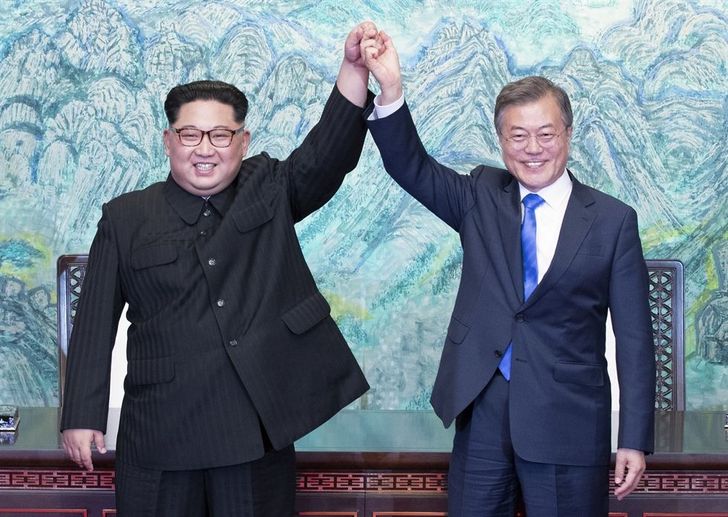
President Moon Jae-in and North Korean leader Kim Jong-un raise their hands after signing the Panmunjom Declaration during their first summit at the border village of Panmunjeom in this April 27, 2018, file photo. Yonhap
By Nam Hyun-woo, Joint Press Corps
SEOUL/WASHINGTON ― A joint statement to be announced after the upcoming summit between President Moon Jae-in and his U.S. counterpart Joe Biden will likely include U.S. recognition of the 2018 Panmunjeom Declaration, in which the two Koreas agreed to cooperate in officially ending the Korean War and halt all hostile activities toward each other, according to a senior Cheong Wa Dae official who is accompanying Moon in Washington, D.C., Thursday (local time).
So far, the Moon administration has been encouraging the U.S. to entice North Korea toward dialogue through approaches based on the 2018 Singapore Declaration made between North Korean leader Kim Jong-un and Biden's predecessor Donald Trump. If the Moon-Biden joint statement includes the U.S.' recognition of the Panmunjeom Declaration, it can be interpreted as a major step forward in Moon's efforts to revive an atmosphere of peace on the Korean Peninsula.
“South Korea has made a great contribution to the Singapore agreement and the Biden administration's North Korea policy review,” the official said during a meeting with pool reporters. “As the U.S.' recognition of inter-Korean relations, the (Moon-Biden) statement may include content from the Panmunjeom Declaration. This means the U.S. not only recognizes agreements between Washington and Pyongyang, but also those between the two Koreas.”
The Panmunjeom Declaration was adopted on April 27, 2018, during the first Moon-Kim summit at the truce village of Panmunjeom. In the declaration, the two sides agreed to try to declare the end of the Korean War, halt hostile activities toward each other and achieve the denuclearization of the peninsula, among others goals.
The Korean War ended with an armistice agreement signed in 1953 by the U.S.-led United Nations Command, China and North Korea, leaving the two Koreas technically still at war.
So far, the U.S. has not been recognizing the uniqueness of inter-Korean relations, expressing concerns that Seoul's efforts to engage Pyongyang could hinder the effectiveness of sanctions against North Korea.
If the U.S. veers to recognize the relations between two Koreas, Moon's efforts to revive an atmosphere of peace on the Korean Peninsula is anticipated to pick up momentum, by narrowing potential differences between Seoul and Washington in handling the North Korea issue.
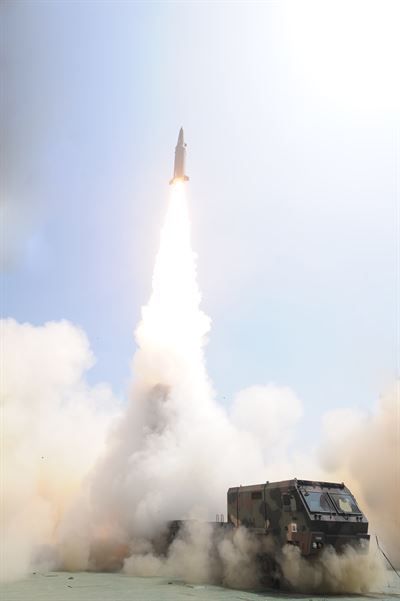
Hyunmoo II ballistic missile is test fired at Agency for Defense Development compound in Taean County, South Chungcheong Province, in this June 23, 2017, file photo. Courtesy of Cheong Wa Dae
The senior official also said Moon and Biden are anticipated to talk about lifting missile guidelines on South Korea.
“The Moon administration has been making plans to address the missile guideline issue before Moon's term ends,” the official said. “I believe there would be positive outcomes on the possibility of lifting the guideline during the summit.”
South Korea's missile development programs have been limited for the past 42 years, after the guidelines were established in 1979. According to government sources, Seoul agreed to bring in or develop missiles under U.S. control, in order to gain technologies related to missiles. But that move ended up curbing the maximum capacity of Korea's missiles to a range of 180 kilometers with a payload of 500 kilograms.
Seoul and Washington have since been engaged in a series of negotiations to ease the limit. In 2017, the two sides agreed to scrap limits on the weight of the payload, and the latest revision last year allowed Korea to develop solid-fuel space launch vehicles.
If Moon and Biden agree to abolish the missile guidelines, South Korea will gain its sovereignty in missile development programs. After lifting the limit on warhead weight, South Korea developed the Hyunmoo IV ballistic missile in 2020, which can travel up to 800 kilometers while carrying a 2,000-kilogram payload. When the range limit is also abolished, South Korea will be able to begin its program to develop intercontinental ballistic missiles.
Also at the summit, Moon and Biden are expected to talk about the two countries' cooperation in the nuclear power generation industry, including joint efforts to tap into new markets.
“At the summit, there is a chance that the two leaders will talk about Seoul-Washington cooperation in the nuclear power generation industry and reveal the outcome of the talks,” the Cheong Wa Dae official said. “There is still noteworthy demand for nuclear power plants in the Middle East and Europe. If South Korea and the U.S. join hands to foray into those markets, they can be very competitive.”
As part of the U.S. climate policy, the Biden administration is focusing on nurturing small modular reactor (SMR) projects. SMRs are smaller than conventional nuclear reactors and require less on-site construction through the use of pre-fabricated modules.