Opposition lawmakers visit Washington for vaccine diplomacy
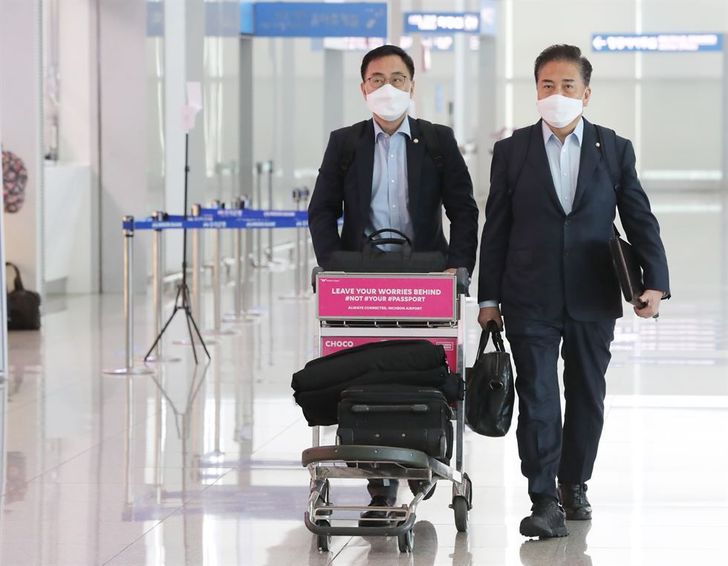
Conservative main opposition People Power Party Reps. Choi Hyung-doo, left, and Park Jin walk through a passenger terminal of Incheon International Airport, Wednesday, to depart for Washington, D.C., where they will meet with officials of the U.S. government and discuss COVID-19 vaccine cooperation between the countries. Yonhap
By Jung Da-min
The conservative main opposition People Power Party (PPP) has sent two of its lawmakers to the U.S., seeking to secure COVID-19 vaccine supplies with the help of the U.S. government and Congress, after determining that the Moon Jae-in government lacks the ability to do so.
Four-term lawmaker Rep. Park Jin and PPP floor spokesman Rep. Choi Hyung-du departed for Washington, D.C., Wednesday morning (KST).
According to the PPP, the two lawmakers are set to meet high-ranking U.S. government officials, including Acting Assistant Secretary of State for East Asian and Pacific Affairs Sung Kim, and officials of the Centers for Disease Control and Prevention (CDC), as well as Korean American Congress members Young Kim and Michelle Park Steel, to discuss vaccine cooperation between the countries. They will also meet members of Washington-based think tanks, including The Wilson Center.
The lawmakers likewise plan to meet representatives of vaccine developers like Pfizer to propose designating Korea as an Asian hub for COVID-19 vaccine production.
The PPP's dispatch of what it calls a “vaccine diplomacy delegation” came without consulting with the ruling Democratic Party of Korea (DPK) or the Moon administration.
PPP floor leader and acting chairman Rep. Kim Gi-hyeon said Tuesday that the PPP had earlier asked the government and the DPK to form a diplomatic delegation to request the U.S. to supply vaccines, but the liberal ruling bloc did not respond.
Kim said the PPP decided to send its own delegation as the matter of securing more vaccine supplies is an urgent task for the country, which is undergoing an imbalance in supply and demand.
“As of May 9, only 0.98 percent of the population has completed receiving the second dose of the COVID-19 vaccine and only 7.09 percent have received the first dose,” Kim said. “Now, we cannot neglect or condone the threat to the lives and safety of the people.”
On Monday, before the departure of the delegation, Rep. Park submitted a resolution with the signatures of all 101 lawmakers of the party, calling on the government to establish a vaccine partnership with the U.S. to seek various cooperative measures.
But the DPK criticized the PPP's unilateral dispatch of the vaccine diplomacy delegation, calling it a publicity stunt that will not bring any tangible results.
“The PPP has so far focused on emphasizing the adverse effects of the vaccine to raise jitters over vaccine safety, and it is now talking about what it claims to be a supply-demand imbalance to mislead people into believing that there is a lack of vaccines,” DPK spokesman Rep. Lee Yong-bin said, Wednesday.
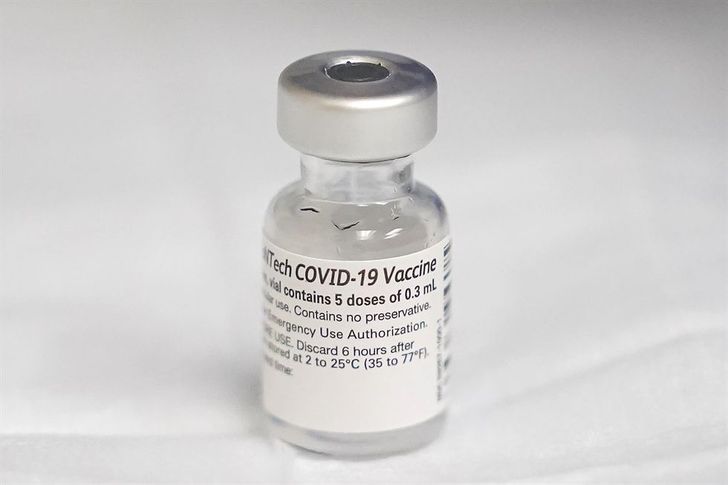
This Dec. 24, 2020, photo shows a vial of the COVID-19 vaccine from Pfizer, shown at Seton Medical Center in Daly City, California. AP-Yonhap
The Korean government has so far signed contracts for 192 million doses of vaccines enough to inoculate 99 million people, but only 3.87 million doses have been delivered to the country as of April 24.
President Moon Jae-in and the DPK have said the ruling bloc will do its best to complete the inoculation of 12 million people in the country by the first half of this year, but there are increasing doubts whether that will be possible with less than two months to go.
Diplomatic experts said they think the PPP's delegation could deliver a message to the U.S. government that Korea is desperately seeking to introduce vaccines as soon as possible, but it will not bring any notable changes in the U.S. government's vaccine policies.
“The Joe Biden administration has already made it clear that it will first supply vaccines to the countries bordering the U.S. ― Mexico and Canada ― and then the member countries of the Quadrilateral Security Dialogue (Quad). And most recently, the Biden administration said it will support waiving intellectual property rights for COVID-19 vaccines,” said Park Won-gon, a professor at Ewha Womans University's Department of North Korea Studies.
“As Korea is not a member of the Quad, the U.S. government cannot offer an exceptional favor, as it has to treat its other allies equally. … And among the allies of the U.S., the quarantine situation of Korea is relatively better than the others.”
Shin Beom-chul, director of the Seoul-based Research Institute for Economy and Society, said that aside from whether the PPP's vaccine diplomacy will bring practical benefits, the ruling bloc should have joined such a diplomatic effort, since securing more vaccine supplies is an urgent task for the country.