Real, mythical animals of ASEAN introduced to Korea

Installation view of “ASEAN Animals: Depiction of Animals in ASEAN Arts & Cultures” exhibition at the ASEAN Culture House in Busan, highlighting how animals are portrayed in the Southeast Asian region / Courtesy of ASEAN Culture House
By Kwon Mee-yoo
"ASEAN Animals: Depictions of Animals in ASEAN Arts & Cultures," a special exhibit at the ASEAN Culture House in Busan, sheds light on how animals are portrayed and associated with values in member countries of the Association of Southeast Asian Nations.
ASEAN people have maintained close relationships with animals such as chickens, water buffaloes, and elephants for a long time and these animals appear in their art and culture.
“Stories about personified, deified, and imaginary or mythical animals are found throughout the many legends and folk tales of traditional ASEAN cultures,” an official of the ASEAN Culture House said.
The exhibit features some 100 traditional and contemporary artworks and audiovisual materials depicting images of animals from the 10 ASEAN countries.
"Symbolic Animals of ASEAN" introduces iconic animals appearing on national symbols of ASEAN countries.
"Visual images of national emblems such as the national flag, coat of arms and seal of the state embody the values and culture the country believes in," the official said.
The ASEAN's real animals representing the country or region include the Komodo dragon of Indonesia and rhinoceros hornbill found in the forests of Malaysia and Southeast Asian islands of Sumatra, Java and Borneo.
There also are imaginary beasts told through ancient tales and legends ― the Merlion of Singapore, which has a lion's head and the body of a fish and the Cambodian royal animals Gajasingha (a lion with an elephant's trunk) and Rajasingha (mythical royal lion).
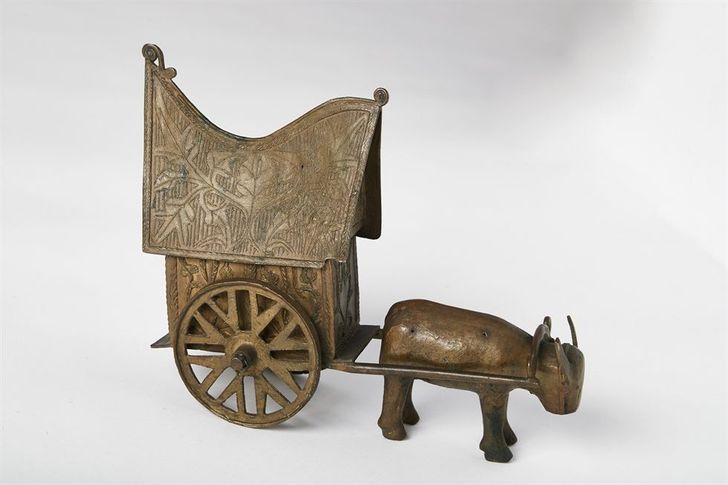
“Pedati Model” from Indonesia / Courtesy of ASEAN Culture House
"Animals and Everyday Life in ASEAN," showcases animals related to hunting and breeding.
Major artifacts on display include "Pedati Model" from Indonesia, showing a cart pulled by a water buffalo, while "Hmong Embroidery" from Laos depicts animals from that region.
Korean artist Cho Han-jin created video art that makes shapes of animals in the languages used in ASEAN countries.
"Animals in Religous Symbolism" offers a glimpse of animism throughout the ASEAN region as people believed they were sacred creatures, bridging the otherworld and the earth.
Personified and deified animals also appear in ancient Hindu and Buddhist tales. In the Hindu epic "Ramayana," Hanuman the divine monkey represents courage, strength and power. Elephants are also popular in ASEAN culture as the animal is considered as an earthly manifestation of the Buddha himself, symbolizing patience, loyalty and wisdom.
Seo Dong-joo, Caroline Reize, Rooah and Ken Pyun's two-channel video, "Animal Beats," featuring sounds of tropical rain forests and the sea portrays animals using multi-sensory methods that inspired awe in observers.
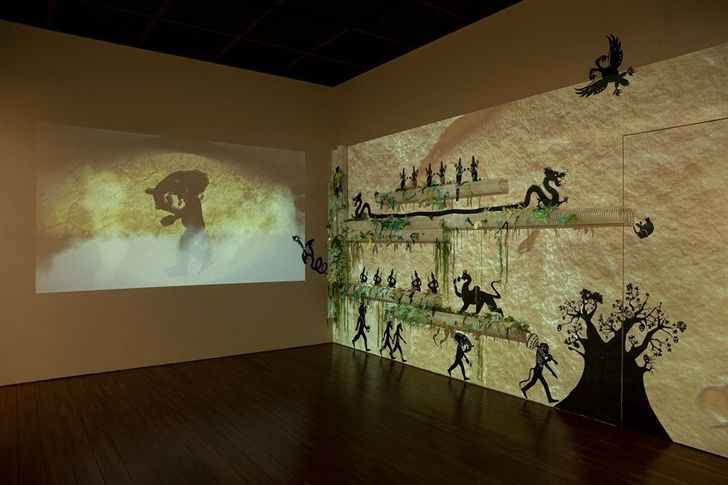
Arisong Media Factory's "Shadow Forest Story" / Courtesy of ASEAN Culture House
"Mythical Animals in ASEAN" centers on a variety of mythical animals of the region, often found in royal palaces, religious structures and artworks.
A typical form of the imaginary creatures is a fusion of different species. Singapore's icon Merlion is half-lion, half-fish and Indonesia's Garuda is depicted as a man with wings and an eagle-like head.
Himavanta, a legendary forest in Hindu mythology, is home to many imaginary animals and variations of these fictional animals appear in local folktales of the ASEAN region, offering a glimpse into the creativity of the ASEAN people.
Arisong Media Factory's interactive installation, "Shadow Forest Story," brings these mythical animals to life inspired by a shadow play from the ASEAN region.
ASEAN Culture House, established to commemorate the 2014 ASEAN-ROK Commemorative Summit in Busan and operated by the Korea Foundation, presents various exhibitions to highlight the history, societies and cultures of the 10 ASEAN Member states ― Brunei, Cambodia, Indonesia, Laos, Malaysia, Myanmar, the Philippines, Singapore, Thailand and Vietnam.
The exhibit runs through Aug. 1. Admission is free.