Possible Chung-Motegi meeting unlikely to bring about reconciliation

Foreign Minister Chung Eui-yong / Korea Times file
By Kang Seung-woo
On the occasion of Foreign Minister Chung Eui-yong's participation in the G7 Foreign and Development Ministers' Meeting set for next week, talks between Chung and his Japanese counterpart Toshimitsu Motegi are expected to take place on the sidelines.
However, diplomatic observers are not pinning high hopes on their long-delayed meeting paving the way for the immediate normalization of the soured relations between Seoul and Tokyo.
Currently, bilateral ties between South Korea and Japan have slumped to their worst level in years over wartime history issues, so Chung, who took office in February, has yet to have had a phone call with Motegi due to Japan refusing contact.
According to the Ministry of Foreign Affairs, Friday, Chung is scheduled to fly to Britain, Sunday, to attend the ministers' meeting and his itinerary also includes bilateral discussions with U.S. Secretary of State Antony Blinken and British Foreign Secretary Dominic Raab.
Although the ministry's announcement did not feature a meeting with Motegi, a senior official said negotiations were being held with several countries to hold one-on-one meetings, including Japan, and that an additional announcement could be made.
“On the sidelines of a multilateral conference, it would be feasible for Chung and Motegi to meet each other,” said Shin Beom-chul, director of the Center for Diplomacy and Security at the Korea Research Institute for National Strategy.
“However, Japan strongly insists that South Korea itself address the diplomatic dispute, a request that the government cannot comply with, so it would not be easy to see any immediate improvement in the bilateral ties even if their foreign ministers meet.”
Yang Ki-ho, a professor of Japanese studies at Sungkonghoe University, expressed a similar view.
“With the ongoing dispute showing no signs of abating, the Japanese side does not seem to be sincere about the meeting as a failed meeting could be unfavorable to its government as well. In that respect, even if the envisioned meeting is held, it might be in an informal setting like a standing meeting,” Yang said.
The professor said the two foreign ministers should meet each other given that there are pending bilateral issues with regard to Tokyo's wartime forced labor and its plan to dump radioactive wastewater, as well as North Korea's nuclear program, adding that it could be the last opportunity for them to meet each other in person.
Compounding the situation, South Korea-Japan reconciliation is losing momentum within both governments, according to Shin.
Entering this year, President Moon Jae-in had sought to mend ties with Japan in order to take advantage of the Tokyo Summer Olympics in July as momentum to revive stalled talks with North Korea, as he successfully improved ties with Pyongyang through the PyeongChang Winter Olympics in 2018, in which the reclusive state participated, thereby leading to both improved inter-Korean and U.S.-North relations.
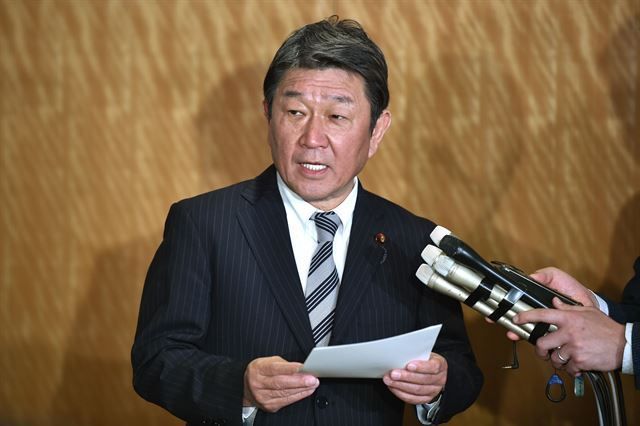
Japanese Foreign Minister Toshimitsu Motegi / Korea Times file
However, Pyongyang's decision not to attend the quadrennial sporting event due to the COVID-19 pandemic has stifled Moon's peace efforts.
“The South Korean government appears to believe there is no merit in improving ties with Japan in terms of the North Korea issue,” Shin said.
The expert also said Japan is not interested in bettering ties with South Korea, as the country is on good terms with the United States.
“A call for excluding South Korea from the U.S.-led Indo-Pacific Strategy has been emerging as a mainstream argument in Japan although Washington may not agree,” Shin added.