Aussie, Kiwi vets virtually commemorate 70th anniversary of Kapyong Battle

From left, Minister of Patriots and Veterans Affairs Hwang Ki-chul; New Zealand Ambassador to Korea Philip Turner; Australian Ambassador to Korea Catherine Raper; Minister for the Defense Acquisition Program Administration Kang Eun-ho and Vice Admiral Stuart Campbell Mayer, deputy commander of the United Nations Command in Korea pose for a photo commemorating the 70th anniversary of the Battle of Kapyong in front of the Australian Memorial in Gapyeong, Gyeonggi Province, Friday. Courtesy of Ministry of Patriots and Veterans Affairs
By Kwon Mee-yoo
April 23 marks the 70th anniversary of the Battle of Kapyong, in which U.N. forces fought against the Chinese army at Gapyeong Valley in Gapyeong, Gyeonggi Province to protect Seoul from April 23 to 25, 1951.
The three-day battle between the 27th British Commonwealth Brigade, including the 3rd Battalion, Royal Australian Regiment (RAR) and the 16th Field Regiment, Royal New Zealand Artillery, and the Red Army is known to have been one of the fiercest of the Korean War.
The Australian soldiers played an important role in holding back the Chinese onslaught, inflicting heavy causalities, and the New Zealand artillery provided fire support to the strategic point.
The embassies of Australia and New Zealand in Korea co-hosted a commemorative ceremony at the Australian and New Zealand Memorials in Gapyeong, Gyeonggi Province, Friday.
Due to the COVID-19 pandemic, Korean War veterans in Australia held a ceremony at the Australian National Korean War Memorial in Canberra and New Zealand veterans Robert Longden and Benjamin Thomas attended via video call.
"We are here in Gapyeong. When our veterans were here 70 years ago today, they remembered the legacy of our ANZACs (Australian and New Zealand Army Corps) in Gallipoli ― mateship, courage, teamwork, tenacity," Captain Chris Smith, Australian defence attache, said during the ceremony, referring to ANZAC Day, which falls on April 25 and commemorates the first major military action fought by Australian and New Zealand forces during World War I.
Colonel Donald Jones, New Zealand defence attache to Korea, said the Battle of Kapyong was the first real test for the Kiwi gunners.
"The continuous accurate artillery fire from 16th Field 70 years ago hitting the Chinese swarming the valleys and up these hills was critical to the success of the Commonwealth Brigade stopping the offensive," Jones said.
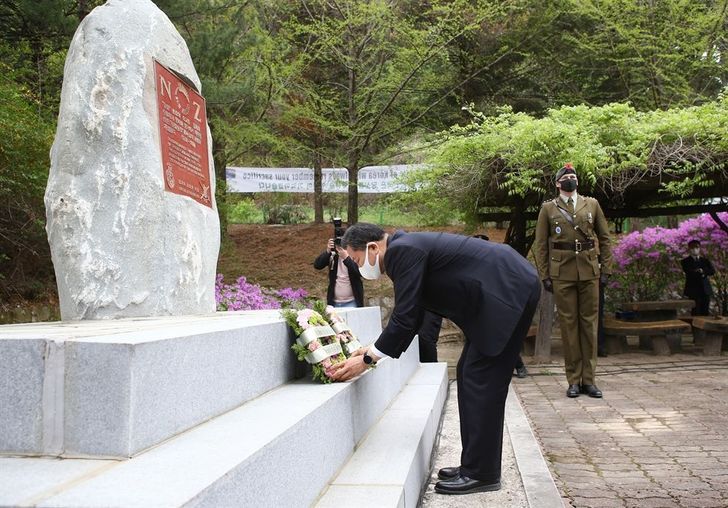
Minister of Patriots and Veterans Affairs Hwang Ki-chul lays a wreath to the Monument for the Participation of New Zealand in the Korean War during the Battle of Kapyong 70th anniversary ceremony in Gapyeong, Gyeonggi Province, Friday.
Major John Garton of the New Zealand Defence Force recited a poem called "Memories of Kapyong" by Kiwi veteran Maurice Gasson who fought in the battle.
"With target after target from our O.P on the crest,
The gunners feed the guns, their body crying out for rest.
For the guns, now like an orchestra, the targets they engage,
With a symphony of anger, a cacophony of rage.
Despite the years that lie between, my mind can still recall,
How we held the line that April, on the road that led to Seoul.”
Major Simon Reynolds of the Australian Defense Force shared "To the Boys We Leave Behind Us," a poem written by Private Paterson of 1 RAR during the Korean War.
"Remember the march through Sydney?
We were really glad that day.
We were going to Korea and it had to end this way.
And the days we spent on the Devonshire,
Our first long voyage by ship,
We laughed and joked,
Not dreaming that this was your one-way trip."
While dignitaries in Korea, including Australian Ambassador to Korea Catherine Raper, New Zealand Ambassador to Korea Philip Turner and Minister of Patriots and Veterans Affairs Hwang Ki-chul, laid a wreath in Gapyeong, the veterans in Australia laid their wreaths in Canberra.