US, China push South Korea into tricky balancing act

South Korea's National Security Adviser Suh Hoon, right, talks with his counterparts Jake Sullivan of the U.S., center, and Shigeru Kitamura of Japan during their meeting at the United States Naval Academy in Maryland, Friday (local time). Courtesy of Ministry of Foreign Affairs
Seoul, Beijing agree on two-plus-two meeting soon
By Nam Hyun-woo
South Korea finds itself stuck in between the United States and China, with the two superpowers striving to tip the balance of Seoul's diplomacy in their own favor at two high-profile meetings in Annapolis and Xiamen over the weekend.
Washington is pressuring Seoul to show support by stressing the importance of their long-term security alliance, while Beijing is trying to leverage its influence over North Korea.
National Security Adviser Suh Hoon met his counterparts Jake Sullivan of the U.S. and Shigeru Kitamura of Japan on Friday (local time) at the U.S. Naval Academy in Maryland for talks on North Korea and the Indo-Pacific situation.
After the meeting, the White House issued a statement that the advisers not only shared “their concerns about North Korea's nuclear and ballistic missile programs” but also discussed “common concerns including Indo-Pacific security,” with the latter seen as a move against China.
Though the White House statement only briefly mentioned the common concern of Indo-Pacific security, it is assumed that indirect pressure has been made for South Korea to stand with Washington in the U.S.-China rivalry.
During a background press call before the trilateral meeting, a senior U.S. administration official commented that the trilateral partnership is “increasingly important in a complex environment in the Indo-Pacific going forward” and the U.S. “would welcome at any point a closer consultation and engagement with South Korean friends in the process” related to South Korea's joining of the Quadrilateral Security Dialogue ― a strategic forum of Australia, India, Japan and the U.S. toward “a free and open Indo-Pacific.”
The U.S. has been sending signals to its Asian allies to bolster their alliances in the face of an assertive China, while South Korea has been pursuing “strategic ambiguity” to maintain its relations with Beijing, which is Seoul's largest trading partner possessing a significant influence over North Korea.
The U.S. pressure appears to be growing on economic issues as well, as the trilateral meeting also discussed the global shortage of semiconductors, whose supply chain is heavily relying on producers in Asian countries.
The U.S. official said, “Three countries hold many of the keys to the future of semiconductor manufacturing technology,” and the countries “will seek to affirm the importance of keeping these sensitive supply chains secure while also working together to uphold upcoming norms and standards discussions.”
The Biden administration has already set the semiconductor shortage in the global market as a matter of national security, with U.S. reports saying that Biden's national security and economic advisers plan to meet semiconductor and car companies on April 12. Bloomberg reported that South Korea's Samsung Electronics is among the chipmakers invited to the White House.
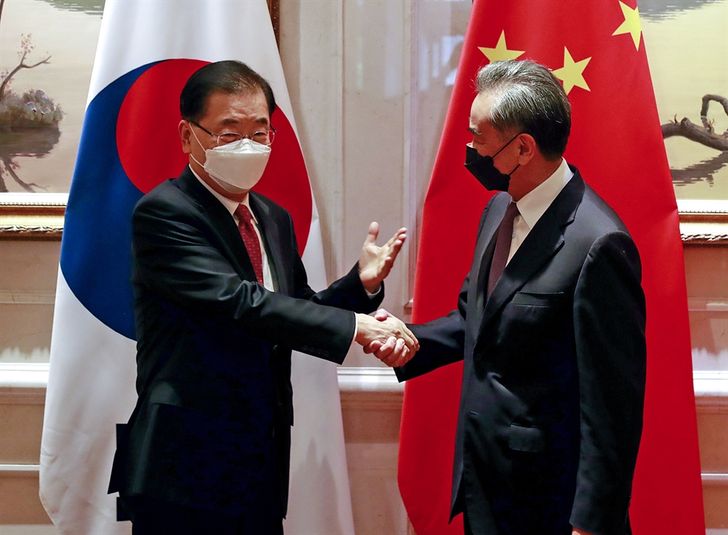
South Korean Foreign Minister Chung Eui-yong, left, shakes hands with his Chinese counterpart Wang Yi before their meeting at a hotel in Xiamen, China, Saturday. Yonhap
China's strategy
China is also ramping up efforts to strengthen its relations with South Korea to counter the U.S.' anti-Beijing campaign.
South Korean Foreign Minister Chung Eui-yong and his Chinese counterpart Wang Yi met in the southeastern Chinese city of Xiamen, Saturday, agreeing to seek to hold a vice foreign ministerial strategic dialogue and a “two-plus-two” dialogue involving the countries' diplomatic and security officials, both in the first half of this year.
Should the dialogues take place, they will be the first of their kind since January 2015. The two sides have not been holding two-plus-two diplomatic talks in the wake of South Korea's decision to deploy a U.S. Terminal High Altitude Area Defense (THAAD) missile defense system in 2016.
"South Korea has been walking a tightrope between the U.S. and China, and this was well-displayed during the talks over the weekend," said Shin Beom-chul, director of the Center for Diplomacy and Security at the Korea Research Institute for National Strategy.
"This is not a consequence that South Korea caused, but a situation that the country is facing. The important thing for South Korea under this situation is that it has to come up with strategies for its own interest with consistency."
He pointed to Suh's remark on the Korea-U.S.-Japan trilateral talk that the three countries agreed that "efforts to resume North Korea-U.S. negotiations at an early date must continue," highlighting this appears inconsistent with the U.S. intention, which is not desirable for Korea in the current situation.
Meanwhile, another point presenting a tricky test to Seoul is the timing of Moon's potential summits with Biden and Xi.
After the meeting, Foreign Minister Chung told reporters that Korea and China agreed to invite Chinese President Xi Jinping to Seoul as soon as the COVID-19 situation stabilizes.
South Korea is also seeking an in-person summit between Moon and Biden. Media outlets anticipate that the meeting could take place as early as this month, but Cheong Wa Dae said it has nothing to confirm though the two countries are in close consultation for a meeting.