INTERVIEW KOICA earns ODA stripes and sets sights on becoming global aid agency

KOICA President Sohn Hyuk-sang speaks during an interview with The Korea Times in his office in Seongnam, Gyeonggi Province, March 22. Courtesy of KOICA
By Kang Seung-woo
Korea is a “unique” player in the official development assistance (ODA) landscape.
Following the 1950-53 Korean War that devastated its economy, Korea fell into the abyss of poverty, becoming heavily dependent on international emergency relief. But on the strength of its remarkable economic development, the country has been giving back what it once received from the global community.
Plus, it became a member state of the Development Assistance Committee (DAC) of the Organization for Economic Cooperation and Development (OECD) in 2010, an international forum of the 30 largest providers of aid. Korea is the 15th-largest donor country, with its ODA spending reaching $2.5 billion (2.84 trillion won) in 2019.
Its case of jumping from the rank of the least developed countries (LDCs) to a significant donor status is unprecedented in the global ODA scene.
Despite the recognition, some feel Korea still has a long way to go before becoming a bona fide donor. The nation is attempting to change such impressions through recent activities led by the Korea International Cooperation Agency (KOICA).
“More than anything else, Korea can play a role as a bridge between developed and developing countries based on its successful development experience from an LDC to a donor country,” KOICA President Sohn Hyuk-sang said in an interview with The Korea Times.
The foreign aid arm of the Ministry of Foreign Affairs, established in 1991, provides bilateral grants and technical cooperation, with 44 country offices.
According to the president, KOICA's aid efforts earned recognition last year when the COVID-19 pandemic grew to affect nearly every country in the world. KOICA gave its full support to developing countries to effectively deal with the deadly virus.
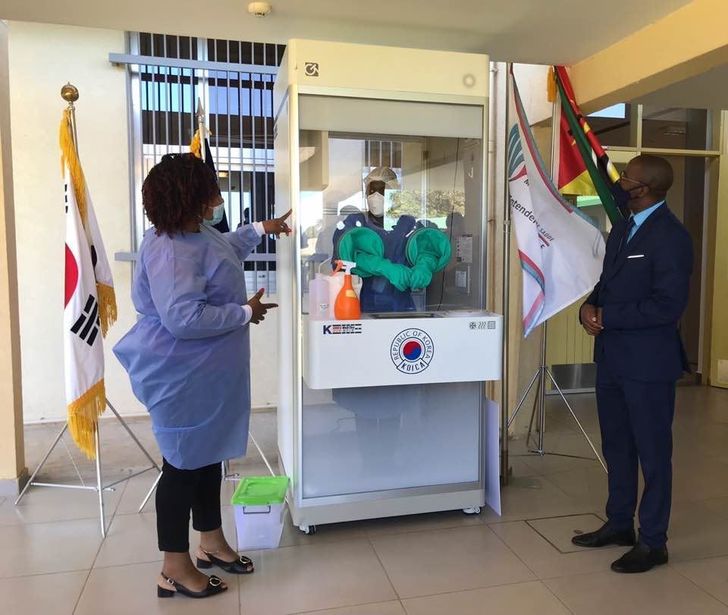
A COVID-19 diagnostic booth, donated by the Korea International Cooperation Agency (KOICA), is set up in Mozambique. Courtesy of KOICA
“Given that Korea has a wealth of knowhow on the ODA and a system enabling a rapid response, as part of the government's ODA Korea: Building Transparency, Resilience, Unity, and Safety Together (TRUST) initiative, KOICA introduced its Agenda for Building Resilience against COVID-19 through Development Cooperation (ABC) Program as its COVID-19 response mechanism,” Sohn said.
Under the program aimed at overcoming COVID-19 with mutual development cooperation, KOICA assisted 38 million people from 116 countries by spending $150 million.
Sohn, who took office in December 2020, said KOICA's efforts to overcome COVID-19 will continue this year, but its focus will shift to helping developing countries strengthen healthcare capabilities in preparation for the post-coronavirus era, as evidenced by KOICA-nurtured Cambodian epidemiological investigators playing a key role in the Southeast Asian country's fight against the coronavirus by conducting contact tracing and finding infection cases.
“Along with the aid helping countries rapidly respond to the coronavirus, we plan to work on boosting their comprehensive healthcare capabilities against infectious diseases that will help them manage and respond to infectious diseases,” the president said.
“In addition, the impact of climate change has to do with human infectious diseases, so we established the Climate Crisis and Pandemic Response Department to deal with the issue.”
Marking its 30th anniversary in 2021, Sohn unveiled three goals for this year: Green and Digital New Deal ODAs and integrated ODA.
“The Green New Deal is a key part of the Korean New Deal for the post-coronavirus period and it also has to do with the outbreak of infectious diseases. In that respect, KOICA plans to push for the Green New Deal ODA as a signature project in response to the climate crisis,” Sohn said.
To this end, the president said the agency will seek to form a partnership with relevant local organizations, while strengthening its cooperation with global bodies, including the Green Climate Fund and the Global Green Growth Institute.
“As part of KOICA's digital transformation, we are seeking to raise the rate of using digital technology in new projects to 80 percent by 2023,” Sohn said.
KOICA will seek to maximize impact by linking development cooperation to the government's ongoing policies.
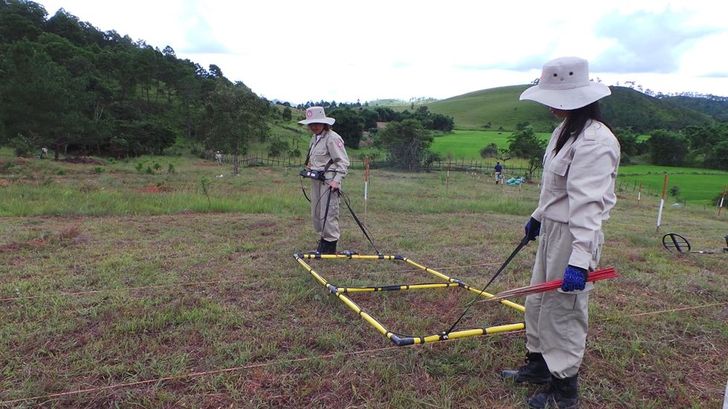
People remove landmines in Laos. Courtesy of KOICA
“In line with the government's New Southern and Northern Policies, KOICA will try to increase the effectiveness of development cooperation by strengthening synergies,” he added.
The New Southern and New Northern Policies center on expanding trade ties with emerging nations and reducing Korea's reliance on China and the United States, which account for roughly 40 percent of annual exports.
Despite its short history, KOICA has established itself as a solid ODA player by respecting international norms, according to Sohn, and he believes it is now at an important inflection point over its future goals.
“Our strength is to accept and follow international norms without creating a conflict, but now it is time to take a step forward on the way to becoming a global leading aid agency,” Sohn said.
“The yardstick determining whether we are a leading agency is how to review and develop local demand from developing countries to new projects and put on a strong performance, a sector KOICA needs to improve.”
He added: “So far we have executed what recipient countries wanted, but now we should think about how to maximize development impact beyond their needs. If that happens, we will be benchmarked and earn respect as a global leader.”