'Launch of Biden administration offers diplomatic opportunities for Seoul'
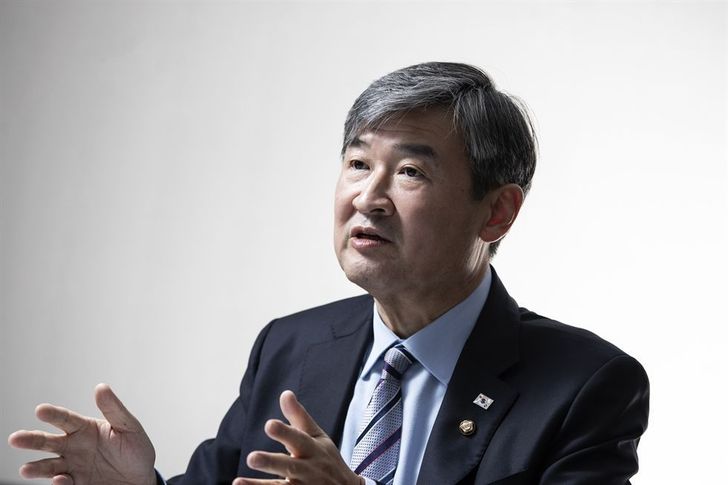
Main opposition People Power Party Rep. Cho Tae-yong speaks during an interview with The Korea Times at his office at the National Assembly, Seoul, Jan. 18. Korea Times photo by Choi Won-suk
Seoul, Washington urged to strengthen military alliance, strategic partnership to deal with security threats in region
By Jung Da-min
Many experts say that U.S. President Joe Biden, who took office Jan. 20 (local time), will want to focus on domestic issues such as overcoming divisions among the American people or fighting the COVID-19 pandemic before paying attention to diplomatic tasks.
But the new president will immediately face diplomatic tasks considering the U.S.' position on the international stage as a leading democratic country with multiple ties to other nations, according to Rep. Cho Tae-yong of the main opposition People Power Party. Cho previously served as vice foreign minister and deputy national security adviser for former President Park Geun-hye and is now a member of both the National Assembly's foreign affairs and unification, and intelligence committees.
According to Cho, the diplomatic tasks facing Biden include dealing with conflict with Iran over financial sanctions, clarifying its stance in mediating conflicts among Middle Eastern countries and coping with the intensifying rivalry with China.
Cho said the North Korea issue may be pushed down Biden's priority list, but there is still a positive side for the South Korean government in that working-level officials with the new administration are diplomatic veterans with experience in handling the North Korea issue.
“Joe Biden's nominee for Secretary of State, Antony Blinken, has knowledge of both Iran and North Korea. And Kurt Campbell, Biden's nominee for a newly created position as senior official for Asia policy, dubbed the Asia Czar, is a veteran diplomat whose interests include not only U.S.-China relations but also North Korea related issues,” Cho said in an interview with The Korea Times at his office, Jan. 18. “With such a lineup of veteran diplomats, I expect it will not take long for the Biden administration to establish a North Korea policy.”
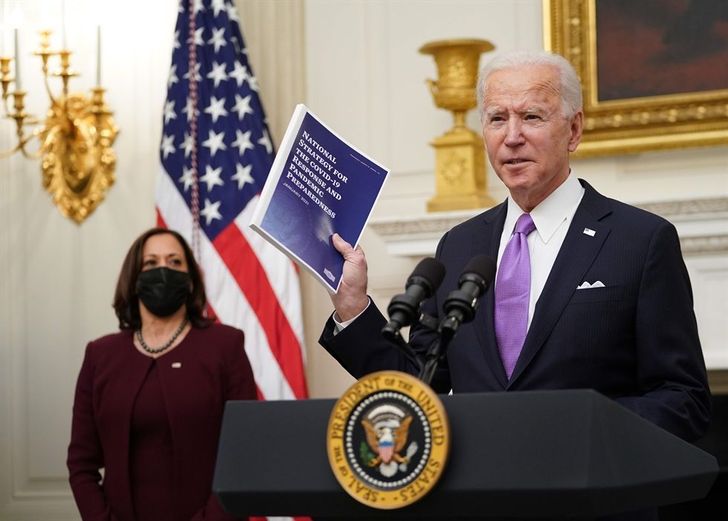
U.S. President Joe Biden, right, speaks about the COVID-19 response as U.S. Vice President Kamala Harris looks on before signing executive orders in the State Dining Room of the White House in Washington, D.C., Jan. 21 (local time). AFP-Yonhap
Cho said the launch of the Biden administration would offer another opportunity for the Moon Jae-in government to build more concrete and organized strategies toward North Korea, although it will not be able to expect “surprise outcomes” as seen from former U.S. President Donald Trump's “event diplomacy” with the North Korea, including summits with North Korean leader Kim Jong-un, and a “snap meeting” at the inter-Korean truce village of Panmunjeom in June 2019.
The lawmaker said how denuclearization negotiations between the U.S. and North Korea turn out depends on Pyongyang. “If Kim really has a strong determination for denuclearization, serious and substantive talks can be held, and the Biden administration would be committed to such negotiations. But if the North doesn't show such a commitment, the Biden government won't seek event diplomacy like Trump, but would review the issue very meticulously.”
But he expects the possibility of the North giving up its nuclear weapons to be low, judging by how Pyongyang showed off its latest weapons during a military parade following the 8th Congress of ruling Workers' Party of Korea.
Cho said North Korea is now focused on establishing a short-range, precision-strike capability in an effort to strengthen its military power in the Korean Peninsula theater, after completing development of intercontinental ballistic missiles that can reach U.S. territory. As a result, the government here is urged to be committed to the denuclearization talks, and to clearly deliver Seoul's stance on the matter to Pyongyang, he said, adding the Moon government should closely cooperate with the Biden administration.
“An interesting point to watch is whether the North will carry out military provocations in the spring or summer,” Cho said. “Once a military provocation is conducted, the Biden administration will draw up its strategies for denuclearization talks with the North and that's when the South Korean government will have the urgent task to closely work together with the U.S. so there will be no daylight between Seoul and Washington.”
Cho said strengthening the military alliance and strategic partnership with the U.S. would also provide the South with more diplomatic options in terms of its policy toward other neighboring countries including China, Russia and Japan.
“Amid the growing rivalry between the U.S. and China, building trust with the U.S. based on a strong military alliance will allow South Korea to cooperate with China in other sectors including the economy, as Washington will not oppose Seoul's moves as long as there is strong trust between each other,” Cho said. “South Korea is also urged to cooperate more with Japan and the U.S. to counter the strategic partnership between China and Russia in the region. The launch of the Biden administration could offer an opportunity for Seoul to improve its thorny relations with Tokyo, as there is the possibility that Washington will pressure both Seoul and Tokyo to cooperate more.”