The linchpin and the cornerstone: how will Korea-Japan ties change under Biden?

President Moon Jae-in talks with U.S. President-elect Joe Biden over the phone at Cheong WA Dae, Thursday. / Yonhap
By Yi Whan-woo
Korea and Japan will be urged to improve their worsened relations by the incoming government of U.S. President-elect Joe Biden, according to analysts, Friday.
Citing Biden's separate telephone conversation with the leaders of the two East Asian allies this week, they said Washington was likely to return to the Barack Obama administration's Asia-Pacific policy.
The alliance commitment is needed for the policy characterized with a U.S. pivot or rebalance in the region, especially because of its intensified row with China.
This circumstance premises the settlement of the colonial-era dispute between Korea and Japan, with the U.S. alliance with the former being the “linchpin” and with the latter being the “cornerstone” for security and prosperity in the Indo-Pacific region.
The terms “linchpin” and “cornerstone” are throwbacks to the Obama government, in which Biden was vice president.
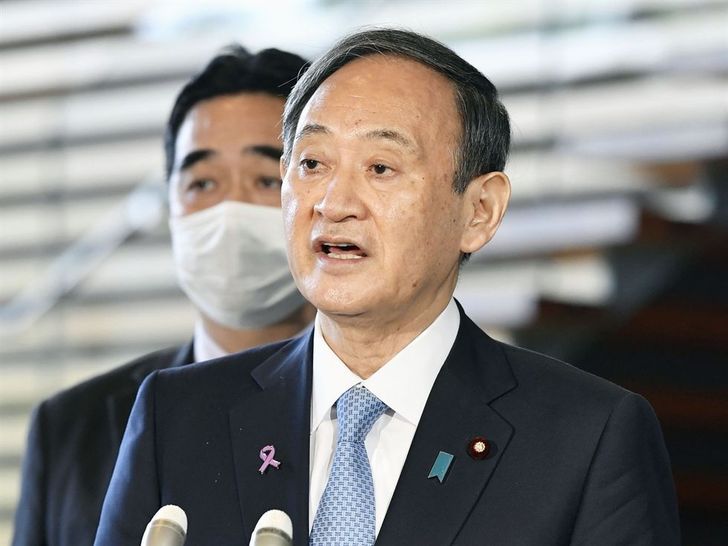
Japanese Prime Minister Yoshihide Suga speaks to journalists in Tokyo, Thursday, about his telephone conversation with U.S. President-elect Joe Biden. / Yonhap
“Each bilateral alliance is critical to enhance a three-way alliance. Korea and Japan will be asked to resolve historical disputes expounded on by past governments,” said Shin Yul, a political science professor at Myongji University.
Kim Hyun-wook, a Korea National Diplomatic Academy (KNDA) professor, said, “The Biden America will actively negotiate with Korea and Japan to improve three-way ties.
“Such negotiations were witnessed throughout many U.S. governments, with the outgoing Donald Trump administration being responsible for a few exceptional cases.”
The first Korean ambassador to Japan for the Moon Jae-in administration, Lee Su-hoon disagreed with speculation that the envisioned Biden government would lean toward Tokyo as some people have suggested.
“I'd rather say the Biden America will be a fair negotiator,” he said. “Washington would not risk being misunderstood as if it was favoring one side and, further hurting Seoul-Tokyo relations that are at their lowest level.”
At a seminar hosted by the Korea-Japan Friendship Association, Thursday, Sejong Institute President Jin Chang-soo suggested elevating the director-general talks on the wartime labor issue to a higher level.
The issue has been at the heart of Seoul-Tokyo disagreements, after the 2018 Supreme Court ruling that Japanese companies should compensate surviving Koreans forced to work for them before and during World War II.
“Elevating the level of diplomatic talks can help prevent confrontation from escalating,” Jin said.
Korea-Japan Friendship Association head Yoo Heung-soo said settling the dispute between the two sides “has a higher chance” with Japanese Prime Minister Yoshihide Suga, who took office in September.
“Unlike his hawkish predecessor Shinzo Abe, Suga is a pragmatist and we may expect optimistic dialogue with Tokyo,” Yoo said.
In relation to the U.S.-China row, Lee said the U.S. presence in the Asia-Pacific region could be diminished if it fails to bring Korea and Japan together.
“Expanding a regional presence is something that can't be done alone, only with allies,” he said.
Jin speculated that the U.S. might expand sanctions against Chinese enterprises and this in turn could affect Korean and Japanese businesses.