Seoul, Washington show discrepancy on new working-level talks

Choi Jong-kun, first vice minister at the Ministry of Foreign Affairs, speaks to reporters at Incheon International Airport, Sept. 12. Yonhap
By Do Je-hae
Choi Jong-kun, new first vice minister of foreign affairs, returned to Seoul, Sept.12, after his first meeting with his U.S. counterpart, Stephen Biegun at the U.S. State Department.
In a statement following the meeting, the Ministry of Foreign Affairs announced that the two sides had “agreed” on the establishment of a new format of bilateral talks at the director-general level. The ministry said that the role of the tentative consultative body would be to check and coordinate on a wide range of bilateral issues. The ministry highlighted the new type of bilateral talks as a primary achievement of the new first vice minister. But some local media have taken issue with a discrepancy in the statements released by the ministry and the U.S. State Department about the outcome of the Choi-Biegun meeting.
In particular, the State Department's readout makes absolutely no mention about any kind of new talks between the two allies. The first vice minister tried to assuage concerns over the discrepancies during an encounter with reporters at Incheon International Airport.
“The two statements could be seen as different from one another, but press releases routinely put a focus on what the respective country wants to emphasize,” Choi said. “Deputy Secretary Biegun and the U.S. side showed strong understanding for the formation of the talks.”
Choi explained that the two sides will enter negotiations for the talks to begin as early as mid-October. “This will enable regular consultations at the director-general and vice-ministerial level.”
Also missing from the U.S. statement is the “close cooperation for a swift resumption of talks between the two Koreas, the U.S. and North Korea,” which also appears at the forefront of the Korean statement.
Sensitive issues for Korea
It is also noticeable that the U.S. statement actually mentions some very sensitive issues for the Korean side, particularly cooperation with Japan and the Indo-Pacific strategy.
The statement underlines cooperation on “a broad range of shared interests, including coordination on COVID-19 response and recovery, peace and stability on the Korean Peninsula, a free and open Indo-Pacific, and cooperation with Japan to promote regional security.”
“The Deputy Secretary and Vice Minister discussed the Special Measures Agreement, reaffirmed the enduring strength of the U.S.-ROK alliance, and discussed ways to enhance the Alliance to ensure it remains a force for peace and prosperity in the Indo-Pacific for the decades ahead,” State Department spokesperson Morgan Ortagus said.
The statement comes at a time when concerns are rising on Korea being sidelined from trilateral security cooperation with Japan. In addition, Korea has faced additional challenges to its diplomacy from the escalating competition between the two superpowers and Washington's call for allies in the region to join its Indo-Pacific strategy aimed at containing China, a country that has been prioritized in President Moon's foreign affairs agenda.
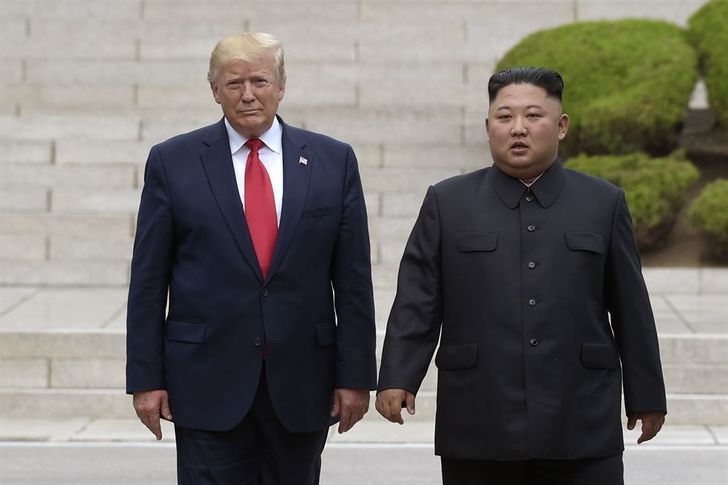
In this file photo from June 30, 2019, President Donald Trump, left, meets with North Korean leader Kim Jong-un on the North Korean side of the Demilitarized Zone in the village of Panmunjeom. AP-Yonhap
With the U.S. presidential election less than two months away, experts are underlining the need for Seoul to maintain close communication with Washington on North Korea as well as bilateral issues.
“The most important thing now is how to prepare to take the initiative in Korean Peninsula issues after the elections are over,” Yang Moo-Jin, a professor at the University of North Korean Studies, told The Korea Times.
In a recent letter to Pope Francis, President Moon said he will “never cease efforts to establish peace on the peninsula under any circumstances.” In a recent reshuffle, the South Korean leader filled his senior leadership positions for dealing with North Korea with figures who have years of experience in arranging talks with the North. The surprise appointment of Choi as vice minister is also seen as strong display of Moon's resolve to keep the talks with Pyongyang going. The former presidential aide at the National Security Office was closely involved in President Moon Jae-in's summit diplomacy with North Korean leader Kim Jong-un.
But the dominant view is that Moon's eagerness to turn things around in the stalled talks with Pyongyang and the nuclear negotiations between North Korea and the U.S. in the coming months are ill-timed and unlikely to bear results. “History has shown that there have rarely been any breakthroughs in U.S.-North Korea relations during the presidential election season,” Yang said. “Seoul should use this time to prepare to get exemption from international sanctions on inter-Korean projects and boost communication with the U.S.”
The professor explained that, from the North Korean point of view, its diplomatic priority after turning the corner on the COVID-19 situation would be to improve relations with China, not resuming talks and diplomacy with the U.S. or South Korea.
Regarding bilateral issues, the biggest point of concern is the Special Measures Agreement (SMA) to determine Korea's share of the costs for the maintenance of U.S. troops. The SMA is one of the few issues that is commonly mentioned in the statements of the two countries following the Choi-Biegun meeting.
Experts say it is important for Seoul to prepare strategies to resolve the bilateral conflict over the SMA quickly and dispel views that the talks may hamper the alliance.
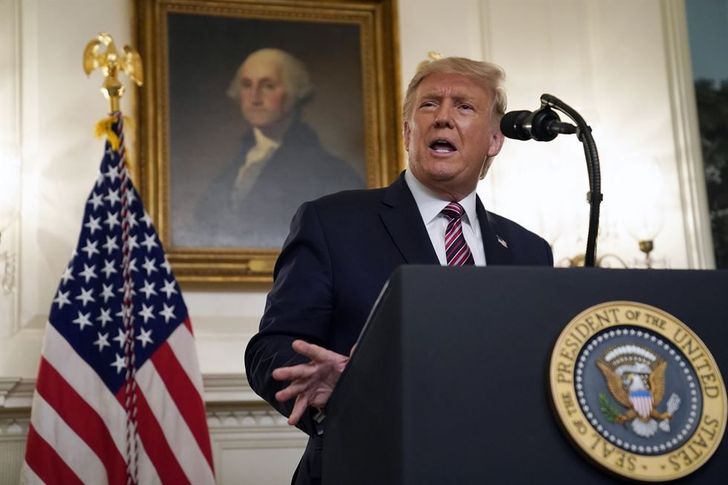
President Donald Trump speaks during an event on judicial appointments, in the Diplomatic Reception Room of the White House, Sept. 9. AP-Yonhap
Concerns are rising that a second Trump term in the White House could bring some real changes to the U.S. forces stationed in Korea. “If Trump wins re-election, I expect that at some point during his second term he will make a real effort at reducing U.S. presence on the peninsula. The question is whether the bureaucracy and Congress will thwart him,” Mason Richey, a professor at the Hankuk University of Foreign Studies, told The Korea Times.
Trump, who withdrew 12,000 U.S. troops from Germany, has threatened to reduce troop numbers here as well, and has also publicly blasted Korea for “paying peanuts” toward the upkeep of the U.S. Forces Korea (USFK).