What will bring Chinese top diplomat to Korea?
By Kang Seung-woo
With Yang Jiechi, China's leading diplomat, likely to visit South Korea as early as next week, discussions about Chinese President Xi Jinping coming to Seoul could be high on the agenda, according to diplomatic pundits.
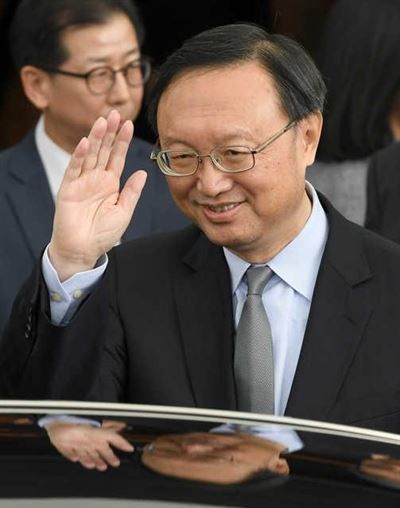
Yang Jiechi / Korea Times file
However, they added that the coordination on the visit, postponed from the first half of the year due to COVID-19, would not be the lone issue amid China's intensifying power struggle with the United States, while the U.S. is rallying its regional allies, including South Korea, against Beijing.
According to diplomatic sources, South Korea and China are in the final phase of arranging the visit of Yang, a member of the Communist Party Politburo.
“If indeed Yang visits South Korea, it's likely he will be talking about an upcoming trip to Seoul by President Xi Jinping, postponed due to COVID-19,” said Joseph DeTrani, a former U.S. special envoy to the six-party talks.
Xi last visited South Korea in July 2014, and Moon visited China in December 2017. Korea had sought Xi's reciprocal visit to Seoul during the first half of this year, to address remaining economic retaliatory measures imposed by China on Korea following deployment of a U.S. anti-missile Terminal High Altitude Area Defense (THAAD) system here, as well as to discuss the North Korea issue.
DeTrani predicted that during a summit between President Moon Jae-in and Xi, the latter would encourage the former to re-establish dialogue with North Korea.
And more importantly, the Chinese president will likely ask his South Korean counterpart to step up efforts to reduce the challenges the Kim Jong-un regime is now facing, DeTrani claimed.
“Xi no doubt will make it clear that China wants North Korea to denuclearize, but will want South Korea's commitment to help ensure that the U.S. and others provide the North with security assurances, the lifting of sanctions and economic development assistance and an eventual peace treaty,” he said.
During his visit to Seoul, Yang is anticipated to meet Moon's newly formed national security team, including National Security Office Director Suh Hoon and National Intelligence Service Director Park Jie-won.
In addition, his visit comes as China hopes to retain close relations with South Korea as it is engaged in a diplomatic row with the U.S.
All things considered, Yang ― and Xi if he comes ― may encourage South Korea to lean closer to China's side, as the U.S. is stepping up its offensive against the country's policies on Hong Kong, the western province of Xinjiang and the South China Sea.
In addition, the Donald Trump administration has banned the use of Huawei products and plans to ban the use of video-sharing social networking service TikTok in the U.S., while sending Health and Human Services Secretary Alex Azar to Taiwan, which angered the Chinese government.
Plus, Yang published an article in the state-run Xinhua News Agency last week, urging the U.S. to respect China and avoid making misjudgments.
“He painted China as the responsible party in the face of the Trump administration's 'erroneous words and moves' and 'interference in China's internal affairs' that have produced the 'most complex and grave situation since the establishment of diplomatic ties,'” said Leif-Eric Easley, an associate professor of international studies at Ewha Womans University.
“Unfortunately for Seoul, while U.S.-China relations are under extreme stress, Beijing is unlikely to pressure Pyongyang to denuclearize or pursue inter-Korean engagement. Moreover, if Beijing shows no improvement in its trade practices, military assertiveness, human rights and investigating the origins of COVID-19, South Korean cooperation with China is likely to raise eyebrows in the United States and its allied countries.”